
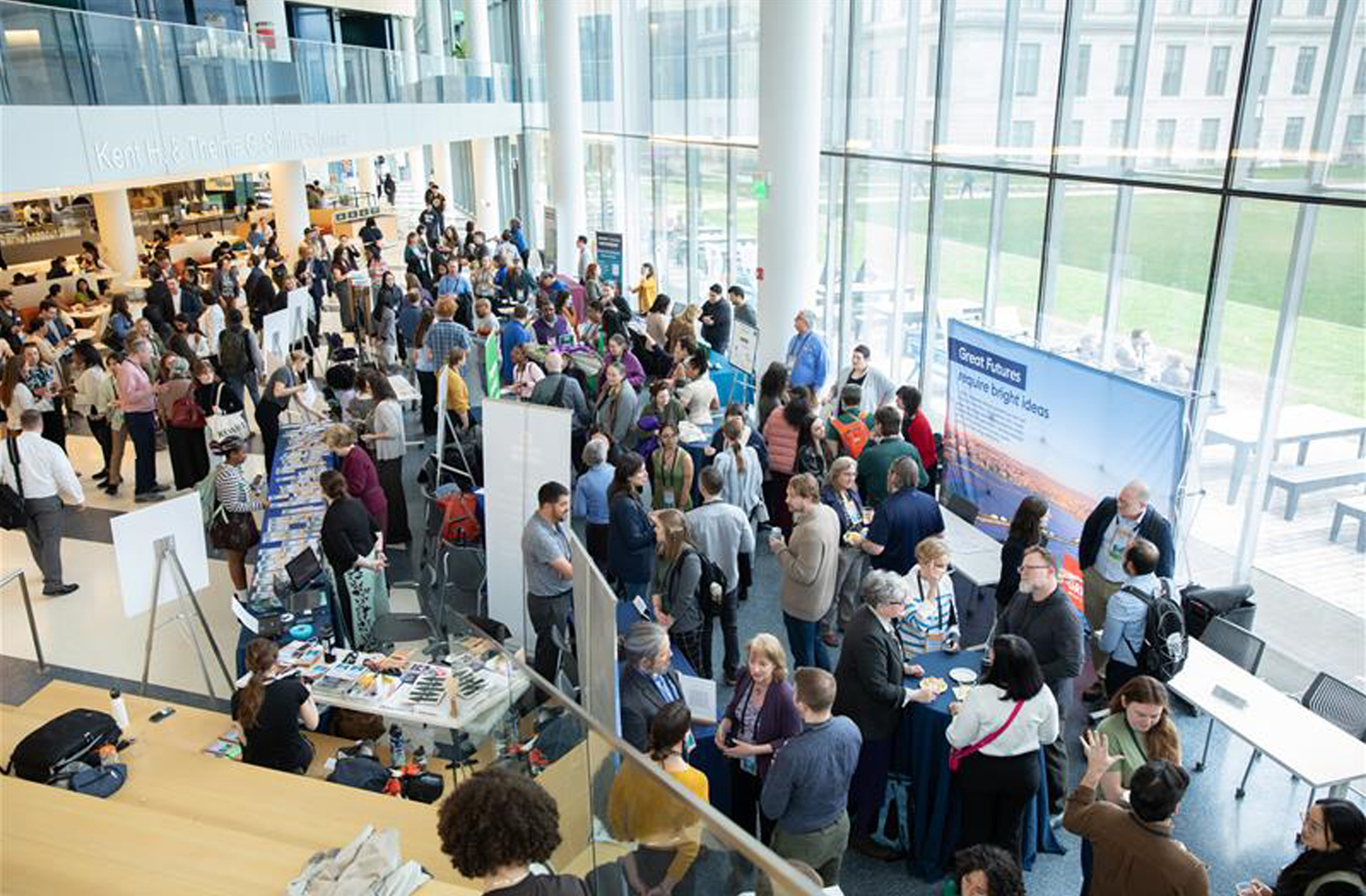
The 2026 Midwest Climate Summit, hosted at Case Western Reserve University in Cleveland, Ohio from March 30 to April 1, brought together climate leaders, researchers, educators, and sustainability practitioners from across a 12-state region and the message was unmistakable: decarbonization is no longer a distant aspiration. It is happening right now on campuses and in communities across the Midwest.
Darcy Solutions exhibited at the event for the first time in 2026. We left the Summit energized and excited about the progression of higher education entities and their aspirations to decarbonize their operations. Across the three-day gathering, session after session reinforced what Darcy has long believed: geothermal energy is emerging as one of the most compelling, scalable, and cost-effective decarbonization technologies available and universities are leading the way.
A Summit Shaped by Urgency and Innovation
The 2026 Summit set a forward-looking tone that permeated every session. There was a student-led element of the event that gave every discussion a differing perspective and an undeniable energy. Under mounting pressure from shifting federal priorities and climate volatility, Midwest institutions are doubling down on proven clean energy solutions rather than waiting for favorable policies stemming from new political leaders. The summit featured workshops on energy resilience, microgrids, building decarbonization, campus sustainability, and thermal energy networks, demonstrating just how deep the regional climate action community has become.
For those focused on buildings and energy infrastructure, Session 3A — Campuses as Climate Engines: Cutting Carbon and Building Resilience and Session 4B — Thermal Energy Networks: Delivering Geothermal Heating and Cooling to the Midwest at a Community Scale were the highlights. These sessions showcased not just the promise of geothermal technology, but real, operational proof that it works.
Session 4B: The Geothermal Conversation That Mattered Most
Session 4B drew a strong lineup of organizations at the forefront of the geothermal and thermal energy network (TEN) movement. Presentations were delivered by the Midwest Building Decarbonization Coalition (Midwest BDC), Miami University, and HEET (Home Energy Efficiency Team) — three organizations whose collective work represents some of the most important progress in building decarbonization happening anywhere in the country.
The session explored how TENs, which are neighborhood and campus scale systems that use underground thermal capacity and ground source heat pumps to deliver heating and cooling, are rapidly becoming a key solution for institutions serious about eliminating fossil fuels from their energy mix. As the Midwest BDC emphasized, TENs produce no on-site emissions, achieve extraordinary efficiency, and offer a credible pathway to transition aging gas infrastructure into clean thermal utilities. These systems can also capture and redistribute waste heat across a campus or community, capitalizing on the diverse energy loads of interconnected buildings.
HEET, whose mission centers on accelerating the transition of gas utilities to thermal utilities at scale, brought a compelling perspective on both the technical and social dimensions of this shift. Their work includes building collaborative networks, collecting rigorous data, and designing policy frameworks that ensure geothermal benefits reach all communities, including low-income households and utility workers navigating the energy transition.
Miami University: A National Model for Campus Geothermal
Perhaps no story at the Summit was more instructive than that of Miami University in Oxford, Ohio. Miami’s presentation in Session 4B served as a masterclass in what long-range, integrated planning can achieve.
Since launching its Utility Master Plan in 2011, Miami has systematically converted its entire Oxford campus away from carbon-intensive steam heating toward geothermal exchange and low-temperature heating hot water systems. The progress has been impressive. Since 2008, the University has reduced its energy-based carbon emissions by more than 50%, while simultaneously expanding its campus footprint, and saving over $115 million in utility costs in the process.
The most recent milestone is the North Geothermal Plant, a project involving 520 geothermal wells drilled 850 feet deep beneath the south lawn of Millett Hall and serving 25 buildings (27% of campus gross square footage). Upon completion, this project alone is projected to eliminate more than 5,810 metric tons of CO₂-equivalent emissions annually, the equivalent of taking more than 1,300 gas-powered cars off the road. By 2026, approximately 72% of Miami’s campus buildings will be heated and cooled by geothermal or heating hot water systems, making geothermal the campus’s largest energy source by both square footage and number of buildings.
Miami is also building the nation’s first co-located solar and geothermal project on a college campus, the Sharon and Graham Mitchell Sustainability Park, combining over 3,330 solar panels installed directly above the Western Geothermal Well Field. The park is a powerful symbol of what integrated, ambitious thinking can accomplish.
Why Geothermal is Winning for Higher Education
The momentum behind geothermal on university campuses is an intentional approach to smart design targeting energy efficiency and sustainability. It reflects the unique structural advantages geothermal offers on an institutional scale:
- Efficiency that can’t be matched. Ground-source heat pump systems regularly achieve COPs of 5+, meaning they deliver five or more units of heating or cooling energy for every unit of electricity consumed. Other technologies cannot compete with that performance.
- The thermal battery advantage. As demonstrated so effectively by Miami’s multi-decade buildout, geothermal systems allow campuses to store excess heat in the ground during summer cooling and recapture it in winter — turning the earth itself into a massive, zero-cost battery. New technologies augmenting these systems with thermal storage in buildings are not far away.
- Cost certainty over time. Unlike natural gas, whose price is subject to market volatility, the earth’s temperature is stable. Once the infrastructure is in place, geothermal dramatically reduces exposure to fuel cost swings while lowering operating expenses and becoming more predictable given electricity prices.
- Highly resilient, quiet, and hidden from view. Geothermal infrastructure is underground. Once installed, the grass grows back, the campus looks unchanged, and the system runs quietly and reliably for decades with minimal maintenance. Challenging weather events and other disturbances often go unnoticed for these systems, as does noise given their quiet nature of operation.
- Alignment with institutional goals. For universities committed to carbon neutrality, geothermal isn’t just a technology choice — it’s a foundational strategy that makes every other sustainability goal more achievable.
The Broader Momentum
The Summit also reflected a growing policy and financing landscape that is increasingly favorable to geothermal. Mobile workshop participants toured the Corix-Cleveland Thermal District Energy Facility and Oberlin College’s carbon-neutral campus — two premier examples of how thermal energy systems can serve both large institutions and broader communities. Nationwide, twelve states have passed legislation related to TENs since 2021, and utility pilot programs are expanding rapidly.
Looking Ahead
At Darcy Solutions, the 2026 Midwest Climate Summit reinforced our conviction that geothermal is no longer an emerging technology — it’s a proven, deployable solution ready to meet the decarbonization ambitions of large universities and campuses today. The work being done by Miami University, Midwest BDC, HEET, Oberlin College, and dozens of other institutions across the Midwest is proof of concept at a scale that matters.
The Midwest is not waiting. And neither are we.
Explore the Darcy Solutions projects that are supporting the trend toward geothermal, in the midwest and beyond, by visiting our projects page.