
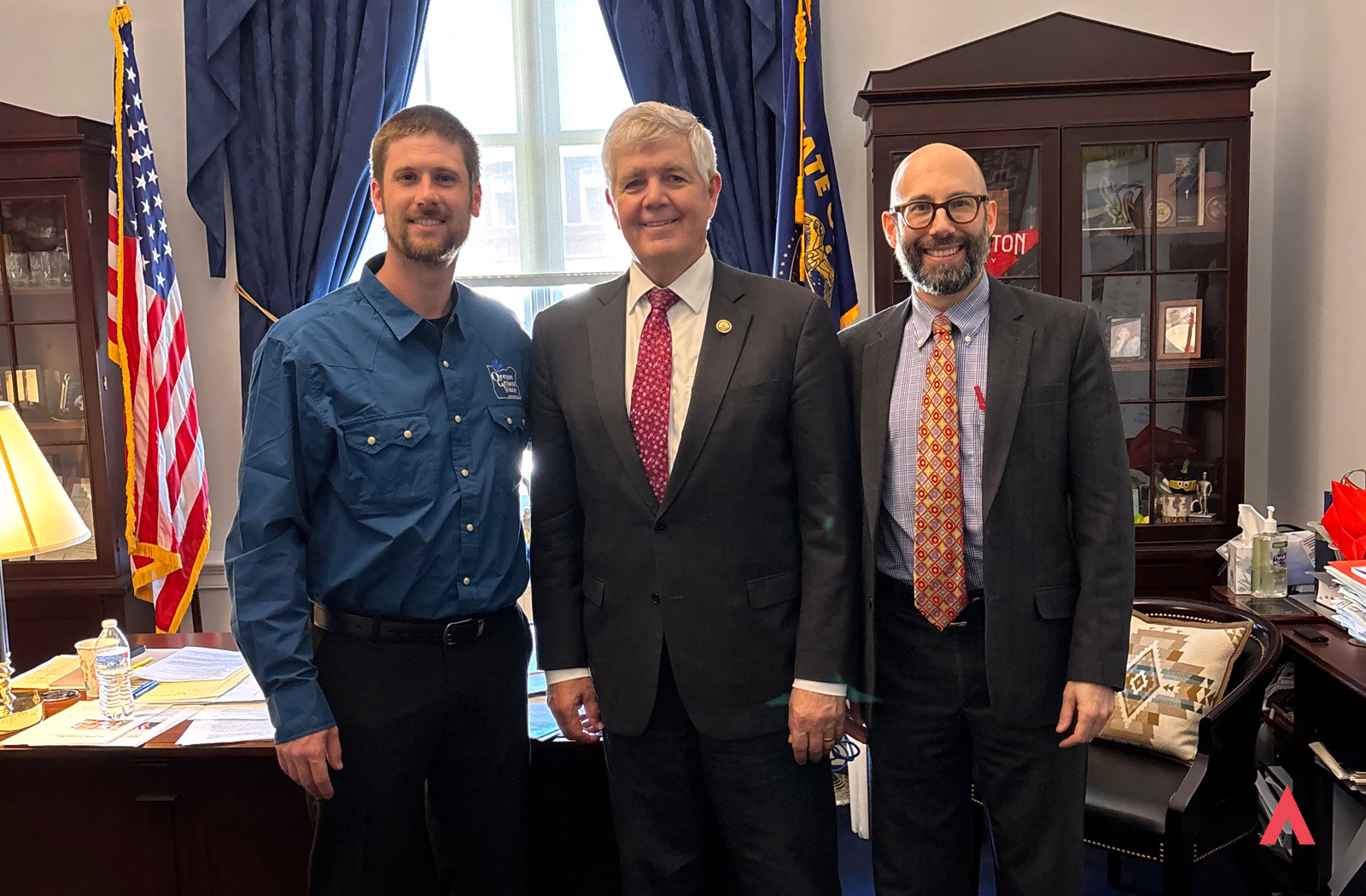
On March 25–26, 2026, Darcy Solutions’ Director of Government Affairs & Strategic Partnerships, Zach Millimet, joined the National Ground Water Association (NGWA) in Washington, D.C. for the association’s 2026 Smart Water Policies Fly-In — two days of policy briefings and direct meetings with Congressional offices to advance the issues that matter most to the groundwater industry.
Water well drillers are key partners for Darcy’s groundwater-enabled geothermal heating & cooling technology, and the policy issues NGWA brought to the Hill this year sit squarely at the intersection of what we do as a company: deliver energy-efficient and resilient heating & cooling, drive building decarbonization, protect and improve local water and air quality, and deploy geothermal solutions that strengthen critical infrastructure and support American jobs and economic vitality.
Over the two days, Darcy participated alongside NGWA or met individually with Rep. Cliff Bentz (OR-2) and staff for Sen. Tina Smith (MN), Sen. Maria Cantwell (WA), Sen. Ron Wyden (OR), Sen. Kirsten Gillibrand (NY), Rep. Jack Bergman (MI-1), and Rep. Michael Turner (OH-10).
Geothermal Tax Credits: Opportunities, Challenges & Future Requests
The passage of the One Big Beautiful Bill Act (OBBBA) in 2025 had three major consequences for the geothermal industry. First, it preserved the Section 48 Investment Tax Credit for geothermal, with a construction-start deadline extended through 2035 — the longest runway of any clean energy technology in the bill. Second, it resolved a longstanding loophole that had effectively blocked third-party ownership of geothermal systems from accessing the ITC, unlocking new financing structures that can significantly expand deployment in commercial and institutional markets. Third, and most significantly for the water well and residential geothermal industries, it eliminated the Section 25D residential tax credit — a real setback for contractors and the families they serve.
There is bipartisan consensus on Capitol Hill that America needs geothermal energy — for power generation, heating & cooling, and direct use. With that in mind, Darcy and NGWA brought three clear requests to every office:
- Restore Section 25D for Residential Geothermal. The residential credit’s elimination was a direct hit to water well drillers and geothermal contractors nationwide. Restoring it is good economic policy — and it will help families and communities access affordable, clean, and resilient heating & cooling.
- Make the Section 48 ITC for Geothermal Permanent. America has an enormous stock of commercial, industrial, and agricultural facilities that stand to benefit from geothermal’s efficiency and resilience. A permanent ITC extension gives businesses the long-term certainty they need to invest.
- Direct Treasury to Establish a Geothermal Safe Harbor Table. This is a targeted technical step that would allow the geothermal industry — especially small businesses in the water well sector — to more easily access the domestic content bonus tax credit and keep local project pipelines moving.
Geothermal Is a Solution for Data Centers & Communities
Among the most substantive conversations Darcy and NGWA had on Capitol Hill — in every office — was about data centers. In advance of the Fly-In, NGWA released a formal position paper on data center development and the responsible use of groundwater resources. Darcy was proud to bring that paper into every meeting and to go a step further: making the affirmative case for geothermal heating & cooling as a practical solution to what is becoming an increasingly fraught community challenge.
The problem is real and growing. Data centers consume enormous quantities of groundwater for cooling, and as they multiply and concentrate in regions across the country, the cumulative strain on aquifers is becoming a serious resource management concern. Communities are pushing back — not just over water withdrawals, but over surging electricity prices, noise from conventional cooling towers, and the broader environmental footprint of large-scale data center development. For many communities, it feels like an intractable tradeoff: economic development on one side, quality of life and resource protection on the other.
Geothermal doesn’t resolve every tension, but it meaningfully changes the math. Darcy’s groundwater-enabled heat exchanger sits in the aquifer in situ — no groundwater is extracted, no groundwater is consumed. That eliminates the need for cooling towers entirely, which in turn addresses two of the most common community objections: water use and noise. And because geothermal is significantly more efficient than conventional cooling systems, it reduces overall electricity demand and helps moderate the load growth pressures that are contributing to rising energy costs in data center corridors across the country.
NGWA’s position paper makes clear that these solutions are scalable, shovel-ready, and directly supported by existing commercial geothermal tax credits. Darcy’s message to Congressional offices was equally direct: the technology exists, the economics work, and the industry is ready to deploy it.
Broader Priorities
Beyond geothermal, Darcy stood alongside NGWA colleagues in advocating for a broader set of groundwater policy priorities that are deeply interconnected with the work Darcy does every day.
Protecting funding for the USGS National Ground-Water Monitoring Network was a priority across every meeting. Groundwater supplies roughly 40% of the nation’s drinking water, yet monitoring funding continues to decline — and the data gaps that result are becoming increasingly consequential as demand from data centers, drought, and long-term supply pressures intensifies. You cannot sustainably manage what you cannot measure.
PFAS contamination, groundwater workforce development, and rural water infrastructure rounded out the agenda — issues that span the partisan divide and directly affect the communities and industries that depend on clean, reliable groundwater access. For Darcy, these aren’t peripheral concerns: they define the operating environments where our projects are being built.
Darcy Solutions is proud to be an active participant in NGWA’s advocacy work and grateful for the association’s leadership in keeping groundwater — and the industries that depend on it — in the policy conversation. We look forward to continued engagement with the offices we met with this week and to advancing the shared priorities of the groundwater and geothermal communities as the 119th Congress works through its energy and water agenda.