

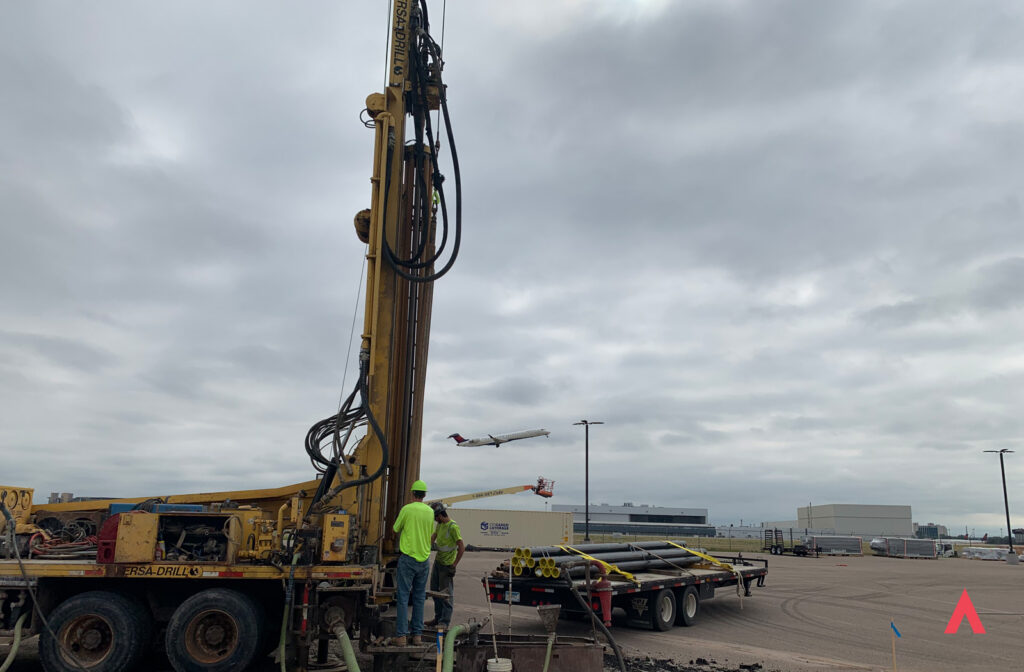
A drill rig mobilizing onto a commercial site is the clearest sign that a geothermal project has moved from planning to construction. In the days and weeks that follow, the crew will build the part of the system that will operate underground for 50 years or more. The decisions made at the rig, from the drilling method to the way each well is sealed, shape how that system performs for the life of the building.
Drilling a geothermal well draws on the same fundamentals as drilling a high-capacity water well, with added requirements tied to heat exchange. The method has to suit the geology, the well has to be constructed to protect the aquifer, and the finished well has to deliver the flow and thermal performance the design calls for. This piece walks through the main drilling techniques, how geology and system type influence which one is used, what happens in the borehole during construction, and how Darcy coordinates the work.
Matching the Drilling Method to the Geology
No single rig or technique handles every formation well. Sand and gravel behave very differently from limestone or granite, and the loose, permeable material that makes an aquifer productive is often the same material that makes a borehole difficult to keep open. Drillers choose among several rotary methods, each with strengths in particular conditions, and the geologic evaluation completed at the start of a project gives the team an early indication of which are likely to apply at a given site.
Mud Rotary Drilling
In mud rotary drilling, a bentonite-based drilling fluid is pumped down the drill pipe, exits through the bit, and carries cuttings up the space between the pipe and the borehole wall. The fluid also presses against the borehole wall, which keeps loose sediments from caving in. Mud rotary is fast and cost-effective in unconsolidated formations such as sand, gravel, and clay, and it generally avoids the need to drive casing during drilling, which is why it is widely used where thick glacial or alluvial deposits make up the target aquifer. Because the drilling fluid can invade the formation around the borehole, mud rotary wells depend on thorough well development, covered later in this piece.
Air Rotary Drilling
Air rotary replaces drilling fluid with compressed air, which carries cuttings to the surface where they are collected at the borehole collar or in a cyclone. It is used primarily in consolidated rock, where the borehole walls stay open without fluid support. Penetration rates are high, the cuttings arrive clean and easy to describe, and the driller and geologist get early indications of where water-bearing zones are encountered. In areas with high water tables, air rotary needs a large volume of air to lift both cuttings and water, which can add time and cost.
Down-the-Hole Hammer Drilling
A down-the-hole (DTH) hammer is a variation of air rotary in which a pneumatic hammer sits at the bottom of the drill string and drives the bit against the rock in rapid, short strokes while the string rotates slowly. The action pulverizes hard formations such as granite, limestone, and dolomite efficiently, and the same air that powers the hammer flushes the cuttings out of the hole. DTH drilling requires a large air compressor, and the hammers and bits wear with use, so the method is selected for the formations that call for it.
Casing Advance and Dual Rotary Methods
Some of the most productive aquifers sit in loose sand and gravel with cobbles and boulders, which tends to collapse into the borehole and challenges conventional methods. Casing advance systems address this by driving steel casing down with the bit, so the hole is supported as it is drilled. Dual rotary rigs use a rotary head that turns the drill string while a second drive advances the casing independently, and air-hammer casing systems use a hammer fitted with a reamer that opens the hole wide enough for the casing to follow. These methods add equipment and time, and they give crews control in glacial till, buried valley deposits, and other unstable formations while keeping the borehole open for well construction.
Other techniques, including cable tool, reverse circulation, and sonic drilling, have specialized roles and are used where site conditions or sampling requirements call for them.
| Method | Best suited for | Key tradeoff |
| Mud rotary | Unconsolidated sand, gravel, and clay | Requires thorough well development to remove drilling fluid |
| Air rotary | Consolidated rock | Needs a large air volume in high water tables, which can add time and cost |
| Down-the-hole hammer | Hard rock such as granite, limestone, and dolomite | Requires a large air compressor, and hammers and bits wear with use |
| Casing advance and dual rotary | Unstable sand and gravel with cobbles and boulders, glacial till, and buried valley deposits | Adds equipment and time |
How Geology and System Type Shape the Approach
Geology often calls for more than one method on a single well. In much of the Midwest, glacial drift of varying thickness sits above bedrock, so a crew may drill through the overburden with mud rotary or casing advance, set casing into competent rock, and then switch to air rotary or a DTH hammer to complete the hole in bedrock. The method changes with the formation, and the geologist on site tracks those transitions as they happen.
System type matters, as well. Closed-loop systems rely on boreholes that are drilled, fitted with a loop of pipe, and grouted for thermal contact with the surrounding ground. Groundwater-based wells are built to produce and return water, so they are larger in diameter and constructed with screens, filter packs, and seals suited to the aquifer. Well diameters in Darcy’s work range from 6-inch design wells to Dipole well systems in 8, 12, and 18-inch sizes. Larger diameters call for rigs with more power, torque, and pullback capacity.
Groundwater-based systems also deliver high capacity per well, so a project often requires a handful of wells instead of dozens or hundreds of boreholes. That shortens the time a rig spends on site and limits disruption on constrained properties such as urban lots and occupied campuses.
Real-Time Site Characterization During Drilling
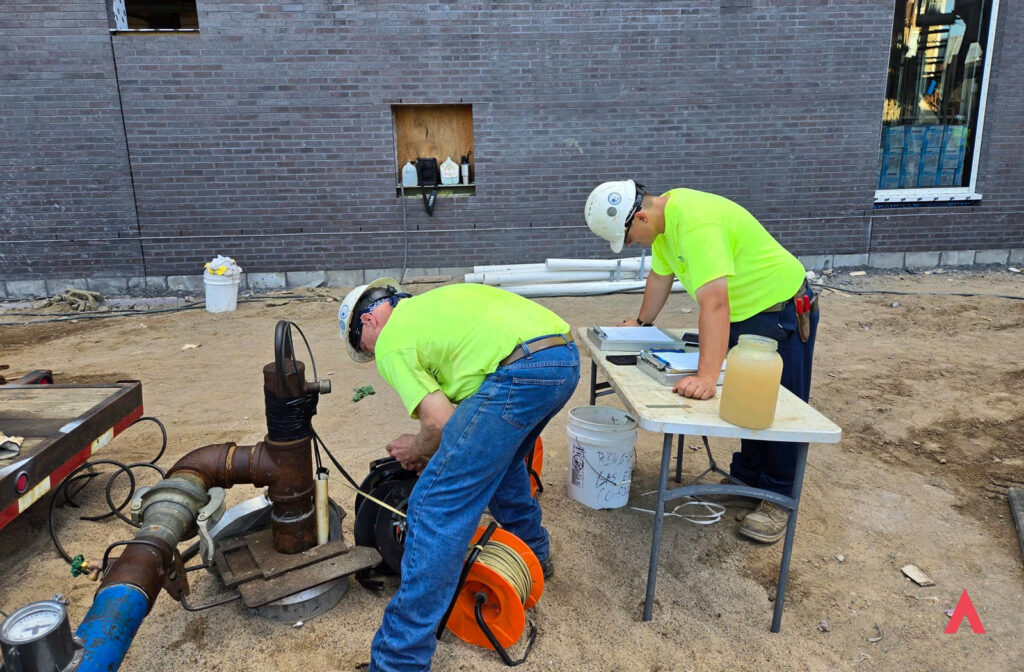
Drilling doubles as a data-collection exercise. As the borehole advances, cuttings are collected at regular depth intervals, then washed, described, and archived by a geologist. Each sample shows what the bit is passing through, whether sand, gravel, clay, or rock, and the geologist compares it against the subsurface model built during the desktop evaluation.
The drilling process itself also provides information. Changes in penetration rate, the loss or return of drilling fluid, and the appearance of water at a given depth all point to changes in the formation. Any difference from the predicted geology is documented and evaluated as it appears, which allows the design team to adjust well depth, screen placement, or construction details before the well is finished. After the borehole reaches its target depth, geophysical logging tools measure the formation’s properties continuously, a process described in more detail in our post on geothermal well testing.
Building the Well
Once drilling reaches the target depth, the borehole becomes a well. Construction details determine how much water the well can deliver, how long it performs, and whether the aquifer stays protected from the surface and from other formations.
Casing and Screens
Steel casing lines the upper portion of the well, supporting the borehole and keeping shallow, loose materials from caving into it. In unconsolidated aquifers, a screen is set across the productive zone, with openings sized to the aquifer material so water flows in freely and sand stays out. In competent rock, wells can often be completed as open boreholes below the casing.
Filter Pack, Seals, and Grouting
In screened wells, the space between the screen and the borehole wall is filled with a clean, graded sand or gravel filter pack that improves flow into the well and filters fine sediment. Above the filter pack, a bentonite seal separates the productive zone from the rest of the annulus, and cement or bentonite-cement grout is placed from the bottom up through a tremie pipe to the surface. This annular seal prevents surface water and contaminants from traveling down the outside of the casing and blocks water movement between formations, which protects the aquifer for the life of the well and meets the well construction requirements set by state and local authorities.
Well Development
Drilling leaves fine sediment, and in mud rotary wells some drilling fluid, in the formation around the screen. Well development removes both. Crews surge the well with a tight-fitting surge block and pump it, alternating until the water runs clear and free of sand and silt. Development opens the pathways between the aquifer and the well, so a well that has been developed thoroughly delivers more water with less sand and puts less wear on pumps and heat exchange equipment. Pump testing then confirms what the finished well can deliver.
How Darcy Coordinates the Drilling Phase
Darcy oversees construction of the geothermal exchange system outside the building from start to finish, which includes the drilling phase, as part of our proven process. For each project, Darcy selects drilling partners with experience in the local geology and the relevant methods, and the geology team translates the site evaluation into specifications for the well, including target depth, diameter, drilling method, and construction details.
During drilling, a Darcy geologist is on site to log cuttings, track formation changes, and confirm that construction follows the design. The data collected feeds directly into pump testing, final system design, and permitting documentation. Darcy also coordinates the drilling schedule with the mechanical contractor and the rest of the construction team, so the exterior wellfield and the building-side work come together for startup and commissioning. Planning for the drilling phase covers site logistics such as rig access, staging areas, utility locates, noise, and the handling of water and cuttings, which matters most on occupied campuses and urban sites.
The Right Drilling Approach Starts with the Geology
The drilling method, the well design, and the construction details all follow what is discovered underground. Darcy’s free site assessment, conducted by a Professional Geologist, identifies the formations a project is likely to encounter and the approach that fits them before any field work begins. Request yours today to see if geothermal is viable in your location.