



Building History and Use
For decades, Macalester College has heated its entire campus with a central natural gas boiler system. That infrastructure served the college well, but when Macalester committed to full campus decarbonization by 2050, it became clear that the boiler network would need to give way to something fundamentally different.
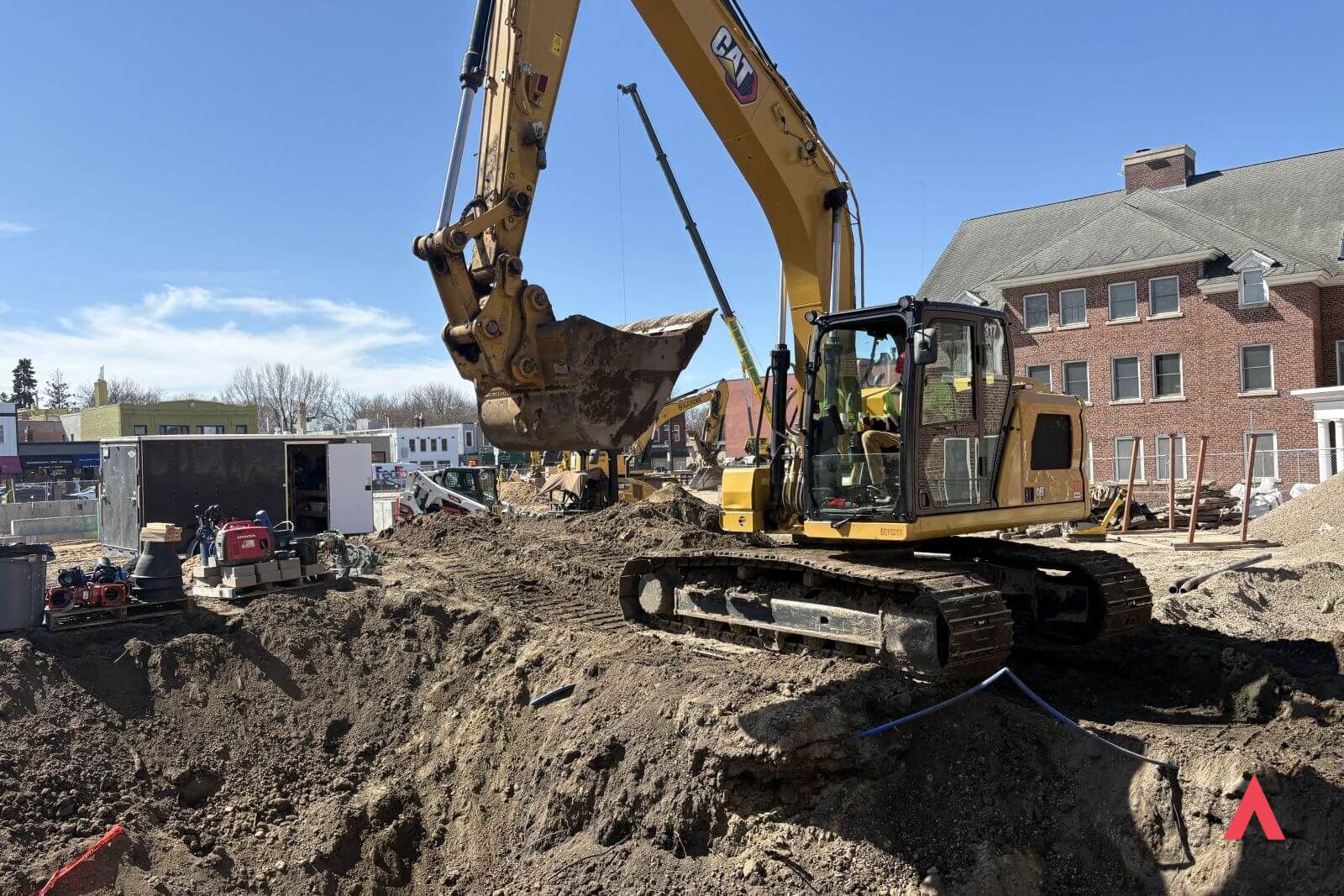
The catalyst for change is a new five-story residence hall and welcome center rising at the corner of Grand Avenue and Macalester Street in St. Paul. The building will house 224 students, create a public plaza, and include a ground-floor welcome center designed to serve as the college’s primary arrival point. Scheduled to open in August 2027, it will be the first building on campus served by geothermal heating and cooling, and is being built specifically with future expansion in mind.
The project reflects Macalester’s broader campus plan. The geothermal plant being constructed to serve the new building is sized to eventually support all campus buildings north of Grand Avenue, allowing additional facilities to connect to the system over time and continue reducing the college’s dependence on fossil fuels.
Why Geothermal?
Macalester’s 60-acre urban campus presents a challenge that has historically made geothermal energy impractical for many dense institutions: there simply is not enough land to support a traditional closed-loop system. A conventional ground-source heat pump installation capable of serving a building of this scale would require hundreds of borings and tens of thousands of square feet of land that the college does not have.
Darcy’s groundwater-enabled approach solves that problem. Four wells, each drilled to approximately 400 feet, access an aquifer where groundwater maintains a consistent temperature of around 52 degrees year-round. Sealed heat exchangers move thermal energy between that groundwater and the building’s heating and cooling systems, delivering 422 tons of cooling capacity and 3,112 MBH of heating from a wellfield that occupies just a few square feet above ground.
The system is also designed as a thermal energy network from the start. When the college eventually connects additional buildings north of Grand Avenue, waste heat from one building can be transferred to another rather than released into the environment, delivering a significant efficiency advantage that compounds as the network grows. The project includes rooftop solar panels and a high-performance building envelope, integrating geothermal into a comprehensive clean energy strategy rather than treating it as a standalone upgrade.
Design and Construction
Construction on the residence hall began in 2026, with the geothermal plant located in the basement of the new building. The system is designed around Darcy’s compact aquifer technology, which was developed from research at the University of Minnesota and has since been deployed across commercial, institutional, and public-sector projects throughout the Midwest and beyond.
The building also features hybrid cross-laminated timber and stick-frame construction to reduce embodied carbon, native plantings, and a green roof terrace. These factors combine to make it one of the most comprehensively sustainable new buildings on any Minnesota college campus.
A Blueprint for Urban Campus Decarbonization
The Macalester project is significant beyond the campus itself. Urban college campuses across the country face the same challenge Macalester has confronted: how to decarbonize aging thermal infrastructure on constrained land, without displacing the outdoor spaces and historic character that define campus life.
By demonstrating that a high-capacity groundwater geothermal system can be installed and expanded in a dense urban setting — and that it can serve as the foundation for a campus-wide thermal energy network — Macalester and Darcy are providing a replicable model that other institutions can learn from and build on.