
For organizations with serious sustainability commitments, the buildings they occupy are one of the most significant variables in the equation. Commercial and institutional buildings account for roughly 18% of total U.S. primary energy consumption and are among the largest sources of greenhouse gas emissions in the built environment. For sustainability managers, facility directors, and C-suite leaders working toward meaningful carbon reduction, the HVAC system is one of the highest-leverage places to act.
Commercial geothermal heating and cooling is increasingly central to that conversation. By replacing combustion-based heating and dramatically cutting the electrical energy required to condition a building, geothermal systems deliver measurable, verifiable, long-term emissions reductions that translate directly into stronger ESG reporting, better LEED and ENERGY STAR performance, and real progress toward net-zero targets.
This piece breaks down exactly how geothermal connects to the sustainability metrics that matter most to organizations and their stakeholders.
Why Buildings Are Central to Any Serious Decarbonization Strategy
Most organizations pursuing ESG goals or net-zero commitments quickly discover that buildings are among their most significant emissions sources. Heating, cooling, ventilation, and hot water production together typically represent 50 to 70% of a commercial building’s total energy use. And for organizations that own or lease large facilities, such as hospitals, universities, corporate campuses, and government buildings, that energy footprint drives a substantial portion of total organizational emissions.
The good news is that building energy systems are also among the most actionable opportunities for reduction. Unlike industrial process emissions or supply chain impacts, HVAC is a capital decision that a single organization controls entirely. Choosing the right system at the outset (or upgrading an existing system at the right time) can lock in decades of lower emissions and lower operating costs simultaneously.
Geothermal systems are uniquely well-positioned to deliver on both dimensions. They are not a marginal improvement over conventional HVAC. They represent a structural shift in how a building produces and consumes thermal energy.
Understanding Scope 1 and Scope 2 Emissions in a Building Context
To understand where geothermal fits within a sustainability strategy, it helps to understand the GHG Protocol framework that most organizations use to measure and report emissions. The protocol divides emissions into three categories:
- Scope 1 emissions are direct emissions from sources an organization owns or controls. In a building context, this typically means on-site combustion such as natural gas or oil burned in boilers, furnaces, or combined heat and power systems.
- Scope 2 emissions are indirect emissions from purchased energy, most commonly electricity consumed from the grid.
- Scope 3 emissions are all other indirect emissions across an organization’s value chain, including supply chain, business travel, and leased assets.
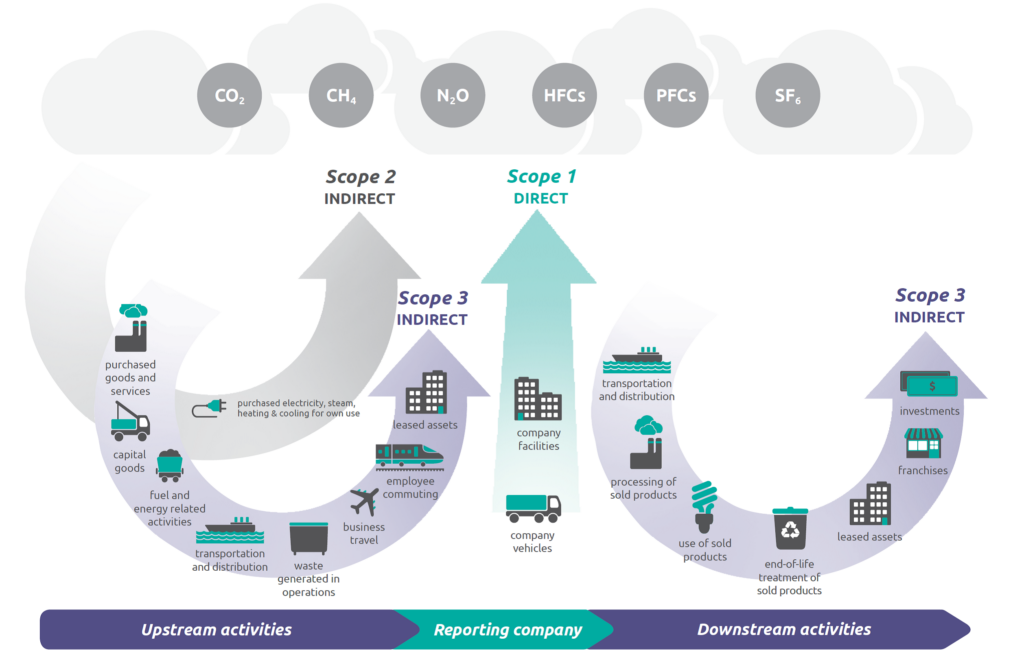
For most commercial and institutional buildings, Scope 1 and Scope 2 are where the HVAC system has direct impact, as well as where geothermal can deliver its most significant sustainability value.
Scope 1: Eliminating On-Site Combustion
A conventional commercial building with gas-fired boilers produces Scope 1 greenhouse gas emissions every time the heating system runs. Those emissions are direct, attributable to the organization, and show up prominently in any GHG inventory. For organizations with Scope 1 reduction targets, gas-fired HVAC systems represent a structural barrier to progress.
Geothermal eliminates this problem entirely. A geothermal system has no combustion component. There is no gas line to the mechanical room, no boiler stack, and no on-site emissions from heating. The system is fully electric, using electricity to operate heat pumps that move thermal energy between the building and the earth. For organizations with Scope 1 reduction commitments, switching from combustion-based heating to geothermal can take that entire category of building emissions to zero.
Scope 2: Cutting Electrical Demand Dramatically
Because geothermal is electric, it does contribute to Scope 2 emissions through its electricity consumption, but does so at a fraction of the rate of conventional electric HVAC alternatives. The key metric is coefficient of performance (COP): for every unit of electrical energy consumed, a geothermal system delivers three to five or more units of heating or cooling energy. Conventional electric resistance heating, by comparison, delivers a COP of 1.0, or one unit of heat for every unit of electricity consumed.
In practical terms, a well-engineered commercial geothermal system can reduce total HVAC-related electricity consumption by 40 to 70% compared to conventional systems, depending on the building type, climate, and system configuration. That reduction flows directly toward lowering Scope 2 emissions, and as the electrical grid continues to incorporate more renewable generation, the emissions factor of that remaining electricity consumption continues to decline. Geothermal and grid decarbonization compound each other, in that a more efficient system drawing from an increasingly clean grid is a powerful combination for long-term emissions reduction.
Geothermal and LEED Certification
LEED (Leadership in Energy and Environmental Design), administered by the U.S. Green Building Council, is the most widely recognized green building certification in the world. For organizations pursuing LEED certification on new construction or major renovation projects, the energy performance of the HVAC system is one of the largest point-earning opportunities in the rating system.
Geothermal systems contribute to LEED points across several credit categories:
Energy and Atmosphere: Optimize Energy Performance (EA Credit)
This is the highest-value credit category in LEED, offering up to 18 points for new construction projects. Points are earned based on demonstrated energy cost savings compared to a baseline building. Because geothermal systems are among the most energy-efficient HVAC technologies available, they typically produce substantial savings versus the baseline, generating meaningful points in this category that would be difficult to achieve with conventional systems.
Energy and Atmosphere: Renewable Energy Production
Geothermal uses renewable ground-sourced thermal energy to displace conventional fuel consumption. Depending on how the project models and documents the energy source, geothermal may contribute to on-site renewable energy credits within the LEED framework. Project teams should work with their LEED consultant to optimize the documentation approach for this credit.
Indoor Environmental Quality
LEED also rewards buildings that maintain high indoor air quality. Because geothermal systems don’t involve combustion, they produce no combustion byproducts. That means no carbon monoxide risk from gas equipment and no exhaust handling requirements. Depending on system configuration, geothermal can contribute to indoor environmental quality credits related to thermal comfort and ventilation.
Innovation Credits
LEED awards innovation credits for exemplary performance or the use of technologies that go beyond standard practice. For projects in markets where geothermal adoption is still relatively limited, its use may support innovation credit documentation, particularly in combination with other advanced building strategies.
It’s worth noting that many of Darcy’s completed projects have involved organizations with LEED aspirations or formal certification goals. The compatibility between geothermal systems and LEED is well-established, and Darcy’s team routinely coordinates with project engineers and sustainability consultants to ensure each geothermal system is modeled and documented in a way that maximizes credit potential.
Geothermal and ENERGY STAR
ENERGY STAR certification is a performance-based certification for existing commercial buildings. To earn ENERGY STAR certification, a building must achieve a score of 75 or higher on the EPA’s 1-to-100 energy performance scale, meaning it outperforms at least 75% of similar buildings nationally.
HVAC efficiency is a primary driver of ENERGY STAR scores for most commercial building types. Because geothermal systems dramatically reduce site energy use intensity (EUI) — the standard metric EPA uses to compare buildings — installing geothermal can be a direct path to achieving or maintaining ENERGY STAR certification.
For organizations that use ENERGY STAR certification as a component of their sustainability reporting, lease negotiation, or tenant attraction strategy, geothermal is one of the most reliable tools for reaching and holding that threshold. And because geothermal’s efficiency advantage is structural rather than behavioral, it doesn’t require ongoing occupant cooperation or operational changes to sustain. The building performs because of how it’s built, not just how it’s managed.
Geothermal in ESG Reporting and Investor Disclosure
The landscape for ESG disclosure has changed significantly and rapidly over the last few years. What began as largely voluntary reporting has become an increasingly complex regulatory patchwork, varying significantly by jurisdiction.
- In the U.S., the SEC’s climate disclosure rules were stayed in 2024, and the Commission formally proposed to rescind them entirely in May 2026, returning climate reporting for public companies to a materiality-based approach.
- At the same time, disclosure requirements have advanced aggressively at the state and international level:
- California’s SB 253 and SB 261 impose Scope 1, 2, and 3 reporting obligations on large companies doing business in the state
- The EU’s Corporate Sustainability Reporting Directive (CSRD) sets mandatory requirements for companies operating in European markets
- A growing number of jurisdictions are adopting the ISSB (International Sustainability Standards Board) framework as their baseline standard.
- Voluntary frameworks including the Global Reporting Initiative (GRI) and the Sustainability Accounting Standards Board (SASB) remain widely used for comprehensive disclosure.
- The TCFD framework, which was foundational to how the industry approached climate risk disclosure for over a decade, completed its work in 2023 and was formally disbanded, with its monitoring role absorbed into the ISSB.
This regulatory complexity makes one thing more valuable, not less: the ability to produce quantifiable, verifiable, long-term emissions data that holds up under scrutiny regardless of which framework applies. Geothermal delivers exactly that.
Verified Emissions Reductions You Can Measure and Report
Unlike some sustainability initiatives where impact is estimated or modeled, geothermal systems produce measurable, metered data on energy consumption. Utility bills and building energy management systems provide clear documentation of the electricity consumed. Because the system type and efficiency characteristics are known, the avoided emissions from replacing combustion-based heating can be calculated using EPA methodology and documented with confidence.
This auditability matters increasingly as ESG reporting standards tighten. Organizations that can provide well-documented, third-party-verifiable emissions data are in a stronger position than those reporting estimated or proxy-based figures.
Long-Term Commitment That Signals Serious Intent
ESG-focused investors and stakeholders are increasingly sophisticated about distinguishing between short-term sustainability gestures and structural, long-term commitments. A geothermal system installed in a commercial building will continue delivering emissions reductions and energy efficiency for 50 years or more.
For organizations building an ESG narrative with institutional investors, tenants, or community stakeholders, that kind of capital commitment carries weight that a carbon offset purchase or a voluntary pledge simply cannot replicate.
Science Based Targets and Net-Zero Alignment
Organizations aligned with the Science Based Targets initiative (SBTi) are committed to emissions reduction pathways consistent with limiting global warming to 1.5 degrees Celsius. For commercial real estate, healthcare, higher education, and other building-intensive sectors, meeting SBTi targets requires deep, measurable reductions in building energy use.
Geothermal systems are designed for exactly this standard. By eliminating Scope 1 building emissions and dramatically reducing Scope 2, geothermal provides the kind of structural decarbonization that SBTi-aligned organizations need to demonstrate credible progress against their targets.
Who Benefits Most: Industries Where ESG Meets Operational Reality
While the sustainability case for geothermal applies broadly across commercial building types, several sectors are finding the combination of ESG pressure and operational benefit particularly compelling.
Healthcare
Hospital systems and healthcare networks face growing pressure from boards, accreditation bodies, and community stakeholders to demonstrate environmental stewardship. Healthcare facilities also happen to be ideal geothermal candidates from an operational standpoint. They are typically large spaces with 24/7 cooling loads, critical reliability requirements, and long building lifecycles. The combination of ESG alignment and strong operational economics makes geothermal an increasingly natural choice for healthcare capital planning.
Higher Education
Universities and colleges are among the most aggressive institutional investors in climate commitments, with many having signed pledges for carbon neutrality by 2030 or 2040. Campus buildings are the single largest source of most universities’ direct emissions. Geothermal, particularly in thermal energy network configurations that can serve multiple campus buildings from shared infrastructure, is a powerful tool for meeting these ambitious targets.
Government and Municipal
For tax-exempt entities, the IRA’s direct pay provisions for the Investment Tax Credit make geothermal financially accessible in a way that wasn’t possible before 2023. That access remains intact: the One Big Beautiful Bill Act (OBBBA), signed in July 2025, explicitly preserved the Section 48/48E ITC for geothermal heat pump systems.
The credit currently provides a 6% base rate, scalable up to 30% with prevailing wage and apprenticeship requirements met, plus additional bonuses for domestic content and energy community siting. That structure holds through 2032, after which the credit steps down to 5.2% in 2033 and 4.4% in 2034 before phasing out.
For public agencies and nonprofits evaluating geothermal for capital projects, the window to capture the full credit value is well-defined and worth building into project timelines accordingly.
Corporate Real Estate and Fortune 500 Tenants
Corporate tenants are increasingly using sustainability performance as a top factor in lease decisions. ENERGY STAR certification, LEED status, and documented carbon performance influence where major organizations choose to locate. For building owners and developers, geothermal is a tool for attracting and retaining sustainability-focused tenants while also building an ESG story for their own investors and stakeholders.
Frequently Asked Questions
Does geothermal count as a renewable energy source for ESG purposes?
This depends on the specific ESG framework and how your organization defines renewable energy. Ground-source geothermal draws from the earth’s naturally stable thermal energy, which is continuously replenished. Many ESG frameworks and green building rating systems recognize geothermal’s renewable characteristics. For reporting purposes, the clearest and most defensible approach is to document geothermal’s impact through its measured reduction in fossil fuel consumption and grid electricity use, which translates directly into Scope 1 and Scope 2 emissions reductions under the GHG Protocol. Work with your sustainability advisor or ESG reporting consultant to determine the optimal treatment for your specific framework.
How do you quantify the emissions reductions from a geothermal system?
Emissions reductions are calculated by comparing the measured energy consumption of the geothermal system against a defined baseline — typically the energy that would have been consumed by a conventional HVAC system serving the same building. The electricity consumed by the geothermal system is converted to emissions using the EPA’s eGRID emission factors for the relevant grid region. The avoided natural gas combustion is calculated using EPA emissions factors for natural gas. Darcy’s engineering team can help project teams develop the energy models and documentation needed to support accurate, verifiable emissions reporting.
Can geothermal help us achieve LEED Platinum certification?
Geothermal is a strong contributor to LEED Platinum performance, primarily through its impact on the Energy and Atmosphere credits, which are the highest-point-value category in the rating system. Achieving Platinum requires strong performance across multiple credit categories, not just energy, so the overall building design strategy matters. That said, geothermal’s efficiency advantage is substantial enough that it meaningfully shifts what’s achievable on the energy side, often enabling projects to reach performance levels that would require much more complex or costly strategies without it. Your LEED consultant and mechanical engineer should model the specific contribution for your project.
What is the difference between LEED and ENERGY STAR for commercial buildings?
LEED is a comprehensive green building certification that evaluates new construction or major renovation projects across multiple categories: energy, water, materials, indoor environmental quality, and site. It is awarded at certification, silver, gold, or platinum levels based on points earned.
ENERGY STAR, by contrast, is a performance-based certification for existing buildings that focuses specifically on energy use intensity (EUI) relative to similar buildings.
The two programs are complementary in that a new building can pursue LEED during design and construction, then use ENERGY STAR to document and certify its ongoing energy performance over its operating life. Geothermal contributes to both.
Does geothermal work for buildings pursuing carbon-neutral or net-zero certification?
Yes, and it’s often a foundational element of carbon-neutral building strategies. Carbon-neutral and net-zero building certifications — such as those offered by the International Living Future Institute (ILFI), ASHRAE, and various national standards — require buildings to achieve deep reductions in operational energy use before relying on renewable energy or offsets to close the gap. Geothermal’s combination of Scope 1 elimination and major Scope 2 reduction makes it one of the most effective tools for meeting the operational efficiency requirements that these certifications demand.
Ready to Quantify the Sustainability Impact for Your Facility?
The path to meaningful, measurable carbon reduction in commercial buildings runs through the mechanical room. For many, geothermal heating and cooling has become the infrastructure decision that will determine what your building’s emissions profile looks like for the next 50 years.
Darcy Solutions works with sustainability managers, facility teams, and project engineers across healthcare, education, government, and corporate real estate to design and build geothermal systems that deliver on both operational and ESG objectives. Our team understands the sustainability frameworks you’re reporting against, and we can help you understand the specific emissions reduction potential of geothermal for your building and site.
The starting point is a free site assessment. In two minutes, you can share your building’s location and take the first step toward gaining a geologically grounded picture of what’s possible.