
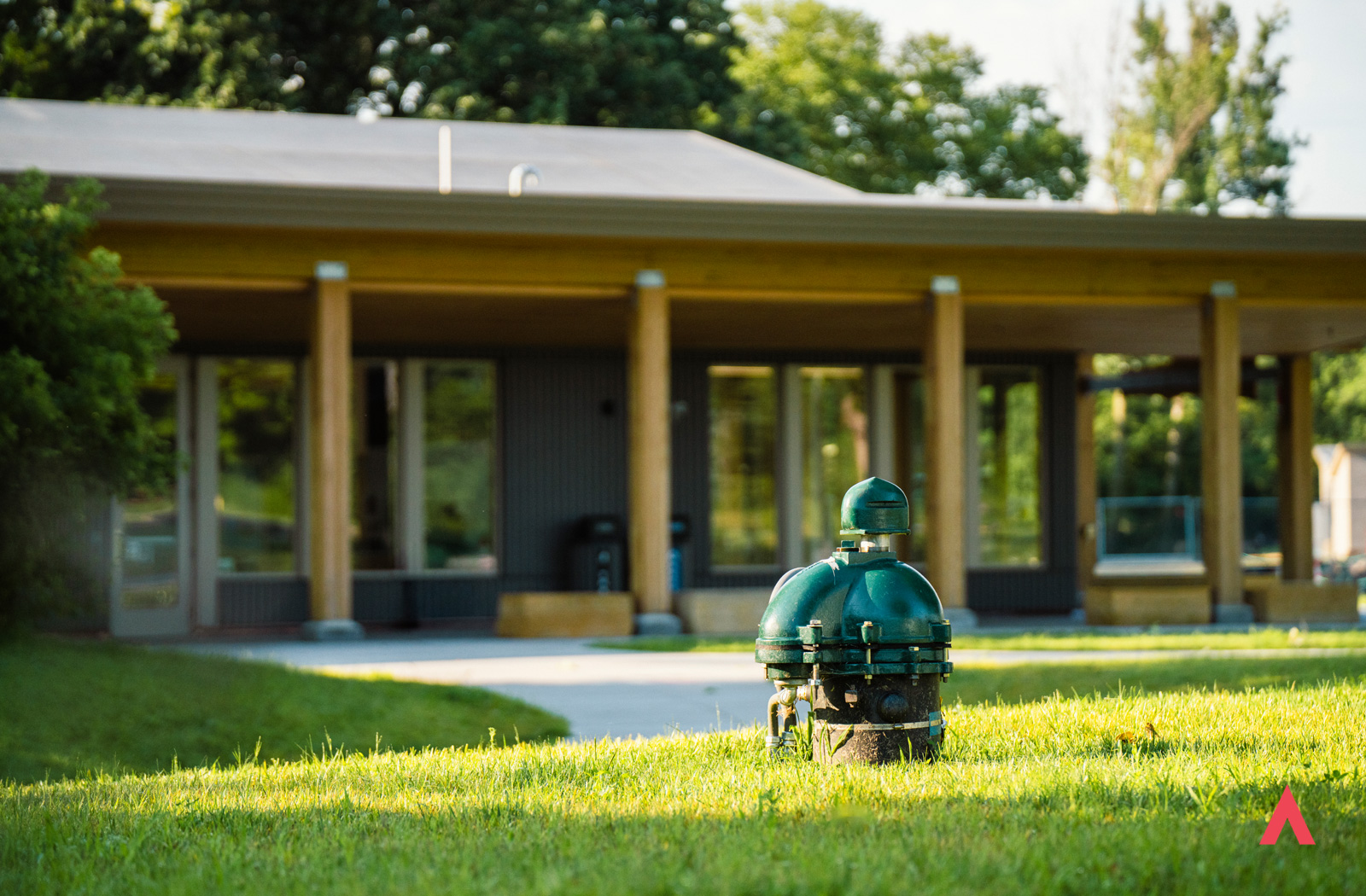
The ground beneath your feet is one of the most reliable sources of energy on the planet. Regardless of what’s happening at the surface, whether Minnesota winter or Texas summer, the earth just a few hundred feet down maintains a remarkably stable temperature, year-round, decade after decade. Commercial geothermal heating and cooling systems harness that stability to deliver efficient, consistent climate control to large buildings without combustion or the volatility of fuel markets.
If you’re an engineer, facility manager, building owner, or procurement professional exploring your options, this piece is designed to provide a clear, practical foundation for understanding how commercial geothermal works — and why it’s becoming the HVAC solution of choice for forward-thinking organizations across the country.
The Core Idea: Using the Earth as Your Heating and Cooling System
At its most fundamental level, a commercial geothermal system is a heat exchange system. Instead of burning fuel to generate heat or using refrigerants to reject heat into outdoor air, a geothermal system moves heat between a building and the ground (or in the most efficient configurations, the groundwater beneath it).
Here’s the concept in plain terms:
- In winter, the system extracts heat energy from the earth (or groundwater) and transfers it into the building.
- In summer, the process reverses: the system pulls excess heat out of the building and deposits it back into the earth.
No combustion. No fuel. Just a heat pump doing what heat pumps do, moving thermal energy from one place to another. Except in this case, the source and sink is the earth itself, which maintains a ground temperature of roughly 45–55°F across most of the continental U.S., regardless of outside air temperature.
This stability is the fundamental advantage of geothermal. A heat pump operating against a 50°F ground temperature works far more efficiently than one operating against 95°F summer air or −10°F winter air. The ground provides a better, more consistent thermal environment than the atmosphere, which translates directly into lower energy consumption and more predictable operating costs for your facility.
How a Commercial Geothermal System Is Structured
A commercial geothermal HVAC system has two primary components: a ground-side subsystem that interfaces with the earth, and a building-side subsystem that delivers heating and cooling to the space. Understanding both sides helps demystify the technology and clarifies where both the real value and the engineering complexity reside.
The Ground-Side Subsystem: Where the Energy Comes From
The ground-side subsystem is what most people think of when they picture geothermal. This is the part of the system installed underground, where thermal energy is either extracted from or deposited into the earth. There are several configurations used in commercial applications, each suited to different site conditions.
Vertical Boreholes (Closed-Loop Systems)
The most widely known geothermal configuration involves drilling vertical boreholes, typically 150 to 500 feet deep, and installing a sealed loop of pipe through which a fluid (usually a water-antifreeze mixture) circulates. The fluid absorbs or releases heat as it passes through the ground, then travels back to the building’s heat pump equipment to complete the exchange.
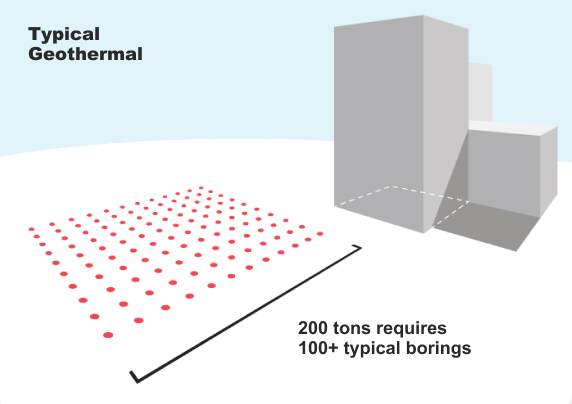
Vertical borehole fields are highly versatile and can be installed in a wide range of geological settings. They’re a proven technology across the U.S. and globally, and they work well for many commercial projects. For buildings with very large thermal loads, delivering sufficient capacity may require a significant number of boreholes. This is where site conditions and groundwater availability can significantly shape the optimal approach.
Groundwater-Based Systems (Open-Loop and Dipole Configurations)
Where suitable aquifers exist, groundwater-based systems offer a step-change improvement in thermal efficiency and capacity. Rather than relying on heat transfer between pipe and soil, these systems draw directly from a groundwater source, which naturally maintains a stable temperature and provides far greater thermal capacity per well than a closed-loop borehole.
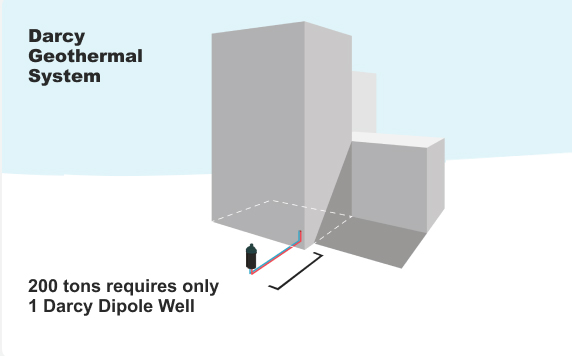
In a groundwater-based open-loop system, water is pumped from a supply well, passed through a heat exchanger where thermal energy is transferred, and then reinjected into the aquifer through a separate return well. Because groundwater is a far more thermally conductive medium than most soils, these systems can deliver substantially more heating and cooling capacity with fewer wells and a dramatically smaller surface footprint.
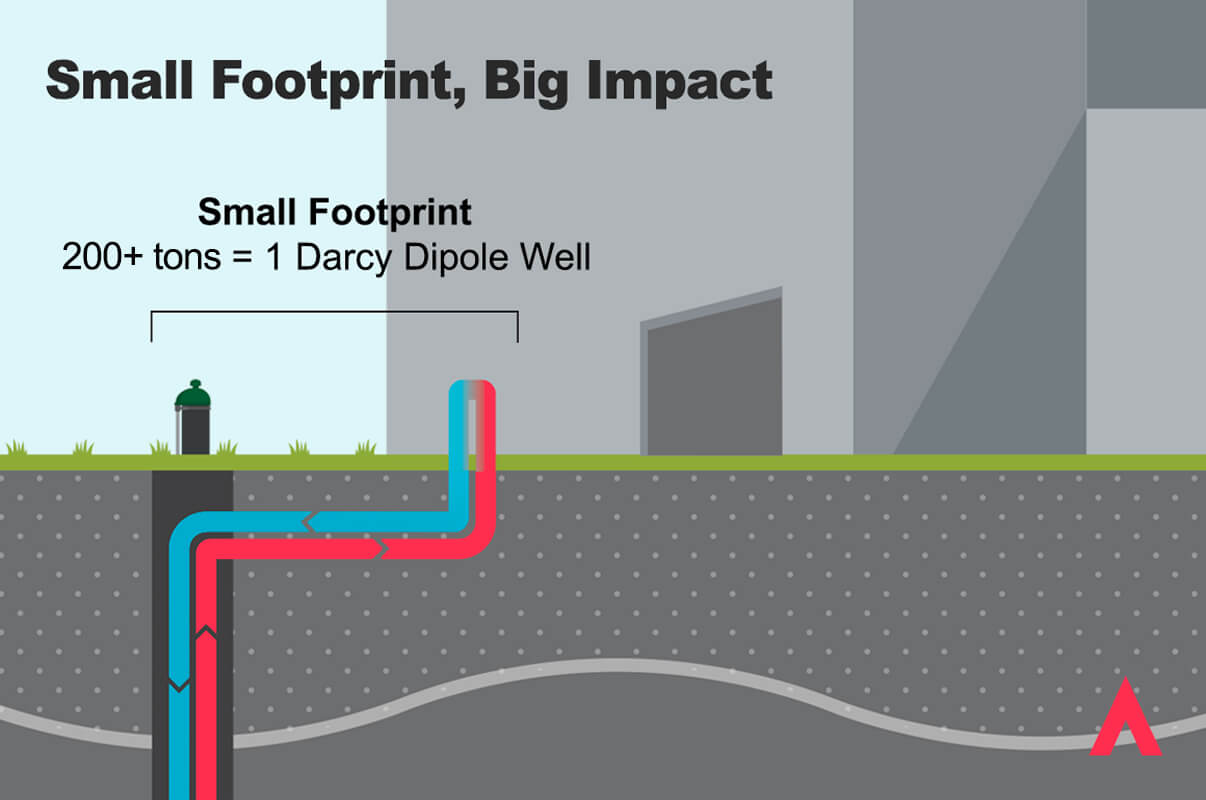
This is the foundation of Darcy’s approach. By engineering for the specific hydrogeological conditions at each site, Darcy’s systems — including the proprietary Darcy Dipole well configuration — are capable of delivering 200 or more tons of cooling capacity from a single well. The result is a geothermal system that can be deployed in dense urban environments, constrained sites, and retrofit scenarios where traditional geothermal was never considered viable.
Thermal Energy Networks
For campuses, districts, or multi-building developments, geothermal systems can be interconnected into thermal energy networks — shared loops or aquifer resources that serve multiple buildings simultaneously. These configurations enable heating and cooling loads to be balanced across a portfolio, allow waste heat from one building to serve another, and create economies of scale in infrastructure, procurement, and operations. University campuses, hospital systems, and municipal districts are natural candidates for this approach.
The Building-Side Subsystem: Delivering Comfort
On the building side, a geothermal system looks and feels very similar to conventional HVAC. The ground-side loop connects to one or more heat pumps that are either centralized (serving the whole building from a central plant) or distributed (smaller units serving individual zones). Those heat pumps condition water or refrigerant that feeds the building’s air handlers, radiant systems, fan coil units, chilled beams, or other terminal equipment.
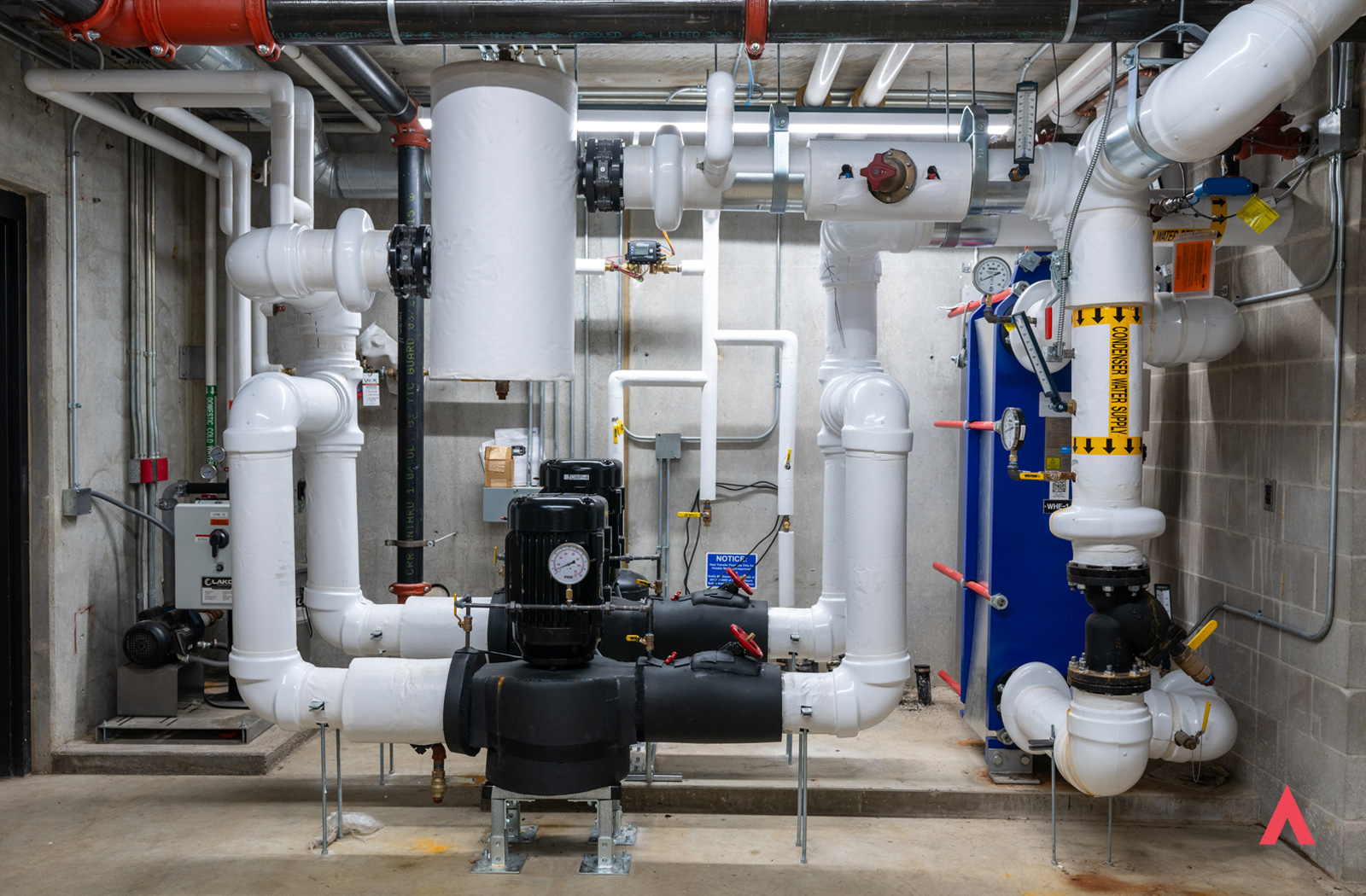
This compatibility with a wide range of building-side equipment is one of geothermal’s underappreciated strengths. Geothermal doesn’t require a wholesale redesign of a building’s HVAC distribution system. Engineers have significant flexibility in how ground-side energy is delivered to the space, which means geothermal can be integrated into new construction or designed around existing mechanical infrastructure.
Why Commercial Buildings Are Particularly Well-Suited for Geothermal
Geothermal has long been used in residential applications, but the economics and performance characteristics of geothermal are often significantly better at commercial scale. Here’s why:
Energy Loads Are Larger and More Predictable
Commercial buildings consume far more energy for heating and cooling than residences, and they do so on consistent, predictable schedules. That means geothermal’s efficiency advantages compound over time, and the operational savings are proportionally larger. A meaningful improvement in HVAC efficiency at commercial scale can represent tens or hundreds of thousands of dollars in annual savings. That math only improves as energy prices fluctuate.
Longer Building Lifecycles Justify the Investment
Commercial and institutional buildings such as schools, hospitals, office campuses, and government facilities are typically built to last 40 to 60 years or more. Geothermal systems are designed with the same longevity in mind: underground loop fields and well systems are engineered to last 50 years or longer, while building-side heat pump equipment typically carries a service life of 20 to 25 years. When you evaluate geothermal across the life of a building rather than just the upfront installation cost, the financial case is compelling.
Sustainability Goals and Decarbonization Mandates
Commercial real estate, healthcare, higher education, and government organizations increasingly operate under sustainability mandates ranging from board-level ESG commitments to municipal carbon reduction targets. Geothermal directly addresses Scope 1 emissions by eliminating on-site combustion, and contributes to Scope 2 reductions by dramatically cutting electrical demand for HVAC. For organizations working toward net-zero targets, LEED certification, or ENERGY STAR compliance, geothermal is one of the most powerful tools available.
Federal Incentives Designed for Commercial Projects
The federal Investment Tax Credit (ITC) for commercial geothermal currently provides up to 30% of system cost under Section 48/48E of the Internal Revenue Code. This is specifically structured for commercial and institutional projects. Tax-exempt organizations such as public schools, municipalities, and nonprofits can access the ITC through direct pay provisions, making the incentive available regardless of tax liability. These incentives materially improve the financial profile of geothermal projects, often shortening payback timelines significantly.
Key Characteristics That Define Geothermal’s Performance
When facility managers and engineers evaluate HVAC options, it helps to understand what makes geothermal distinctly different from other technologies in both concept and in practice.
Exceptional Energy Efficiency
Geothermal systems use electricity to move heat rather than generate it, at a coefficient of performance (COP) that typically ranges from 3.0 to 5.0 or higher. That means for every unit of electrical energy consumed, a geothermal system delivers three to five units of heating or cooling energy. This efficiency ratio is available 24 hours a day, 365 days a year, independent of weather conditions. It’s the foundational reason geothermal consistently outperforms conventional HVAC in operating cost over a building’s lifetime.
Inherent Reliability and Low Maintenance
The earth doesn’t have cloudy days beneath its surface. Groundwater temperatures don’t fluctuate with the seasons. A properly engineered geothermal system delivers consistent, reliable performance year-round, with fewer mechanical components exposed to outdoor elements and a maintenance profile that building operators appreciate over the long term.
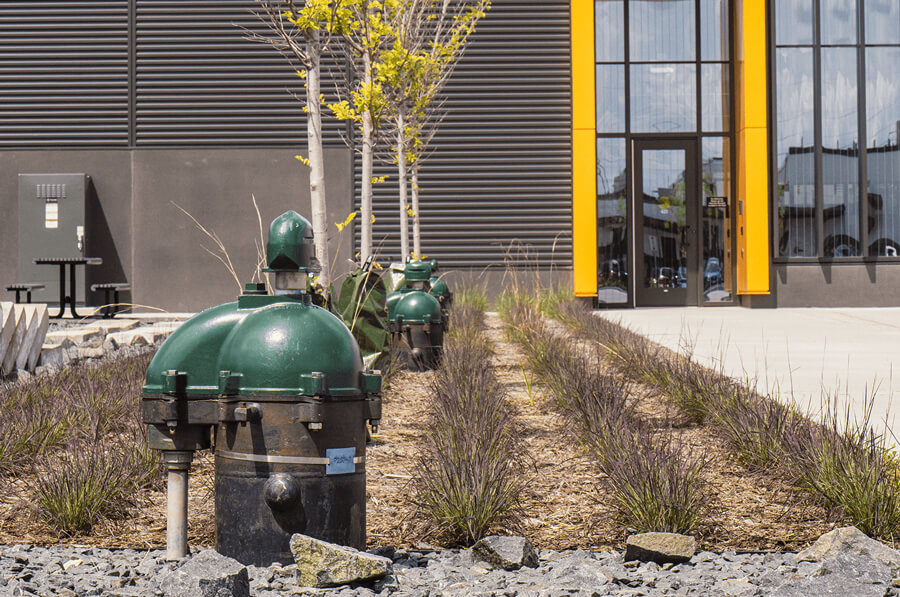
Underground components are largely passive; the primary maintenance activities center on the building-side heat pump equipment, which follows standard service intervals. For facilities where HVAC reliability is mission-critical, such as hospitals, data centers, and manufacturing facilities, this consistency is a meaningful operational advantage.
No On-Site Combustion
Geothermal is a fully electric system that uses electricity to operate heat pumps, with no combustion anywhere in the process. This eliminates on-site greenhouse gas emissions from the HVAC system, simplifies operations, and positions the building for a clean energy future as the electrical grid itself continues to decarbonize. It also removes the dependency on fossil fuel supply chains and the price volatility that comes with them.
Compatibility with Existing Building Systems
Geothermal heat pumps can be configured to work with virtually any type of building-side distribution equipment, from ducted air systems and radiant heating to chilled beams and beyond. This compatibility means geothermal isn’t limited to new construction, but is a viable upgrade path for buildings with existing mechanical infrastructure, including many retrofit scenarios that building owners might assume are too complex or costly to address.
What Does a Geothermal Installation Actually Involve?
One of the most common questions from building owners and facility managers considering geothermal for the first time is simply: what does this actually look like in practice? The answer is highly site-specific, but the general process follows a logical, well-established sequence.
Site Assessment
The process begins with a geological and hydrogeological evaluation, examining subsurface conditions, available land, groundwater resources, and the building’s thermal load profile. This assessment determines not only whether geothermal is feasible but which configuration will perform best. Darcy provides free site assessments as a starting point for any project, giving owners and engineers a geologically grounded picture of what’s possible before any significant commitment is made.
Development Support and Preliminary Design
Once a site is confirmed as a strong candidate, the engineering team develops preliminary system layouts, performance models, and budget estimates. This phase includes coordination with the building’s mechanical engineer, regulatory review where applicable, and refinement of the thermal load analysis to ensure the system is sized correctly for the facility’s actual needs.
On-Site Diagnostics
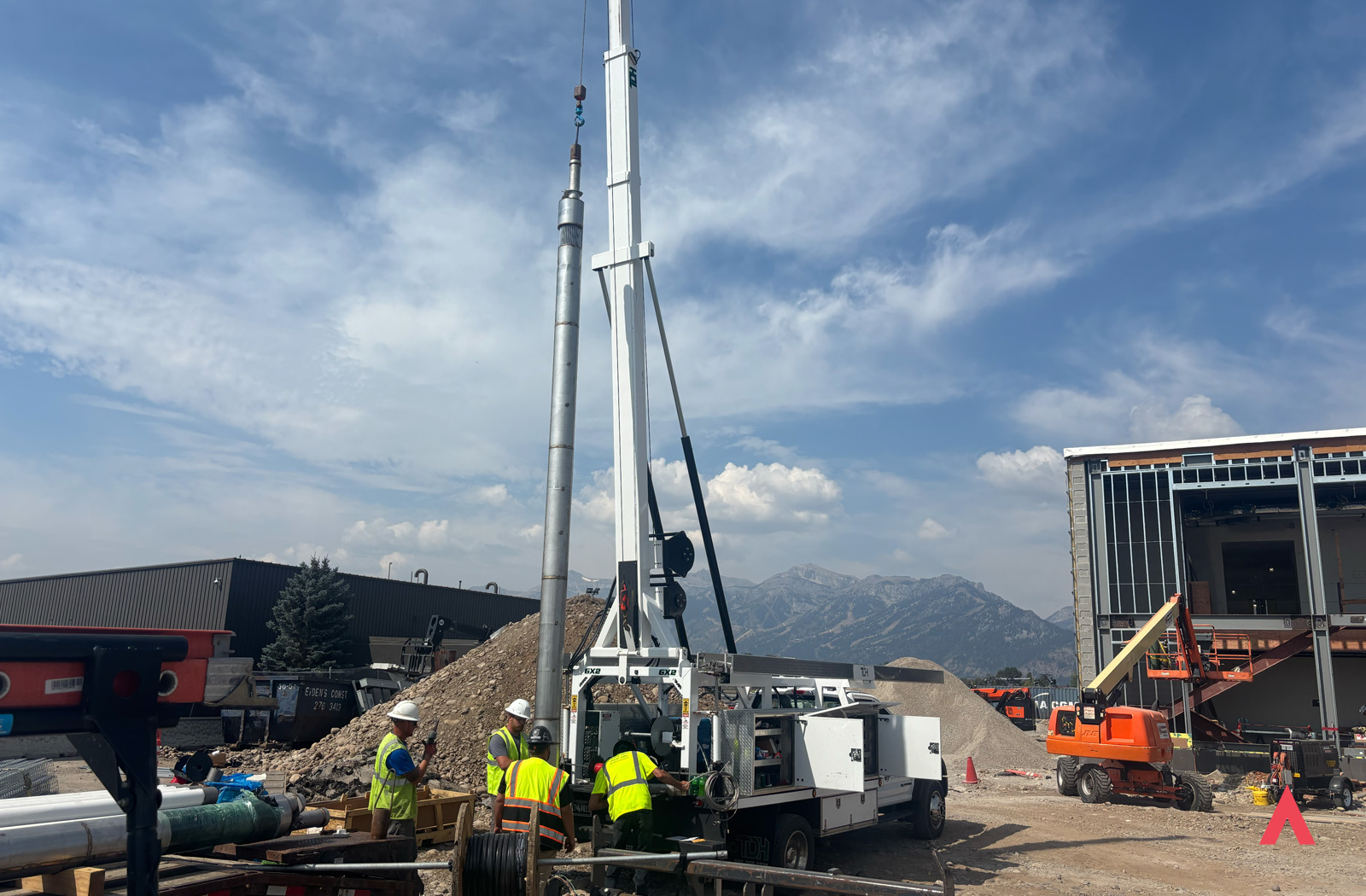
For groundwater-based projects, on-site design well drilling and aquifer testing validates the assumptions from the study and provides the data needed to finalize system design. This step is one of Darcy’s core competencies and is critical to engineering a system that performs as modeled, not just on paper.
Construction and Commissioning
Well construction, horizontal distribution piping, and mechanical equipment installation typically proceed in coordination with other construction activities on the project. For retrofit projects, this work is often phased to minimize disruption to ongoing building operations. Commissioning ensures the system is operating within design parameters before handoff to the owner.
Long-Term Performance
A well-engineered geothermal system is designed to perform reliably for decades. Many owners invest in remote monitoring and performance optimization to ensure the system continues to operate at peak efficiency throughout its service life, as well as to catch any issues early before they affect building comfort or energy costs.
Who Is Geothermal Right For?
Commercial geothermal is a strong option for a wide range of building types and ownership situations. Some of the most compelling candidates include:
- Schools and universities: Long building lifecycles, strong sustainability mandates, large energy budgets, and access to federal incentives (including direct pay for public institutions) make educational facilities excellent geothermal candidates.
- Healthcare facilities: Hospitals and medical office buildings operate 24/7, have large and consistent thermal loads, and have critical reliability requirements, all of which align exceptionally well with geothermal’s strengths.
- Government and municipal buildings: Public facilities with access to ITC direct pay provisions, sustainability goals, and long ownership horizons are natural fits for geothermal investment.
- Corporate campuses and commercial real estate: Organizations with multi-building portfolios, net-zero commitments, or energy cost reduction goals find geothermal increasingly attractive, particularly as ESG reporting requirements expand.
- Industrial and manufacturing facilities: Process cooling loads, combined heat and power applications, and large energy footprints make geothermal a significant operational asset for the right manufacturing profile.
- Data centers: The constant, high-density cooling loads of data centers are an ideal match for groundwater-based geothermal systems, which can deliver massive cooling capacity in a remarkably compact footprint.
The question isn’t really whether geothermal can work for a given building, but whether the site’s geological conditions, the building’s thermal load profile, and the project’s financial parameters align to make it the best choice. That’s exactly what a site assessment is designed to determine.
Frequently Asked Questions
How is commercial geothermal different from residential geothermal?
The underlying technology is the same in that both use the earth as a thermal source and sink, but commercial systems operate at far greater scale and complexity. Commercial projects involve larger thermal loads, more sophisticated engineering, larger well fields or groundwater systems, and typically multiple heat pumps, central plant configurations, and distribution systems serving many zones or buildings. The financial incentives, permitting processes, and engineering requirements are also distinct from residential applications.
Does geothermal work in all climates?
Yes. Because geothermal systems exchange heat with the ground rather than outdoor air, they perform consistently across a wide range of climates from the Upper Midwest to the Southeast and beyond. Ground temperatures below the frost line remain stable regardless of surface climate. Darcy has designed and built systems in states across the country, and the underlying principles apply wherever geothermal resources are accessible.
What is the payback period for a commercial geothermal system?
Payback periods vary based on system size, project type, local energy costs, and the incentives applied. When federal tax incentives including the ITC (up to 30%) and bonus depreciation are combined with energy cost savings, many commercial projects achieve payback in the 5 to 10 year range. Some projects with favorable conditions and significant incentive stacking achieve payback even faster. Accurate energy modeling and financial analysis during the development phase are the best way to understand the economics for a specific project.
Does geothermal require a large amount of land?
It depends on the system configuration. Groundwater-based systems like those Darcy engineers can deliver substantially greater capacity in a much smaller footprint than conventional borehole-based approaches, making geothermal viable in urban sites, existing campuses, and constrained properties where it was previously impractical. A free site assessment is the best way to determine what’s possible for a specific location.
Can geothermal be integrated into an existing building?
Yes. Geothermal can be retrofitted into existing buildings, and Darcy has completed retrofit projects across a range of building types. The complexity of a retrofit depends on the building’s existing mechanical infrastructure, the available site for well or borehole installation, and the coordination required to maintain building operations during construction. Darcy’s project team has developed phased construction processes specifically to manage retrofit installations in occupied facilities.
What happens to the groundwater in an open-loop system?
In a properly engineered groundwater-based system, water is extracted from the aquifer, passed through a heat exchanger where thermal energy is transferred, and then fully reinjected into the same aquifer through a return well. The water’s temperature changes slightly before returning to the ground, where it quickly equilibrates with the surrounding aquifer. Darcy’s systems are designed with aquifer sustainability in mind and comply with all applicable groundwater regulations and permitting requirements.
Ready to See What Geothermal Can Do for Your Building?
Geothermal heating and cooling is a proven, deployed, operating reality across commercial and institutional buildings throughout the U.S. It is currently delivering lower energy costs, reduced emissions, and long-term operational reliability to organizations that have chosen to invest in it.
Darcy has completed or has under contract more than 65 commercial geothermal projects, from Minnesota to Florida, and has conducted over 1,200 site evaluations for facilities across the country. Our team of geologists, engineers, and builders specializes exclusively in commercial geothermal, and we’ve developed the proprietary technology and the project methodology to make geothermal work in locations where it wasn’t possible before.
If you’re evaluating geothermal for your facility, the best place to start is a site assessment. It takes two minutes, it’s free, and it gives you a geologically grounded picture of your project’s potential.
→ Request Your Free Site Assessment