

When evaluating the viability of commercial geothermal for your site, understanding which type of system will work best is key to shaping the entire project, from well count and project footprint to upfront cost and long-term performance.
The two primary configurations in commercial geothermal are closed-loop systems, which circulate fluid through sealed underground pipe loops, and groundwater-based (open-loop) systems, which draw directly from an aquifer to perform the thermal exchange. Both use the earth as a stable thermal resource to deliver efficient, reliable heating and cooling, but they work in fundamentally different ways, perform differently across site conditions, and have meaningfully different implications for project economics and site feasibility.
This piece explains both approaches in plain terms, covers where each one is most applicable, and describes what becomes possible when the right hydrogeological conditions allow for a groundwater-based approach.
How Closed-Loop Geothermal Systems Work
Closed-loop geothermal systems circulate a heat transfer fluid, typically a water and antifreeze mixture, through a continuous sealed loop of pipe installed underground. The fluid absorbs heat from the surrounding ground in winter and deposits heat back into the ground in summer, then returns to the building’s heat pumps to complete the exchange. Because the loop is sealed, the fluid never contacts groundwater or soil directly.
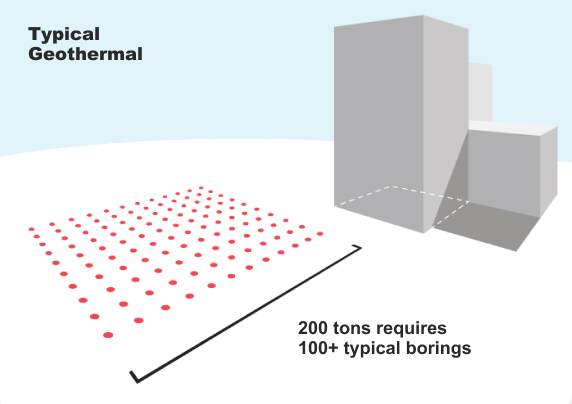
In commercial applications, the most common closed-loop configuration is a vertical borehole field. Boreholes are drilled to depths typically ranging from 150 to 500 feet, and a U-shaped pipe is inserted and grouted in place. Multiple boreholes are connected in parallel to create the field that serves the building’s load. Horizontal configurations, where pipe is buried in shallow trenches, are used in some lower-density applications with sufficient land area.
What Drives Performance in Closed-Loop Systems
Heat transfer in a closed-loop borehole occurs by conduction through the grout, the borehole wall, and the surrounding soil or rock. The rate of that transfer depends on the thermal conductivity of the subsurface material, the temperature difference between the fluid and the ground, and the surface area of the pipe. Denser, more conductive materials like saturated soil or certain rock types transfer heat more efficiently than dry sand or low-conductivity fill.
The critical design constraint is that the thermal exchange capacity of any single borehole is limited by the thermal conductivity of the surrounding material and the borehole geometry. Delivering large heating and cooling loads requires a proportionally large borehole field, which means significant drilling volume, land area, and upfront cost for major commercial projects.
Where Closed-Loop Systems Excel
Closed-loop systems are highly versatile. They can be installed in a wide range of geological conditions, including sites with no accessible groundwater, low-permeability formations, or regulatory environments where groundwater use is restricted. They require no water well permitting in most jurisdictions, and their performance is well-characterized across decades of commercial installations. For smaller commercial projects, constrained budgets, or sites where groundwater is not accessible, a closed-loop system is often the right choice.
How Groundwater-Based Geothermal Systems Work
Groundwater-based geothermal systems perform the thermal exchange using water from an aquifer at a targeted point in the subsurface, rather than the entirety of piping from the field. Where a closed-loop borehole transfers heat by conduction through pipe and soil, a groundwater system transfers thermal energy by advection through the moving water itself. That distinction is the source of groundwater’s fundamental performance advantage.
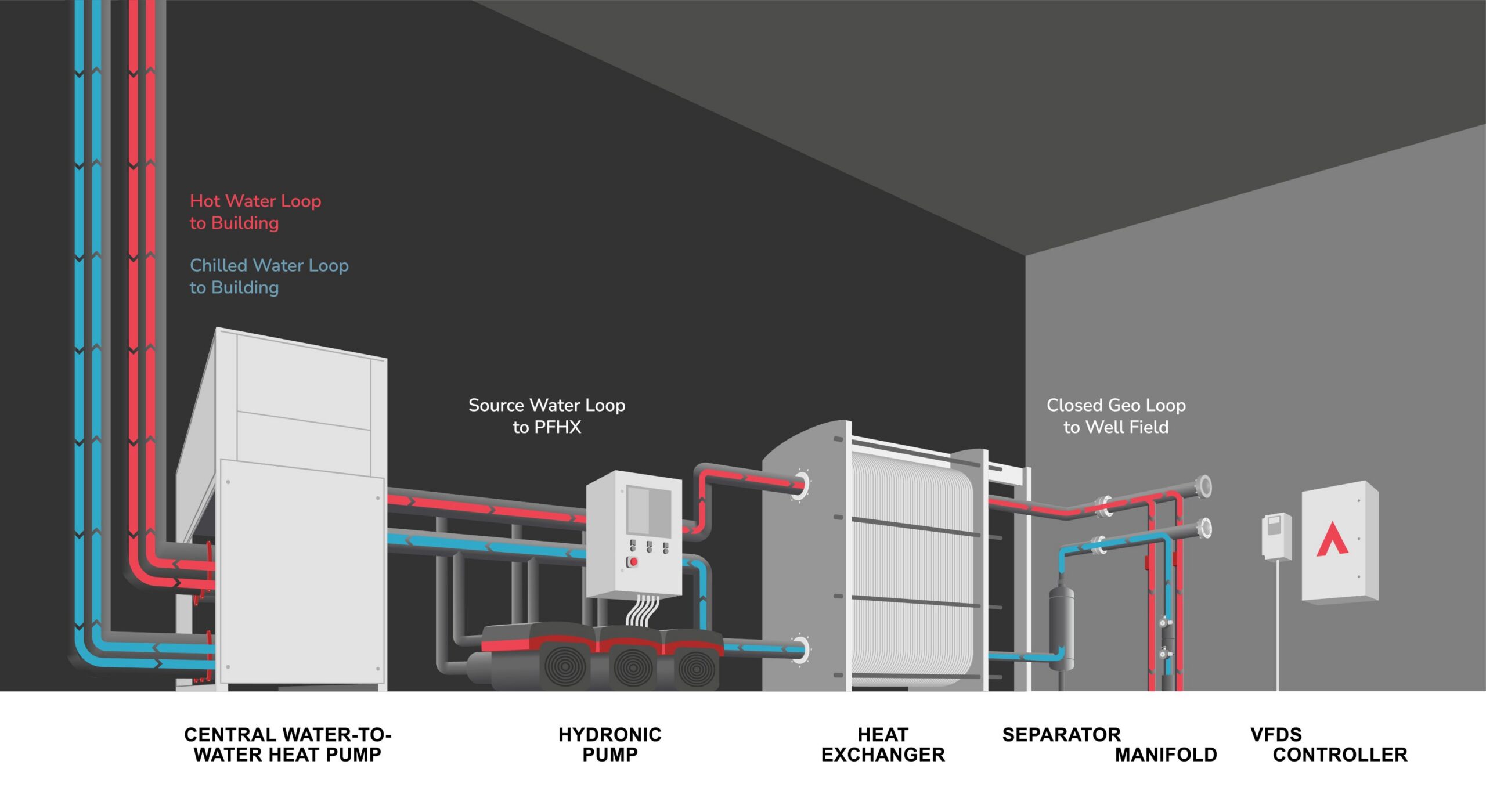
In a standard open-loop configuration, groundwater is pumped from a production well, passed through a heat exchanger where thermal energy is transferred to or from the building’s loop, and then returned to the aquifer through a separate injection well.
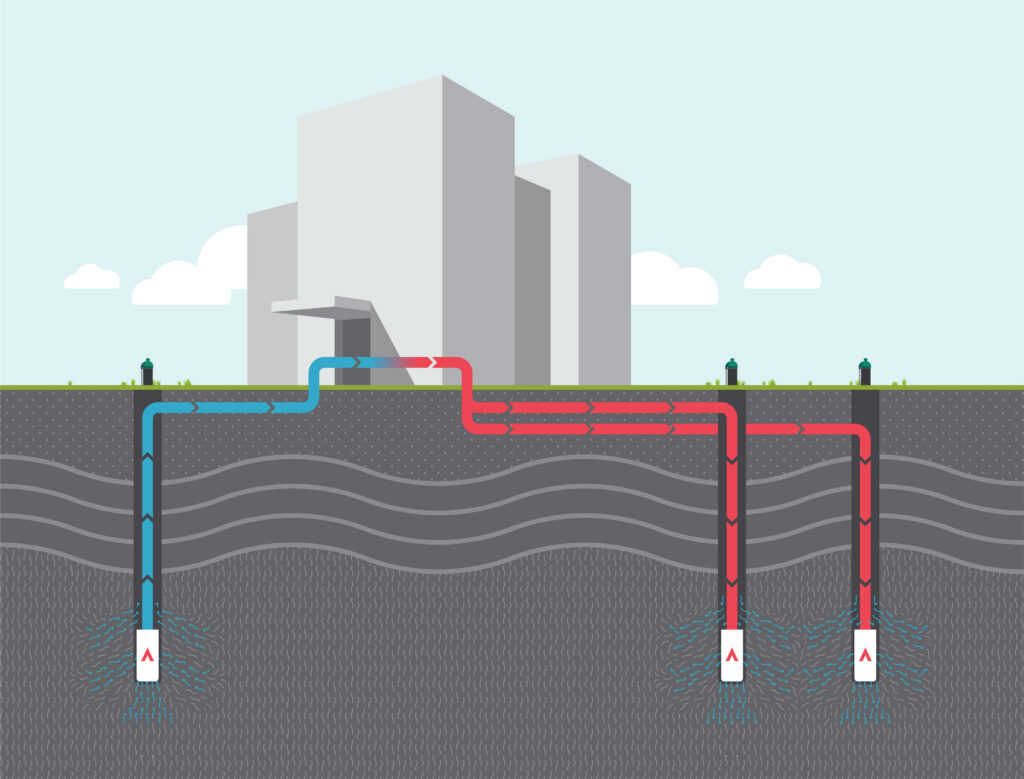
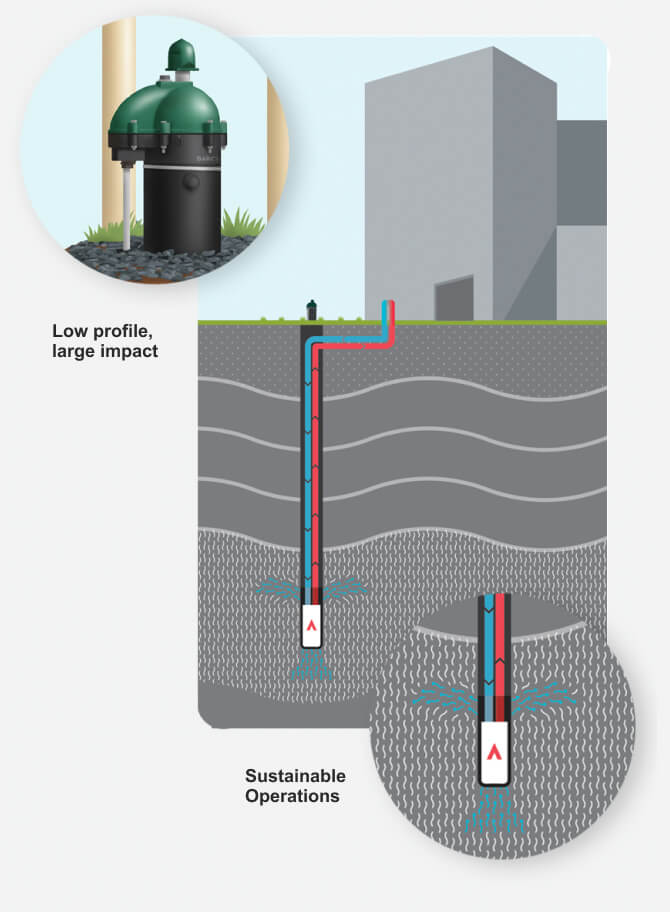
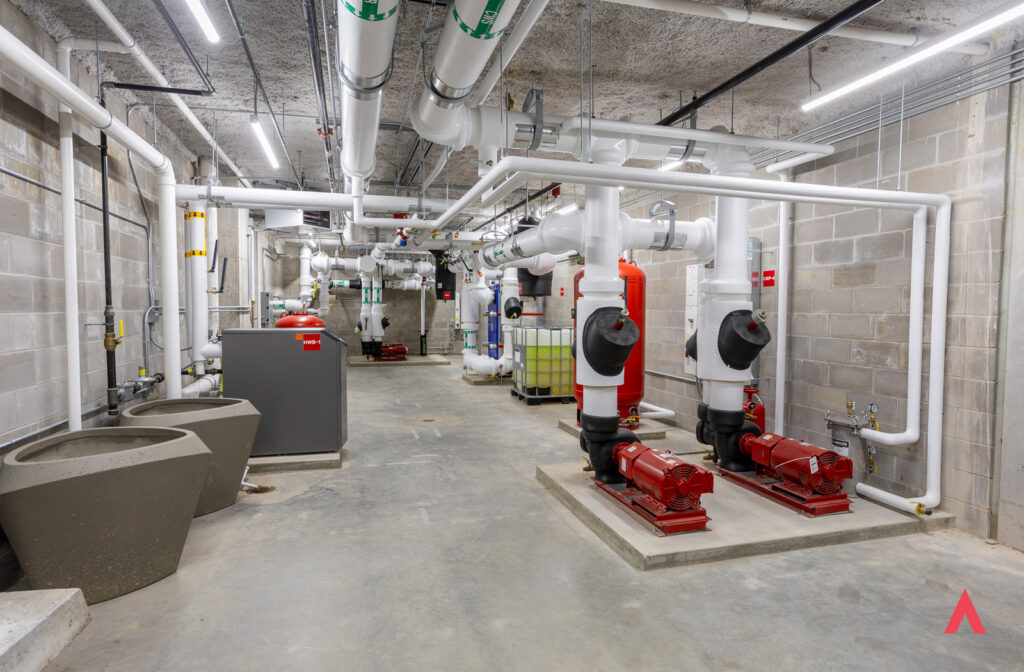
In more advanced configurations, including Darcy’s Dipole well technology (shown below), both production and injection occur within the same engineered well system, creating a directed flow of groundwater through the heat exchanger with exceptional thermal efficiency and minimal surface footprint.
What Drives Performance in Groundwater-Based Systems
Groundwater is a far more thermally conductive medium than soil or rock. Water conducts heat roughly 25 times more effectively than dry soil and several times more effectively than most saturated formations. A cubic meter of groundwater moving through a heat exchanger transfers thermal energy orders of magnitude faster than a cubic meter of static soil surrounding a borehole pipe.
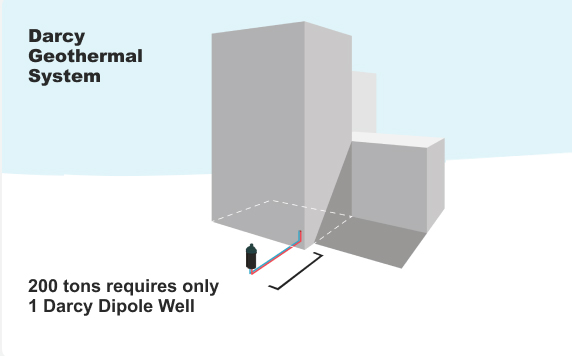
The result is a step-change in thermal capacity per well. Where a conventional borehole might deliver 1 to 3 tons of cooling capacity, a groundwater-based well in a productive aquifer can deliver 50, 100, or 200-plus tons from a single well location. This capacity concentration is what makes groundwater-based geothermal viable for large commercial loads, and what enables it to serve those loads from a footprint that a closed-loop borehole field simply could not match.
The Darcy Dipole: Engineered for Maximum Capacity
Darcy’s patented Dipole well technology takes groundwater-based geothermal a step further by engineering the subsurface flow field directly, rather than relying on natural aquifer flow patterns. The Dipole creates a controlled thermal exchange zone within the aquifer by establishing a directed pressure differential between two points in the same well system. This produces a concentrated, high-velocity flow of groundwater through a proprietary down-well heat exchanger, maximizing the thermal exchange rate while keeping the surface footprint to a single well location.
The performance result is significant. A Darcy Dipole well can deliver more than 200 tons of cooling capacity from a single well, with no glycol in the closed loop, greater control over produced fluid temperatures than conventional configurations, and the ability to support imbalanced heating and cooling loads that would cause thermal drift problems in standard borehole fields. For large commercial projects on constrained sites, this combination of high capacity and minimal footprint opens project opportunities that other geothermal approaches cannot reach.
Comparing the Two Approaches: A Practical Summary
The table below summarizes the key differences between closed-loop and groundwater-based systems across the factors that matter most to commercial project teams.
| Factor | Closed-loop | Groundwater-based |
| Thermal capacity per well | 1 to 3 tons per borehole, depending on subsurface thermal conductivity. | 50 to 200-plus tons per well, depending on aquifer productivity and system design. |
| Site footprint | Requires significant land area for the borehole field at large commercial scales. A 500-ton project may require 200 or more boreholes spread across a substantial footprint. | Compact well field with a fraction of the surface area. A comparable load may be served by a handful of wells within a parking lot or utility corridor. |
| Geological requirements | Workable in a wide range of geological conditions; performance varies with subsurface thermal conductivity. | Requires a productive aquifer at accessible depth. A hydrogeological assessment is essential to confirm feasibility before project development. |
| Permitting and regulatory | Generally does not require water well permitting. Environmental review requirements vary by jurisdiction. | Requires water well permits and may require groundwater appropriation or injection permits depending on state and local regulations. Darcy manages all permitting as part of the project process. |
| Upfront project cost | Lower cost per borehole, but the large number of boreholes required for major commercial loads drives total cost up significantly. | Higher engineering complexity per well, but dramatically fewer wells required, which typically results in lower total project cost at large commercial scales. |
| Long-term performance | Susceptible to thermal drift in borehole fields with heavily imbalanced heating and cooling loads over time. | The aquifer provides a continuously refreshed thermal resource. Darcy’s Dipole configuration is specifically designed to handle imbalanced loads without the thermal accumulation issues that affect closed-loop fields. |
Which System Is Right for a Given Project?
The most important factor in choosing between closed-loop and groundwater-based geothermal is geology. If a site has a productive, accessible aquifer and the regulatory environment supports groundwater use for thermal exchange, a groundwater-based system will almost always deliver superior performance, a smaller footprint, and better project economics at commercial scale. If the site lacks accessible groundwater, a closed-loop system is typically the right approach.
A few other factors can also shape the decision:
- Project scale: At smaller scales, the efficiency advantage of groundwater may not outweigh the additional permitting and engineering complexity. At large commercial scales, the footprint and cost advantages of groundwater-based systems are most significant.
- Site constraints: Projects on built-out urban sites, dense campuses, or constrained parcels where a large borehole field simply doesn’t fit are natural candidates for groundwater-based evaluation.
- Load profile: Cooling-dominant facilities, or those with significantly imbalanced heating and cooling loads, benefit from groundwater-based systems’ ability to handle thermal asymmetry without performance degradation over time.
- Regulatory environment: States and municipalities vary in how they regulate groundwater thermal exchange. Darcy’s team navigates permitting as a standard part of the project process, but understanding the regulatory landscape early helps set realistic project timelines.
The right starting point is a site assessment. Darcy’s geology team evaluates subsurface conditions, aquifer characteristics, and regulatory requirements to determine which system configuration is best suited to a specific location, before any engineering commitment or capital expenditure is made.
Frequently Asked Questions
Does a groundwater-based geothermal system consume or contaminate groundwater?
No. In a properly engineered open-loop or Dipole system, groundwater is extracted from the aquifer, passed through a heat exchanger where thermal energy is transferred, and fully reinjected into the same aquifer. The water is not consumed, and because Darcy’s Dipole system uses a closed-loop heat exchanger (i.e., the building fluid never contacts the groundwater directly), there is no risk of contaminating the aquifer with glycol or other heat transfer fluid additives. The water’s temperature changes slightly before reinjection and equilibrates with the surrounding aquifer quickly.
How many wells does a groundwater-based system typically require?
It depends on the building’s load requirements and the aquifer’s productivity at the site. Because groundwater-based wells can deliver dramatically more thermal capacity per well than closed-loop boreholes, large commercial loads that would require dozens or hundreds of boreholes in a closed-loop configuration can often be served by 1–2 groundwater wells. Darcy’s site assessment and on-site testing process is designed to characterize aquifer productivity and size the system accurately before construction begins.
Can a closed-loop system be converted to a groundwater-based system later?
Converting an existing closed-loop system to a groundwater-based approach is technically possible but involves significant engineering and construction work, including new well installation, revised mechanical room connections, and updated controls. In most cases, it’s more practical to design the right system from the outset than to plan for a conversion. Darcy’s site assessment process is specifically designed to identify the optimal system type early, before capital commitments are made.
What is a standing column well, and how does it differ from Darcy’s Dipole?
A standing column well is a type of groundwater-influenced geothermal configuration in which a single open borehole is drilled to depth, and water is circulated within the borehole column, drawing on the surrounding groundwater through the borehole wall. Heat exchange occurs partly by conduction through the borehole wall and partly through groundwater bleed drawn into and bled out of the column. Standing column wells improve on standard closed-loop boreholes by accessing some groundwater thermal capacity, but they are dependent on passive groundwater infiltration rather than engineered directed flow. Darcy’s Dipole creates a controlled, directed flow of groundwater through a proprietary heat exchanger, producing significantly higher thermal capacity and more predictable performance than a standing column configuration.
What regulatory approvals are needed for a groundwater-based geothermal system?
Requirements vary by state and municipality but typically include water well construction permits and, depending on jurisdiction and system design, groundwater appropriation permits or injection well permits. Some states have developed specific permit pathways for geothermal heat pump wells that streamline the process. Darcy manages all permitting activities as part of the project process, including coordination with state agencies and local authorities having jurisdiction. The regulatory landscape is assessed during the initial site evaluation so that permitting timelines can be built into the project schedule from the start.
Start with a Site Assessment
The best way to determine which geothermal configuration is right for a specific project is to evaluate the site’s geology and hydrogeology directly. Darcy’s site assessment is free, requires only an address or site coordinates, and delivers a clear recommendation from a Professional Geologist within one to two weeks. It’s the most efficient path to an informed system selection decision.