
The third quarter of 2026 was a busy one for Darcy. From active construction sites in Minneapolis to conference stages in Dublin, our team spent the summer putting in the work to advance geothermal across the country and beyond. Here’s a look at what we were up to.
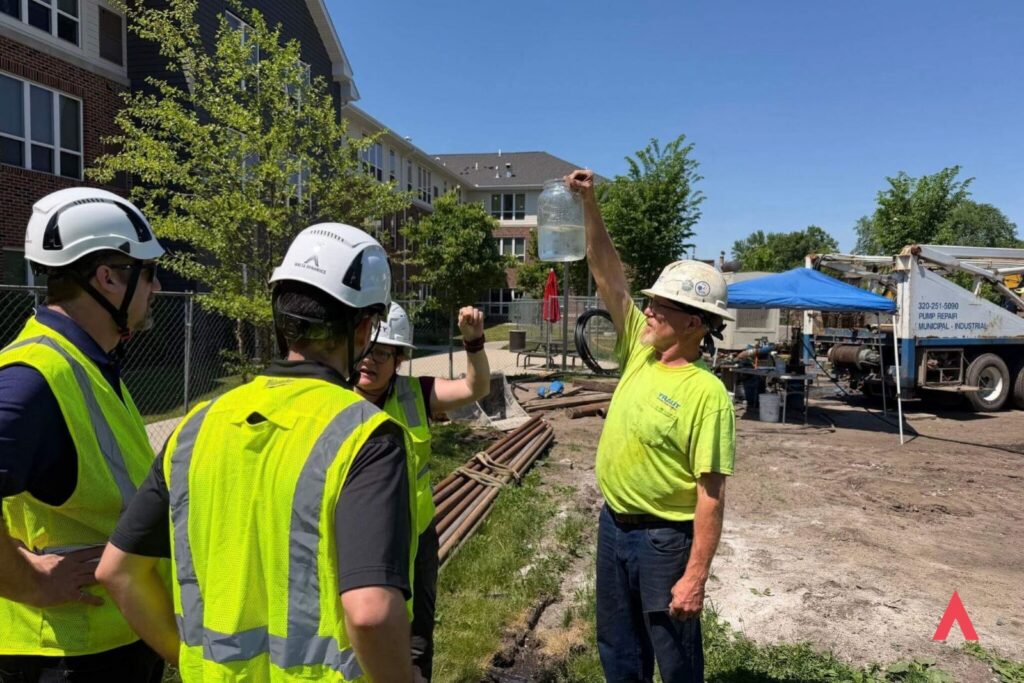
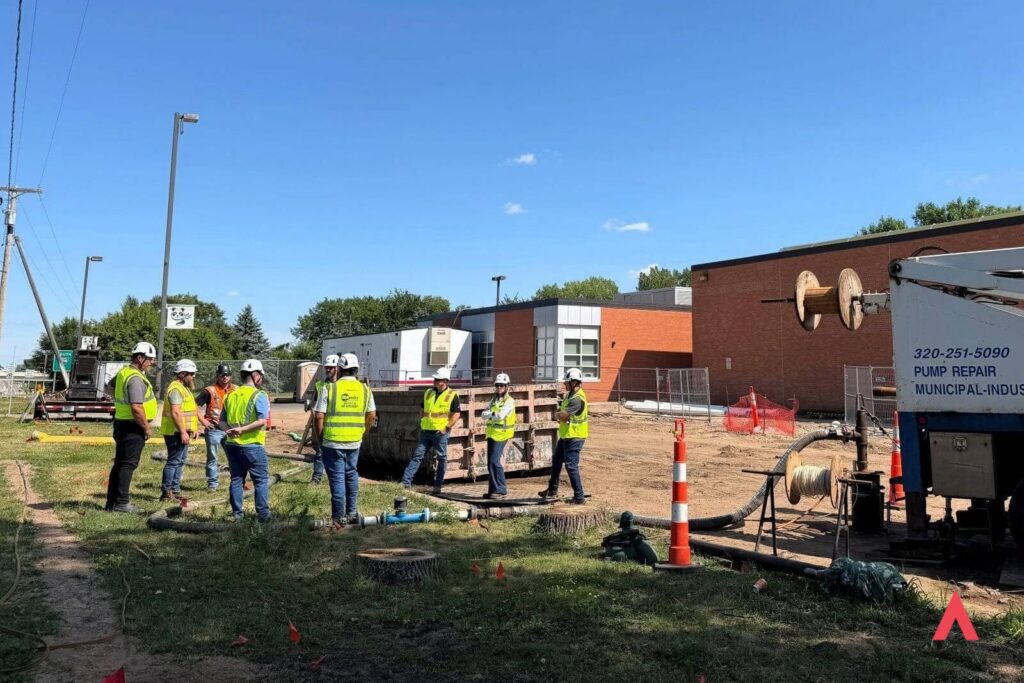
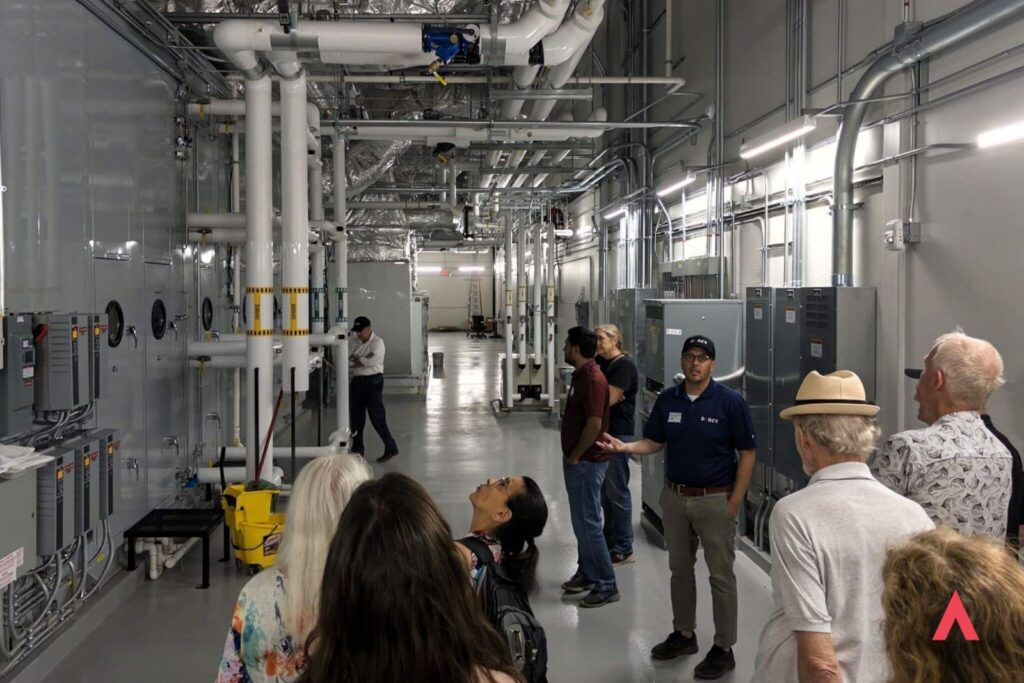
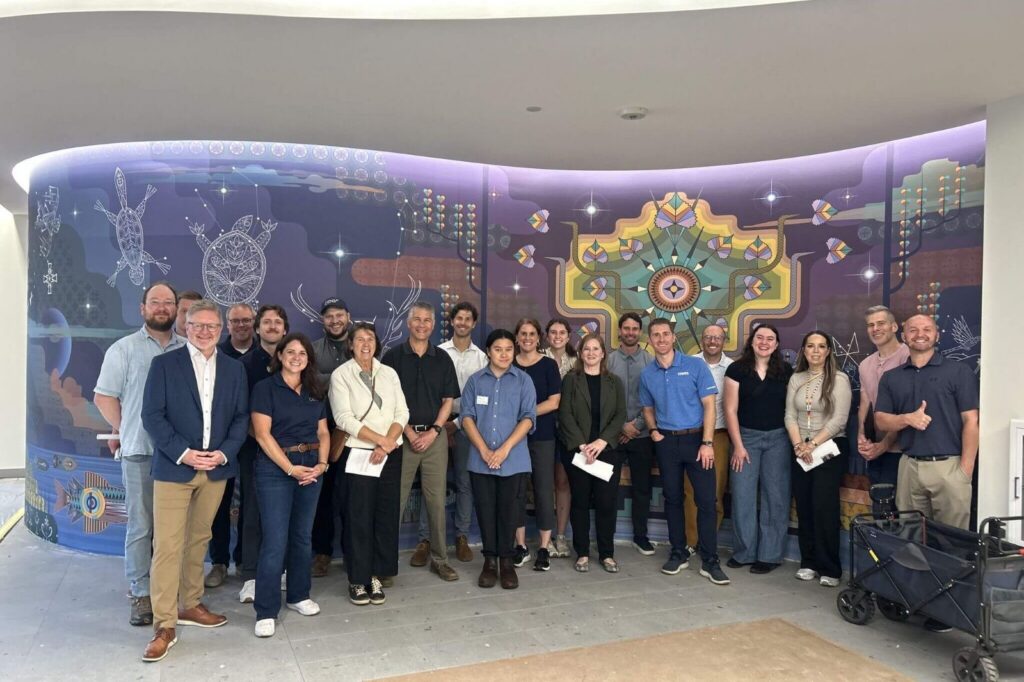
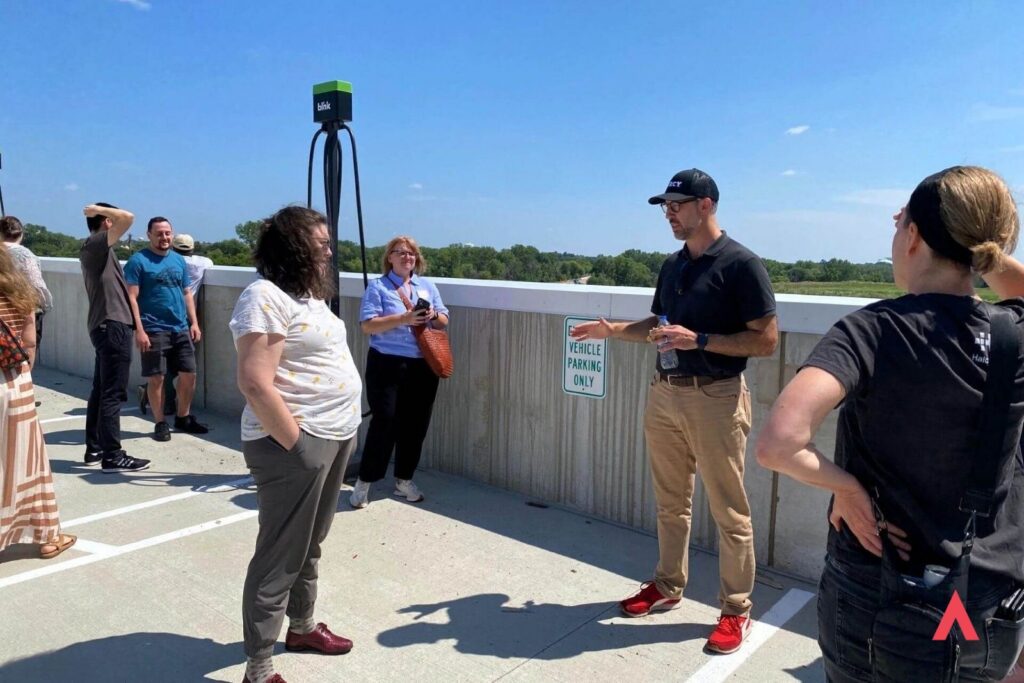
Throughout the summer, we were lucky to host customers, partners, nonprofits, and policy leaders on site visits across the Twin Cities. Our site visit program experience is designed to bring our geothermal technology to life, with visitors touring active construction, walking completed installations, and hearing directly from our team and operators.
These visits are designed to be simple, impactful, and tailored to your interests. We want you to leave with real answers, real context, and a clearer picture of what Darcy can do for your projects.
Interested in scheduling a site visit? Email marketing@darcysolutions.com for more info.
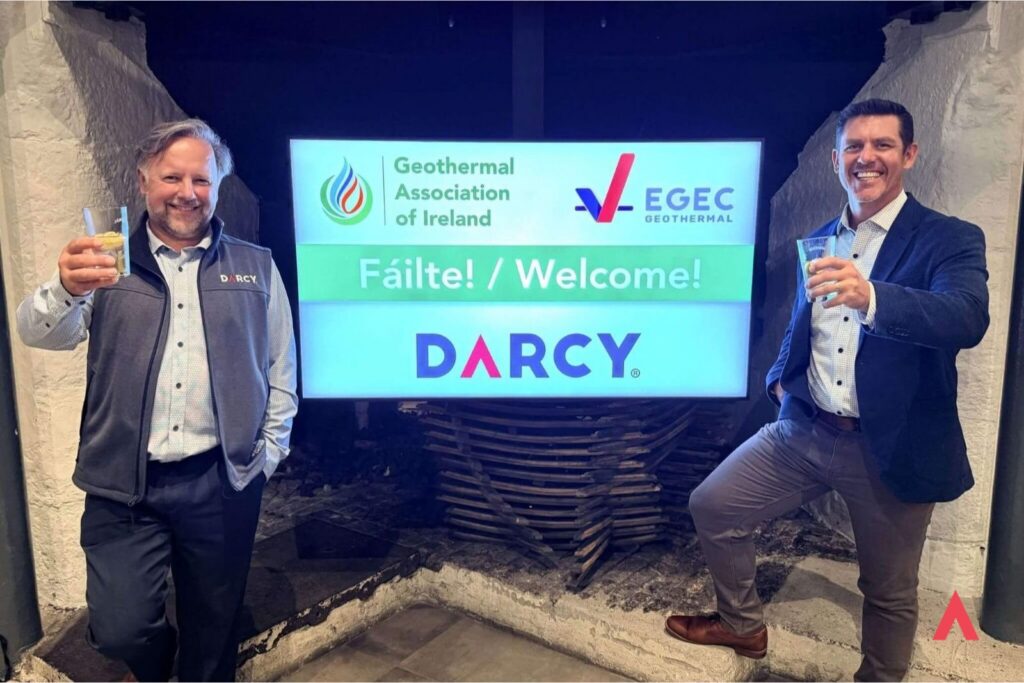
Throughout Q3, Darcy continued our event momentum across the summer by participating in industry education and collaboration through international conferences and speaking opportunities. This allows us to remain committed to our company mission of providing industry education on how geothermal can be implemented everywhere, including outside of the United States.
Our team participated in several major industry gatherings, including:
In addition to conferences and trade shows, Darcy representatives continued supporting educational opportunities with universities, regional organizations, and industry partners across the globe.
Want to learn more about what Darcy has been up to? Check out some of our recent coverage from this quarter to get the latest scoop on Darcy projects, innovation, and more.
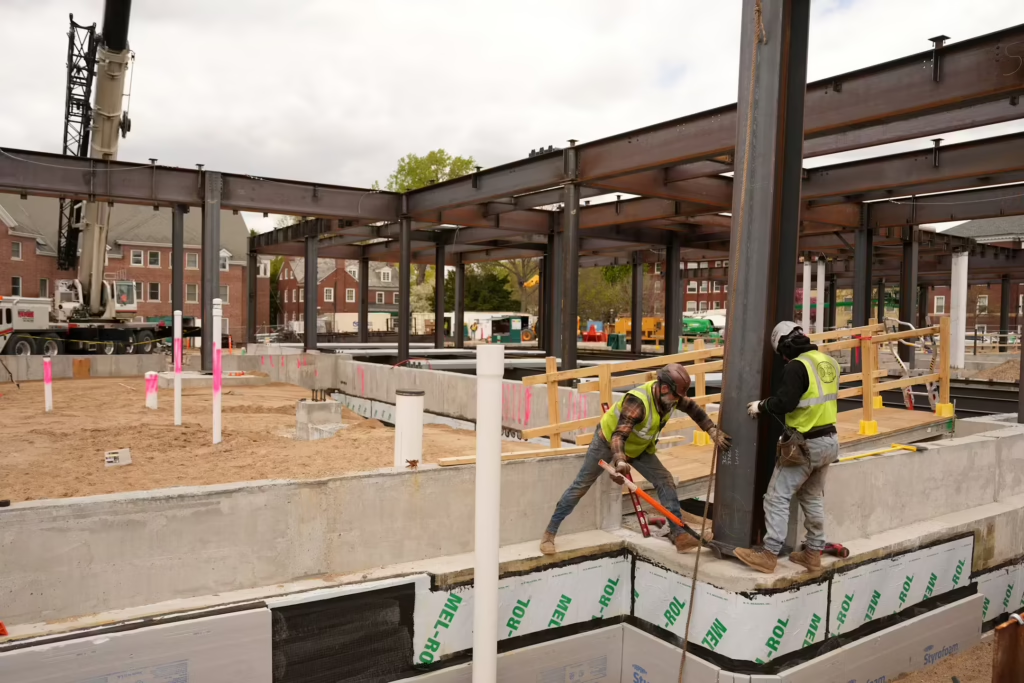
Macalester College and its new residence hall project were recently featured in the Star Tribune for advancing this important work, and Darcy is proud to provide the geothermal heating and cooling technology helping bring the initiative to life. Developed from research at the University of Minnesota, the Darcy system delivers high-efficiency heating and cooling for dense urban environments while requiring a significantly smaller footprint than traditional geothermal systems.

The Darcy website was recognized with a 2026 American Digital Design Award, presented by GDUSA Magazine. The competition honors exceptional achievement in digital communications across websites, apps, social media, motion graphics, digital advertising, publications, and more. Out of nearly 3,000 entries, the Darcy website was selected as one of this year’s winners.
Learn more about the award and see other winners here →
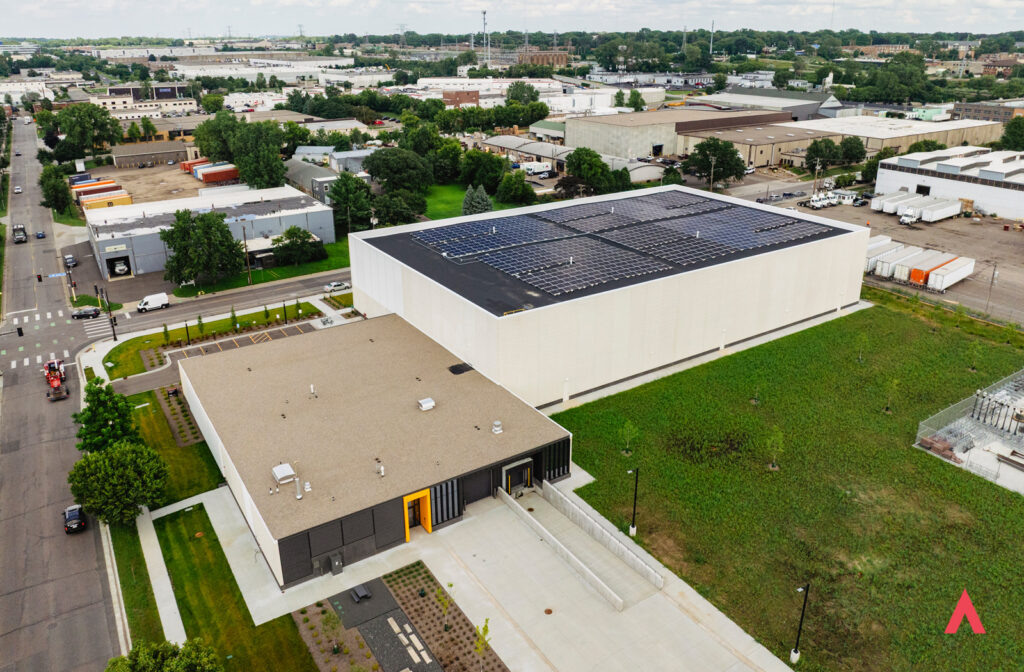
The University of Minnesota’s Offsite Collections Facility (OCF) serves as the first project for the university that originated Darcy’s hydrogeology research. Learn how Darcy grew out of the University’s Technology Commercialization office, and how public research fuels enterprises that will help decarbonize the planet.
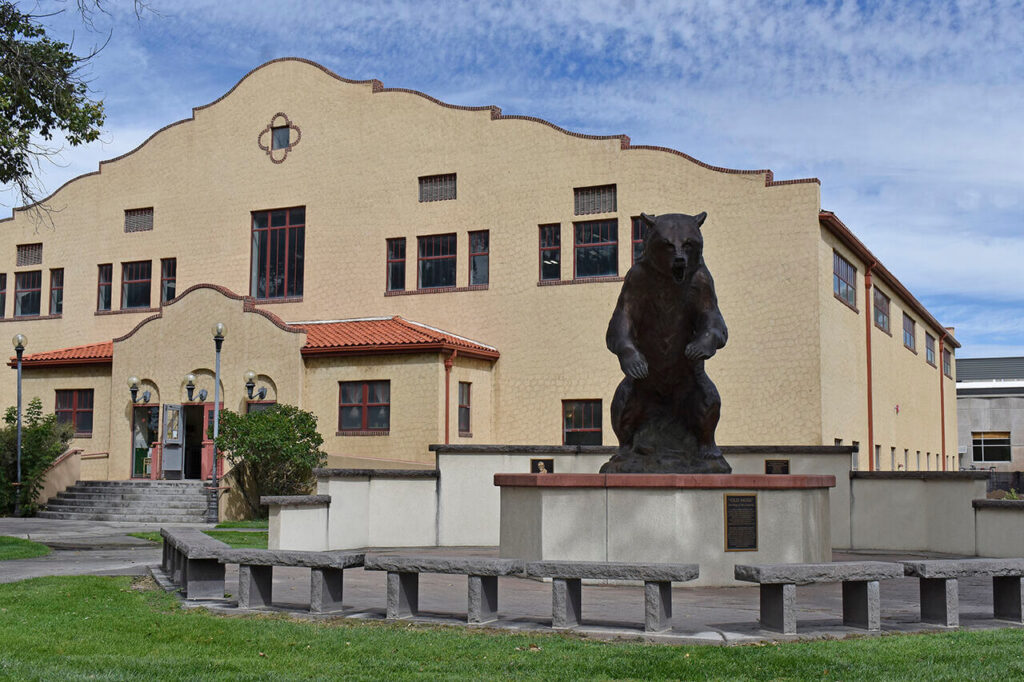
Adams State University is planning Colorado’s first Darcy geothermal system with McKinstry, Darcy, and Engineered Products. The project will bring efficient heating and cooling to campus while using about 10,000 square feet, compared to the nearly two acres (87,000+ square feet) needed for a conventional system. The investment will support students today, create opportunities for future campus growth, and help advance sustainability goals across the region.
As we head into the final months of 2026, Darcy continues to remain committed to the efforts of decarbonizing the environment by bringing geothermal everywhere. Stay up to date with Darcy on LinkedIn to see our latest projects, events, and industry insights.
Before a geothermal system is designed, timelines are laid out, or wells are drilled, every Darcy project typically begins with the same foundational question: Does this location have the geology to support geothermal? It is the most important question in the entire process, and the answer hinges completely on what is underground.
That might seem like a simple thing to check, but the reality is much more nuanced. Geothermal viability has very little to do with where in the country a building sits, and almost everything to do with the specific subsurface conditions beneath it. Two buildings two miles apart can have dramatically different geothermal potential based on differences in rock formations, aquifer conditions, and groundwater characteristics. A site in a northern climate with excellent aquifer access may be a far stronger geothermal candidate than a site in a warmer region with shallow bedrock and no viable groundwater.
In this piece, we’ll take an in-depth look at the geological factors that shape geothermal viability for commercial buildings, covering what aquifers are, how they form, what makes one productive for thermal exchange, and how Darcy’s geology team evaluates a site before any engineering or construction decisions are made. Let’s dig in.
In the broader energy world, the term “geothermal” often brings to mind images of Iceland or Yellowstone, where superheated steam is venting from volcanic rock or where turbines are spinning from naturally occurring high-temperature resources. That type of geothermal, sometimes called hydrothermal or deep geothermal, is geographically constrained. It requires proximity to active volcanic or tectonic features that simply don’t exist across most of the continental United States.
Commercial geothermal for heating and cooling is a different technology with a much broader geographic reach. Ground-source heat pump systems exchange thermal energy with the shallow subsurface, which maintains a stable temperature of roughly 45–65°F across most of the continental U.S. year-round regardless of surface climate. The earth’s thermal mass is the resource, not its heat. That resource is available nearly everywhere.
What varies by location is not whether that resource exists, but how efficiently and at what scale it can be accessed. That’s where geology comes in.
An aquifer is an underground layer of permeable rock, sediment, or soil that holds groundwater in the spaces between particles or within fractures and that allows that water to move. The U.S. Geological Survey (USGS) has identified 62 named principal aquifer systems across the conterminous United States, covering a substantial portion of the country. Hundreds of smaller, local aquifer systems exist beyond those mapped at the national scale.
For geothermal heating and cooling, aquifers matter because groundwater is a dramatically more effective thermal exchange medium than solid soil or rock. Water conducts and carries heat roughly 25 times more effectively than dry soil. A well drilled into a productive aquifer can access this moving water, run it through a heat exchanger to transfer thermal energy to or from a building, and reinject the water back into the aquifer, returning it to the ground essentially unchanged except for a small temperature differential that equilibrates quickly.
This is the mechanism behind Darcy’s groundwater-based geothermal approach. When a productive aquifer exists beneath a site, accessing it unlocks a level of thermal capacity per well that closed-loop borehole systems simply cannot match. A productive aquifer well can deliver 50 to 200-plus tons of heating and cooling capacity from a single Darcy well. The equivalent closed-loop borehole field for that same load might require 100 or more individual boreholes spread across a large surface footprint.
Not every site has an accessible aquifer. Some locations sit atop low-permeability bedrock with little or no viable groundwater. Others have aquifers too deep, too saline, or too low in yield to support a commercial geothermal system. That is precisely why geology is the starting point for every Darcy project.
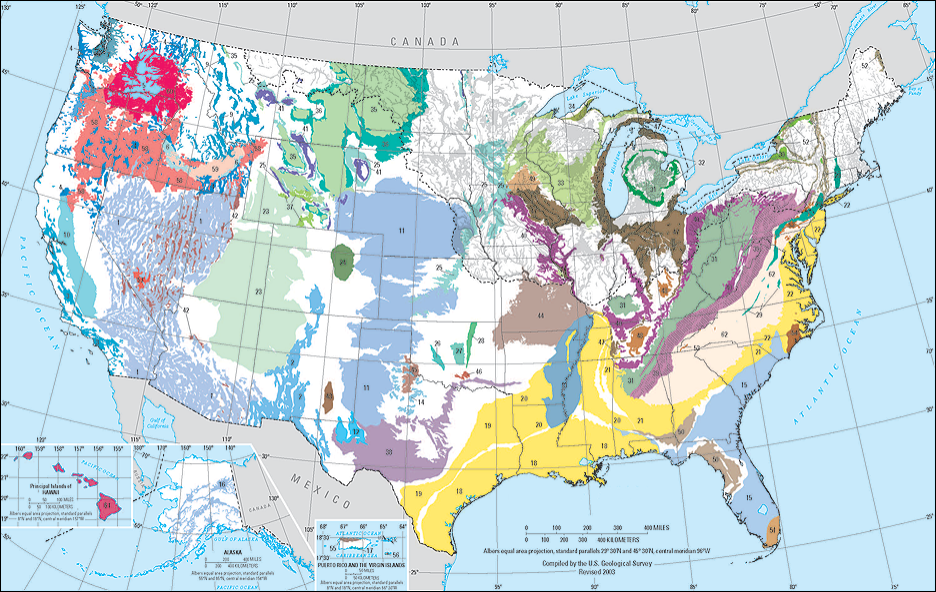
Aquifers come in a range of types, each with distinct characteristics that affect how suitable they are for geothermal thermal exchange. The USGS classifies principal aquifers into six lithologic categories based on the type of material that stores and transmits groundwater. Here are the types most relevant to commercial geothermal applications.
These are among the most productive and geothermal-friendly aquifer types in the United States. Sand and gravel aquifers form in river valleys, glacial outwash plains, and coastal plains where water-deposited sediments have created thick, highly permeable layers. The Midwest, upper Great Plains, and portions of the Northeast overlie extensive sand and gravel aquifer systems deposited by glacial activity during the last ice age. The high permeability of these materials means that wells drilled into them can yield large volumes of groundwater at relatively shallow depths, making them excellent candidates for the pump-and-reinject geothermal configurations Darcy engineers.
Limestone and dolomite aquifers, sometimes called karst aquifers, are characterized by secondary porosity created by the dissolution of calcium carbonate over geologic time. Water moving through these rocks gradually enlarges fractures and bedding planes into conduits that can transmit groundwater rapidly and in large volumes. The Floridan Aquifer System (covering most of Florida and parts of Georgia, South Carolina, and Alabama) and the Edwards Aquifer in Texas are among the most productive carbonate aquifers in the country. Karst aquifers can support high-yield geothermal wells, though their heterogeneity can make predicting well yield more challenging than in homogeneous sand and gravel systems.
Consolidated sandstone aquifers underlie large portions of the Midwest, the Great Plains, and the Appalachian region. Their permeability is generally lower than unconsolidated sand and gravel systems, but many sandstone units are thick, laterally extensive, and capable of supporting moderate groundwater yields at depth. The Mount Simon Sandstone beneath the upper Midwest is one example of a deep, regional sandstone unit that serves as a groundwater source across multiple states. Geothermal viability in sandstone aquifers depends heavily on local yield and water quality.
In regions where crystalline bedrock (e.g., granite, gneiss, schist) is at or near the surface, groundwater occurs primarily within fractures rather than in pore spaces between grains. Fractured crystalline rock aquifers are common in New England, the upper Midwest, and the Rocky Mountain foothills. Yields from fractured bedrock wells are often lower and more variable than from sedimentary aquifers, which can constrain the geothermal capacity available from a single well. In these settings, closed-loop borehole systems are often the more practical choice, though favorable fracture zones can support groundwater-based approaches in some locations.
Across the Midwest and upper Midwest, repeated glaciation over the past two million years deposited thick sequences of sand and gravel outwash in river valleys and between till units. These buried valley aquifers are often highly productive and exist in close proximity to the dense urban and suburban areas where commercial geothermal demand is strongest. Minnesota, Wisconsin, Illinois, Indiana, Ohio, and much of the Great Lakes region sit atop geologies that are particularly well-suited for groundwater-based geothermal systems.
Not all aquifers are equally useful for geothermal applications. Even within a region with good groundwater resources, individual sites can vary significantly. Darcy’s geology team evaluates several key characteristics when assessing a site, detailed below.
Hydraulic conductivity is a measure of how easily water flows through the aquifer material. High hydraulic conductivity means the aquifer can supply water to a well quickly and in large volumes. Well yield, typically measured in gallons per minute (gpm), is the practical expression of this in a drilling context. For a commercial geothermal system, well yield is directly tied to thermal capacity. A well yielding 300 gpm in favorable temperature conditions can support a very large geothermal system. A well yielding 20 gpm is better suited to a smaller application or a closed-loop approach.
Thicker aquifer units generally support higher yields and provide more thermal exchange volume. Depth matters for both practical and regulatory reasons. Shallower aquifers are less expensive to drill and may fall under simpler permitting regimes, while deeper aquifers may require more complex well construction but offer access to groundwater that hasn’t been influenced by surface conditions. For most commercial geothermal applications, Darcy targets aquifer systems accessible within a few hundred feet of the surface, though the optimal depth range varies by geology and system design.
A confined aquifer is one bounded above by a low-permeability layer (a confining unit or aquitard) that restricts the upward movement of water. Pressure in a confined aquifer often exceeds atmospheric pressure, meaning water in a well may rise above the top of the aquifer and sometimes to or above the ground surface (artesian conditions). Confined aquifers are often well-protected from surface contamination and tend to maintain more stable temperatures. Unconfined aquifers, also called water table aquifers, have a free water surface at atmospheric pressure and are more susceptible to surface influences. Both types can support geothermal systems, but confined aquifers often present advantages for water quality and thermal stability.
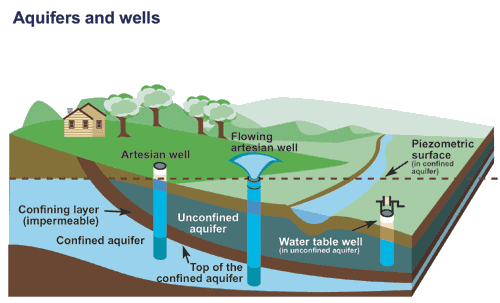
Groundwater temperature in most U.S. aquifers closely tracks the mean annual air temperature of the region, typically ranging from 45–65°F across the continental United States, annually varying only by a few degrees at any given location. This natural temperature stability is one of the fundamental assets of groundwater-based geothermal systems. Warmer groundwater temperatures favor cooling-season performance, while cooler temperatures favor heating performance. In practice, the moderate, stable temperatures found in aquifers across most of the U.S. are well-suited to year-round commercial HVAC applications.
The chemical composition of groundwater affects equipment selection, heat exchanger design, and long-term system maintenance. Water with high iron content, elevated hardness, or high total dissolved solids can cause scaling or corrosion in heat exchangers and piping if not properly accounted for in the design. Darcy’s assessment process includes groundwater chemistry analysis for sites where chemistry data is not already available from existing well records. Understanding the chemistry early in the project is essential for specifying the right equipment and avoiding maintenance issues that would not otherwise be anticipated.
Darcy’s site assessment process is built around the reality that no two sites are the same. The goal at each stage is to reduce uncertainty about subsurface conditions before committing significant resources to the next phase of work.
The first step for any potential project is a desktop geologic evaluation conducted by one of Darcy’s Professional Geologists. Using published geologic maps, well log databases maintained by state geological surveys and the USGS, existing groundwater study reports, and Darcy’s own database of well and project data accumulated over years of work across the country, the geology team builds an initial picture of the subsurface at a given location. This includes identifying the likely aquifer units present, estimating their depth and thickness, reviewing groundwater yield data from nearby wells, and assessing groundwater chemistry based on available records.
The output is a clear professional recommendation. Either the site is a strong candidate for a groundwater-based system, it warrants further investigation, or the geology suggests a closed-loop approach would be more appropriate. This assessment is provided at no cost as the first step in Darcy’s project engagement process. For most sites, Darcy can deliver an initial geological picture within a week or two of receiving the address or site coordinates.
One of the advantages of working with a dedicated geology team rather than a generalist engineering firm is deep familiarity with the groundwater data resources that inform these assessments. State geological surveys across the country maintain well log databases, aquifer characterization studies, and groundwater monitoring datasets that provide a rich subsurface picture for most populated areas of the United States. The USGS National Water Information System (NWIS) provides access to water level, water quality, and streamflow data from tens of thousands of monitoring wells nationwide. The USGS Ground Water Atlas of the United States remains the foundational national reference for aquifer extent and characteristics.
For sites in areas where Darcy has previously completed projects or assessments, proprietary well data from those projects further refines the subsurface picture. This accumulated dataset is one of the operational assets that distinguishes Darcy’s geological assessment from what a typical HVAC or mechanical contractor can offer.
When the desktop evaluation identifies a site as a viable candidate and the project team is ready to proceed, on-site investigation confirms and quantifies the aquifer’s characteristics. For groundwater-based systems, this typically involves drilling and testing a design well, where a borehole is drilled to the target aquifer zone, logged for subsurface conditions, and pump-tested to measure yield, drawdown, stratigraphy, geophysical data, and requirements for construction. Water samples collected during testing characterize the groundwater chemistry, while temperature profiling confirms the thermal resource characteristics at depth.
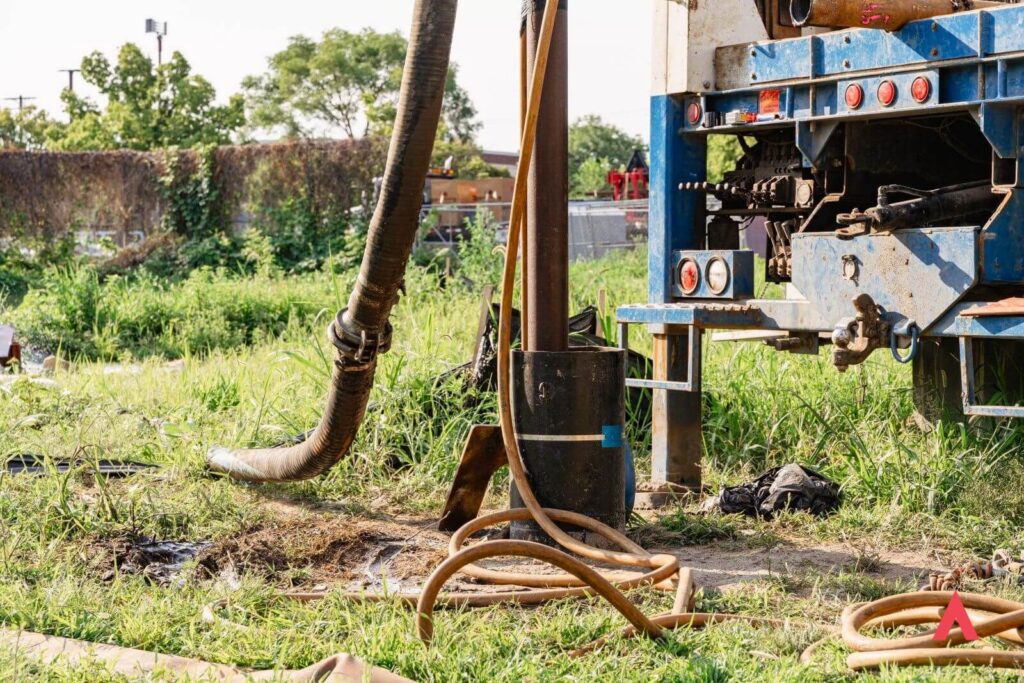
The design well program produces the data Darcy needs to finalize system design with confidence, specifying well count, depth, spacing, pump capacity, and heat exchanger configuration based on measured site conditions rather than regional averages. It also provides the documentation required for well construction permits and any required groundwater appropriation or injection approvals.
While every site requires individual assessment, regional geology provides a useful starting frame. Several broad geologic settings across the United States are particularly well-suited for groundwater-based commercial geothermal:
Absence from this list does not mean absence of geothermal potential. Many areas underlain by fractured bedrock, moderate-yield sandstone, or localized sand and gravel deposits can support closed-loop geothermal systems with excellent performance. The geology informs the system design; it rarely eliminates the possibility of geothermal entirely.
The single most valuable thing a project team can do early in the evaluation of geothermal for a given site is to get a professional geological opinion on what’s underneath the site. That opinion doesn’t require a drilling program or a significant capital commitment. It requires the site address and a geologist who knows how to read the regional subsurface picture.
Darcy’s site assessment is that starting point. It’s free, it’s conducted by a licensed Professional Geologist, and it typically delivers an initial recommendation within one to two weeks. For projects that advance, the desktop assessment becomes the foundation for every subsequent phase of the work, from design well to final system engineering.
If you’re evaluating geothermal for a building or campus and haven’t yet looked at the geology, that’s the right place to start.
→ Request Your Free Site Assessment
When evaluating the viability of commercial geothermal for your site, understanding which type of system will work best is key to shaping the entire project, from well count and project footprint to upfront cost and long-term performance.
The two primary configurations in commercial geothermal are closed-loop systems, which circulate fluid through sealed underground pipe loops, and groundwater-based (open-loop) systems, which draw directly from an aquifer to perform the thermal exchange. Both use the earth as a stable thermal resource to deliver efficient, reliable heating and cooling, but they work in fundamentally different ways, perform differently across site conditions, and have meaningfully different implications for project economics and site feasibility.
This piece explains both approaches in plain terms, covers where each one is most applicable, and describes what becomes possible when the right hydrogeological conditions allow for a groundwater-based approach.
Closed-loop geothermal systems circulate a heat transfer fluid, typically a water and antifreeze mixture, through a continuous sealed loop of pipe installed underground. The fluid absorbs heat from the surrounding ground in winter and deposits heat back into the ground in summer, then returns to the building’s heat pumps to complete the exchange. Because the loop is sealed, the fluid never contacts groundwater or soil directly.
In commercial applications, the most common closed-loop configuration is a vertical borehole field. Boreholes are drilled to depths typically ranging from 150 to 500 feet, and a U-shaped pipe is inserted and grouted in place. Multiple boreholes are connected in parallel to create the field that serves the building’s load. Horizontal configurations, where pipe is buried in shallow trenches, are used in some lower-density applications with sufficient land area.
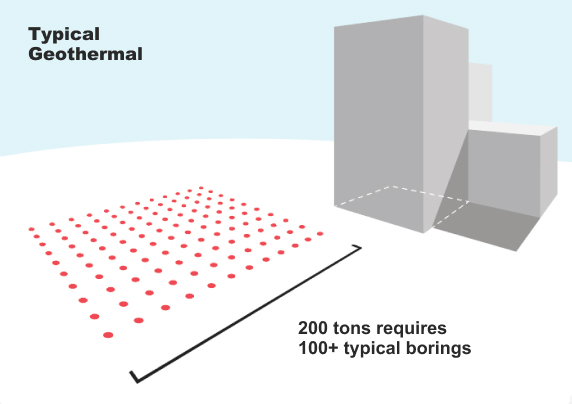
Heat transfer in a closed-loop borehole occurs by conduction through the grout, the borehole wall, and the surrounding soil or rock. The rate of that transfer depends on the thermal conductivity of the subsurface material, the temperature difference between the fluid and the ground, and the surface area of the pipe. Denser, more conductive materials like saturated soil or certain rock types transfer heat more efficiently than dry sand or low-conductivity fill.
The critical design constraint is that the thermal exchange capacity of any single borehole is limited by the thermal conductivity of the surrounding material and the borehole geometry. Delivering large heating and cooling loads requires a proportionally large borehole field, which means significant drilling volume, land area, and upfront cost for major commercial projects.
Closed-loop systems are highly versatile. They can be installed in a wide range of geological conditions, including sites with no accessible groundwater, low-permeability formations, or regulatory environments where groundwater use is restricted. They require no water well permitting in most jurisdictions, and their performance is well-characterized across decades of commercial installations. For smaller commercial projects, constrained budgets, or sites where groundwater is not accessible, a closed-loop system is often the right choice.
Groundwater-based geothermal systems perform the thermal exchange using water from an aquifer at a targeted point in the subsurface, rather than the entirety of piping from the field. Where a closed-loop borehole transfers heat by conduction through pipe and soil, a groundwater system transfers thermal energy by advection through the moving water itself. That distinction is the source of groundwater’s fundamental performance advantage.
In a standard open-loop configuration, groundwater is pumped from a production well, passed through a heat exchanger where thermal energy is transferred to or from the building’s loop, and then returned to the aquifer through a separate injection well.
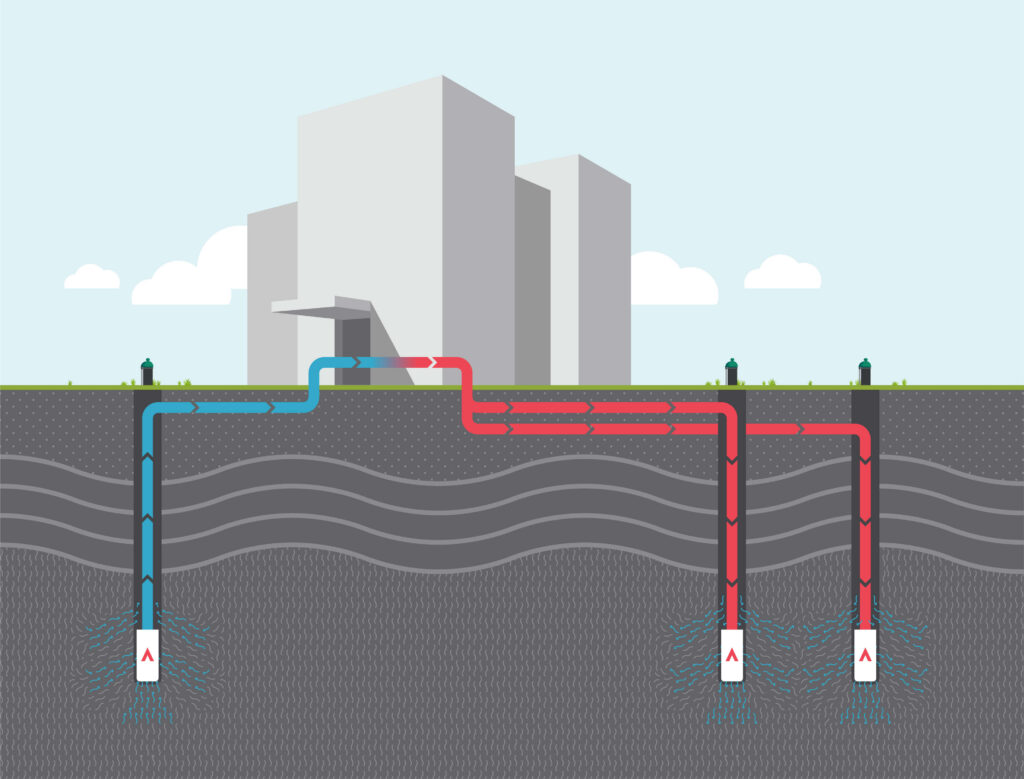
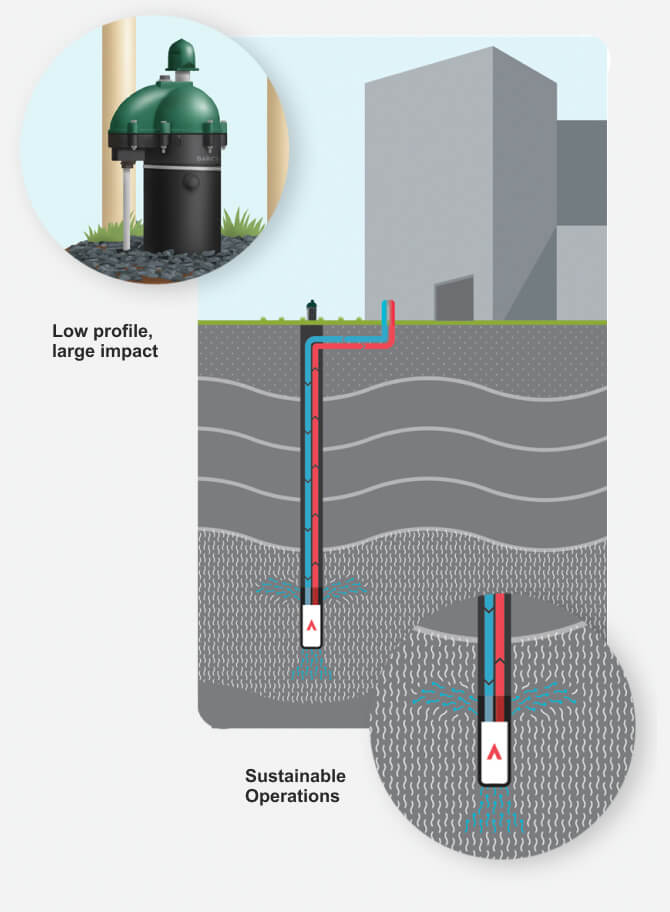
In more advanced configurations, including Darcy’s Dipole well technology (shown below), both production and injection occur within the same engineered well system, creating a directed flow of groundwater through the heat exchanger with exceptional thermal efficiency and minimal surface footprint.
Groundwater is a far more thermally conductive medium than soil or rock. Water conducts heat roughly 25 times more effectively than dry soil and several times more effectively than most saturated formations. A cubic meter of groundwater moving through a heat exchanger transfers thermal energy orders of magnitude faster than a cubic meter of static soil surrounding a borehole pipe.
The result is a step-change in thermal capacity per well. Where a conventional borehole might deliver 1 to 3 tons of cooling capacity, a groundwater-based well in a productive aquifer can deliver 50, 100, or 200-plus tons from a single well location. This capacity concentration is what makes groundwater-based geothermal viable for large commercial loads, and what enables it to serve those loads from a footprint that a closed-loop borehole field simply could not match.
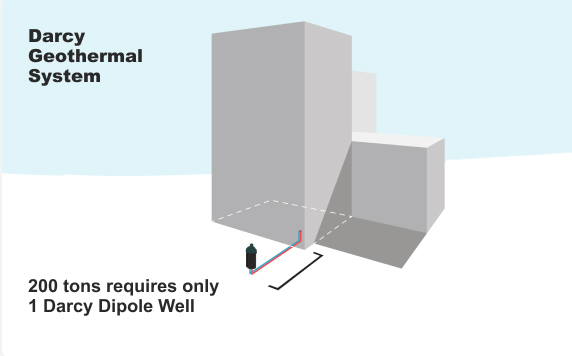
Darcy’s patented Dipole well technology takes groundwater-based geothermal a step further by engineering the subsurface flow field directly, rather than relying on natural aquifer flow patterns. The Dipole creates a controlled thermal exchange zone within the aquifer by establishing a directed pressure differential between two points in the same well system. This produces a concentrated, high-velocity flow of groundwater through a proprietary down-well heat exchanger, maximizing the thermal exchange rate while keeping the surface footprint to a single well location.
The performance result is significant. A Darcy Dipole well can deliver more than 200 tons of cooling capacity from a single well, with no glycol in the closed loop, greater control over produced fluid temperatures than conventional configurations, and the ability to support imbalanced heating and cooling loads that would cause thermal drift problems in standard borehole fields. For large commercial projects on constrained sites, this combination of high capacity and minimal footprint opens project opportunities that other geothermal approaches cannot reach.
The table below summarizes the key differences between closed-loop and groundwater-based systems across the factors that matter most to commercial project teams.
| Factor | Closed-loop | Groundwater-based |
| Thermal capacity per well | 1 to 3 tons per borehole, depending on subsurface thermal conductivity. | 50 to 200-plus tons per well, depending on aquifer productivity and system design. |
| Site footprint | Requires significant land area for the borehole field at large commercial scales. A 500-ton project may require 200 or more boreholes spread across a substantial footprint. | Compact well field with a fraction of the surface area. A comparable load may be served by a handful of wells within a parking lot or utility corridor. |
| Geological requirements | Workable in a wide range of geological conditions; performance varies with subsurface thermal conductivity. | Requires a productive aquifer at accessible depth. A hydrogeological assessment is essential to confirm feasibility before project development. |
| Permitting and regulatory | Generally does not require water well permitting. Environmental review requirements vary by jurisdiction. | Requires water well permits and may require groundwater appropriation or injection permits depending on state and local regulations. Darcy manages all permitting as part of the project process. |
| Upfront project cost | Lower cost per borehole, but the large number of boreholes required for major commercial loads drives total cost up significantly. | Higher engineering complexity per well, but dramatically fewer wells required, which typically results in lower total project cost at large commercial scales. |
| Long-term performance | Susceptible to thermal drift in borehole fields with heavily imbalanced heating and cooling loads over time. | The aquifer provides a continuously refreshed thermal resource. Darcy’s Dipole configuration is specifically designed to handle imbalanced loads without the thermal accumulation issues that affect closed-loop fields. |
The most important factor in choosing between closed-loop and groundwater-based geothermal is geology. If a site has a productive, accessible aquifer and the regulatory environment supports groundwater use for thermal exchange, a groundwater-based system will almost always deliver superior performance, a smaller footprint, and better project economics at commercial scale. If the site lacks accessible groundwater, a closed-loop system is typically the right approach.
A few other factors can also shape the decision:
The right starting point is a site assessment. Darcy’s geology team evaluates subsurface conditions, aquifer characteristics, and regulatory requirements to determine which system configuration is best suited to a specific location, before any engineering commitment or capital expenditure is made.
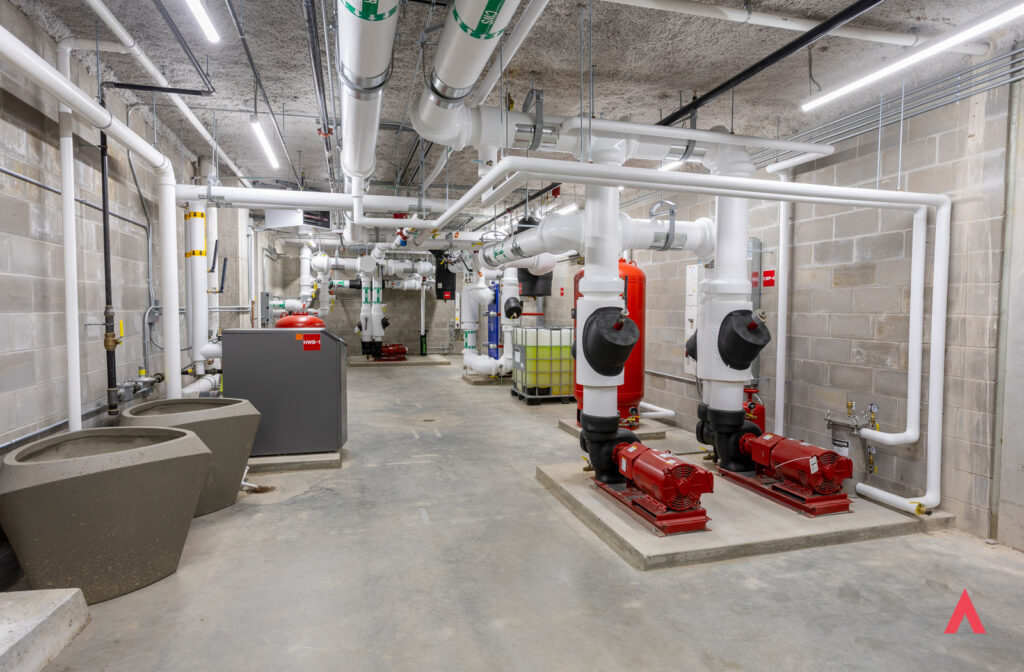
No. In a properly engineered open-loop or Dipole system, groundwater is extracted from the aquifer, passed through a heat exchanger where thermal energy is transferred, and fully reinjected into the same aquifer. The water is not consumed, and because Darcy’s Dipole system uses a closed-loop heat exchanger (i.e., the building fluid never contacts the groundwater directly), there is no risk of contaminating the aquifer with glycol or other heat transfer fluid additives. The water’s temperature changes slightly before reinjection and equilibrates with the surrounding aquifer quickly.
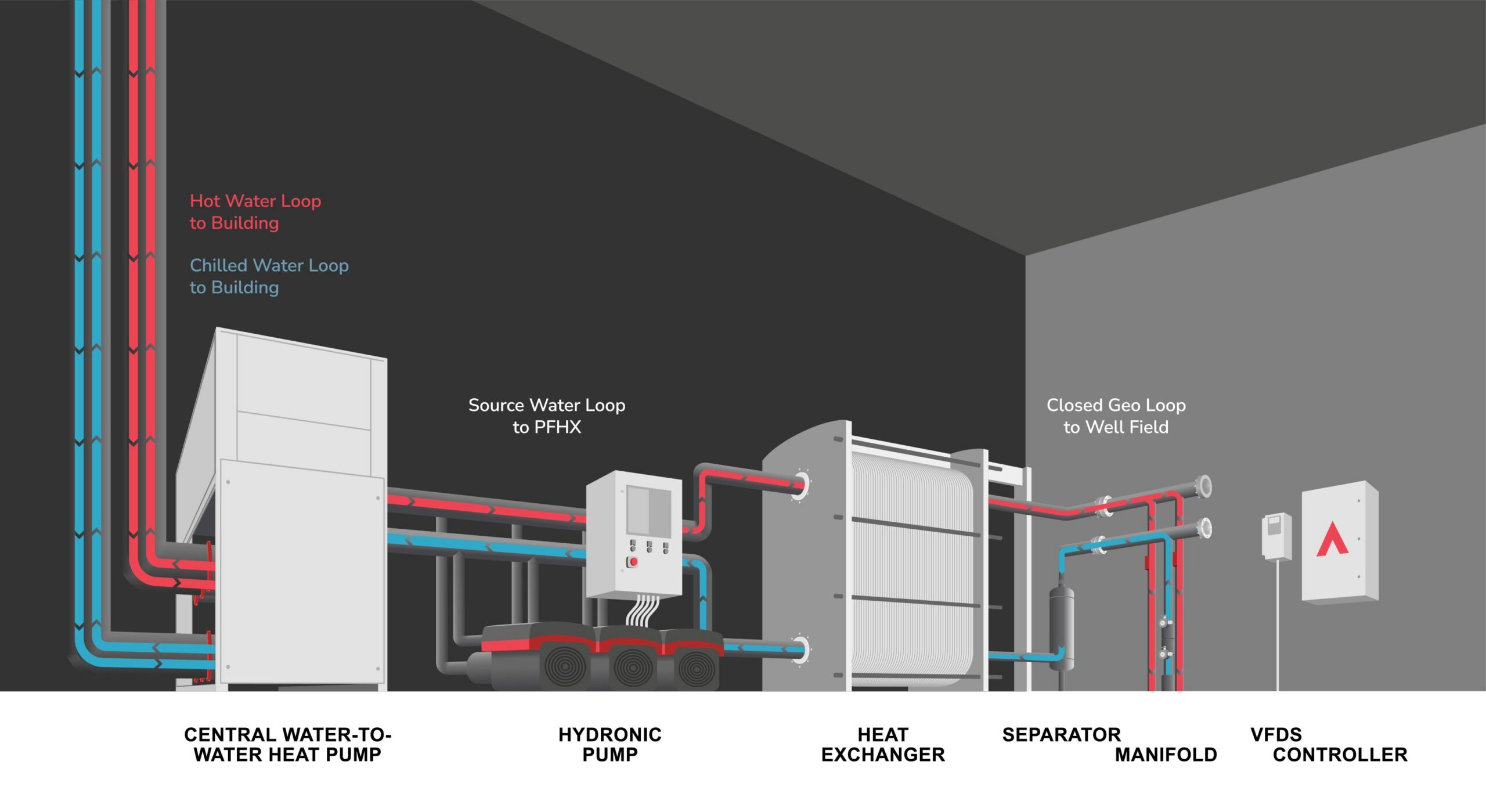
It depends on the building’s load requirements and the aquifer’s productivity at the site. Because groundwater-based wells can deliver dramatically more thermal capacity per well than closed-loop boreholes, large commercial loads that would require dozens or hundreds of boreholes in a closed-loop configuration can often be served by 1–2 groundwater wells. Darcy’s site assessment and on-site testing process is designed to characterize aquifer productivity and size the system accurately before construction begins.
Converting an existing closed-loop system to a groundwater-based approach is technically possible but involves significant engineering and construction work, including new well installation, revised mechanical room connections, and updated controls. In most cases, it’s more practical to design the right system from the outset than to plan for a conversion. Darcy’s site assessment process is specifically designed to identify the optimal system type early, before capital commitments are made.
A standing column well is a type of groundwater-influenced geothermal configuration in which a single open borehole is drilled to depth, and water is circulated within the borehole column, drawing on the surrounding groundwater through the borehole wall. Heat exchange occurs partly by conduction through the borehole wall and partly through groundwater bleed drawn into and bled out of the column. Standing column wells improve on standard closed-loop boreholes by accessing some groundwater thermal capacity, but they are dependent on passive groundwater infiltration rather than engineered directed flow. Darcy’s Dipole creates a controlled, directed flow of groundwater through a proprietary heat exchanger, producing significantly higher thermal capacity and more predictable performance than a standing column configuration.
Requirements vary by state and municipality but typically include water well construction permits and, depending on jurisdiction and system design, groundwater appropriation permits or injection well permits. Some states have developed specific permit pathways for geothermal heat pump wells that streamline the process. Darcy manages all permitting activities as part of the project process, including coordination with state agencies and local authorities having jurisdiction. The regulatory landscape is assessed during the initial site evaluation so that permitting timelines can be built into the project schedule from the start.
The best way to determine which geothermal configuration is right for a specific project is to evaluate the site’s geology and hydrogeology directly. Darcy’s site assessment is free, requires only an address or site coordinates, and delivers a clear recommendation from a Professional Geologist within one to two weeks. It’s the most efficient path to an informed system selection decision.
→ Request Your Free Site Assessment
Educational facilities occupy a unique position in the commercial geothermal market. School buildings are typically owned and operated by public entities with long planning horizons, substantial energy budgets, and real accountability to the communities they serve. University campuses face growing pressure from students, faculty, boards, and accreditation bodies to demonstrate meaningful progress on sustainability. And virtually every K-12 district and higher education institution in the country is looking for ways to reduce operating costs without compromising the quality of the learning environment.
Geothermal heating and cooling addresses all of these pressures simultaneously, and the characteristics that define most educational facilities make them among the strongest geothermal candidates in the commercial market. This piece covers why that is, what the financial case looks like, and what educational institutions should know before evaluating geothermal for their next capital project.
School buildings are designed to last, with most K-12 facilities built today being able to serve students for 40–60 years or more, and the mechanical systems installed during original construction or a major bond-funded renovation will define the building’s energy profile for decades.
Geothermal systems are engineered to match that horizon. Underground well infrastructure carries a service life of 50-plus years, and building-side heat pump equipment typically runs 20–25 years before replacement. When a school district or university evaluates HVAC over the full life of a building rather than just the upfront capital cost, geothermal’s long-term operating cost advantage is substantial.
Public school districts and state universities operate on multi-year budgets with defined capital planning cycles. Bond referendums, deferred maintenance programs, and state facility funding all follow predictable timelines.
Geothermal fits well into this environment because its financial case is durable, in that the energy savings, the reduced maintenance burden relative to conventional systems, and the incentive stack are all quantifiable well before a project goes to bond or procurement. For facilities directors and CFOs building a capital investment case, geothermal’s numbers hold up under the kind of scrutiny public projects require.

COLLEGES & UNIVERSITIES
One of the historic objections to geothermal for schools and universities is the assumption that it requires large amounts of open land for borehole fields. That constraint has been substantially reduced by groundwater-based system configurations.
Darcy’s groundwater approach can deliver substantially more heating and cooling capacity per well than a conventional closed-loop borehole, making geothermal viable on built-out school campuses, urban K-12 sites, and dense university districts where open land simply doesn’t exist. For campuses with suitable aquifer resources below them, the wellfield footprint can fit within a parking lot, courtyard, or utility corridor.
Educational buildings follow predictable occupancy schedules, with clear peaks during school hours and significant load reduction during nights, weekends, and summer months.
This predictability supports accurate system sizing, straightforward energy modeling, and well-managed operating schedules. It also means that geothermal’s efficiency advantage is realized consistently during occupied hours, when the system is running at the utilization rates where its performance is strongest.
With a coefficient of performance (COP) typically ranging from 4.0–8.0 or higher, geothermal systems deliver three to eight units of heating or cooling energy for every unit of electrical energy consumed. For a school district operating dozens of buildings or a university with millions of square feet of conditioned space, that efficiency margin translates into meaningful annual savings that compound over the life of the system. Eliminating natural gas from the HVAC equation also removes exposure to fuel price volatility, making long-term energy budgeting more predictable.
The federal Investment Tax Credit (ITC) for commercial geothermal, under Section 48/48E of the Internal Revenue Code, provides a base credit of 6% scalable up to 30% with prevailing wage and apprenticeship requirements met, plus additional bonuses for domestic content and energy community siting.
For public school districts, state universities, and other tax-exempt educational institutions, the Inflation Reduction Act’s direct pay provisions allow the ITC to be claimed as a direct cash payment from the U.S. Treasury, regardless of tax liability. This is a significant provision that makes the full economic value of the ITC accessible to public entities that previously had no mechanism to use tax credits.
The One Big Beautiful Bill Act (OBBBA), signed in July 2025, explicitly preserved the Section 48/48E ITC for geothermal heat pump systems. The current credit structure holds through 2032 before beginning to step down, giving school districts and universities evaluating geothermal for capital projects a defined window to capture the full credit value.

Beyond the ITC, educational institutions have access to several additional funding sources that can meaningfully improve geothermal project economics, including:
Stacking the federal ITC direct pay with state grants and bond financing can dramatically improve the net cost of a geothermal project, sometimes reducing the effective upfront cost by 40% or more before energy savings are even considered.
When school districts go to voters for facility bond referendums, the projects that succeed are those with a clear, defensible case for long-term value. Geothermal systems, with their 50-plus year underground infrastructure and well-documented energy cost savings, make a strong case for inclusion in capital programs. The operating savings over the bond repayment period can be modeled with confidence, and the sustainability narrative resonates with communities that expect their school districts to make responsible long-term investments.
Sustainability expectations in higher education have moved well beyond voluntary aspirations. Many universities have made formal pledges for carbon neutrality by 2030 or 2040, signed on to the American College and University Presidents’ Climate Commitment, or incorporated climate goals into their strategic plans. For K-12 districts, state-level sustainability requirements and community expectations are increasingly shaping facilities decisions.
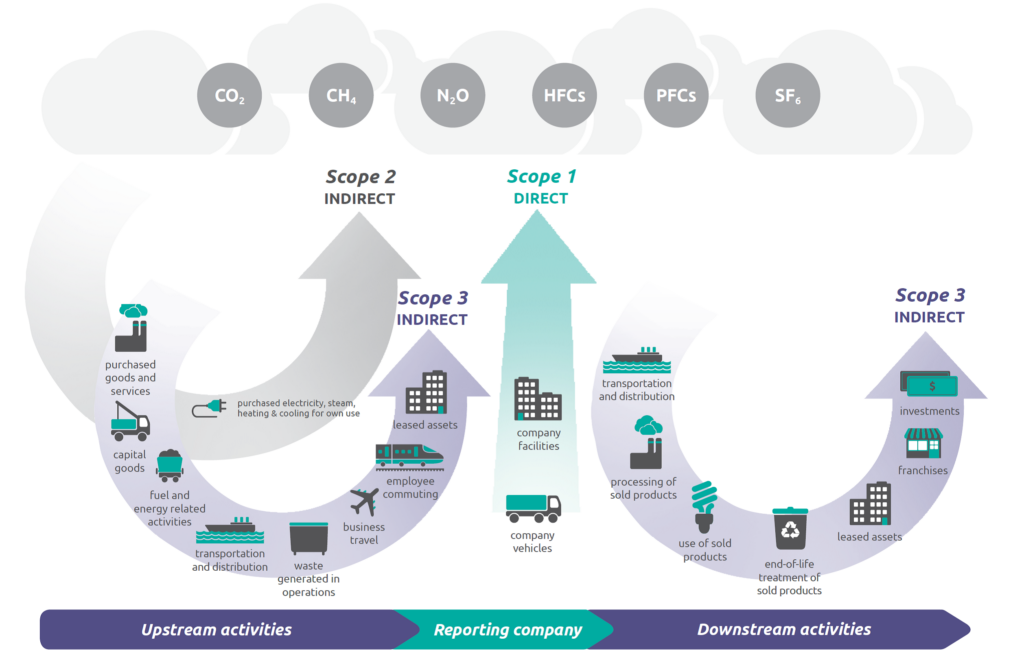
Buildings are where educational institutions have the most direct control over their emissions, and HVAC is the largest single lever within buildings. Geothermal directly addresses Scope 1 emissions by eliminating on-site combustion from the HVAC system, and contributes to Scope 2 reductions by cutting electrical demand for heating and cooling by 40 to 70% compared to conventional electric systems. For universities reporting under GHG Protocol frameworks or working toward LEED or ENERGY STAR certification, geothermal produces the kind of measurable, verifiable impact that sustainability reports and accreditation reviews require.
Educational institutions that invest in geothermal are also creating living examples of sustainable infrastructure that students can engage with directly. Engineering, environmental science, and sustainability programs benefit from having operating geothermal systems on campus as real-world learning assets.
For universities and larger K-12 campuses with multiple buildings, geothermal becomes even more compelling at the campus scale through thermal energy networks. Rather than installing independent systems in each building, a shared underground loop or aquifer resource can serve multiple facilities from common infrastructure.
Campus thermal energy networks offer several advantages beyond what building-level systems provide. Heating and cooling loads can be balanced across buildings, using surplus heat from one facility to serve another. Infrastructure and equipment costs are shared, reducing the per-building capital investment. And the network can grow incrementally as the campus adds buildings or phases out aging conventional HVAC equipment, rather than requiring a single large upfront commitment.
For university campuses in the middle of long-term decarbonization plans, a thermal energy network built around geothermal is one of the most durable infrastructure investments available. The underground wellfield, once installed, serves the campus for 50-plus years, across multiple generations of heat pump equipment and building renovations.

K-12 EDUCATIONAL FACILITY
Yes. The IRA’s direct pay provisions allow tax-exempt entities, including public K-12 school districts and state universities, to claim the Section 48/48E Investment Tax Credit as a direct cash payment from the U.S. Treasury rather than as a tax offset. The current credit structure, preserved under the OBBBA signed in July 2025, provides a base rate of 6% scalable up to 30% with prevailing wage and apprenticeship requirements, plus bonuses for domestic content and energy community siting. The full structure holds through 2032 before beginning to phase down.
Yes. Groundwater-based geothermal systems, like those Darcy engineers, can deliver significantly more heating and cooling capacity per well than conventional closed-loop borehole configurations. This compact footprint makes geothermal viable on built-out school campuses and urban sites where open land for a conventional borehole field simply doesn’t exist. A free site assessment is the best way to determine whether a specific location has the hydrogeological conditions that make groundwater-based geothermal practical.
Geothermal systems can be included in bond-funded capital programs like any other major mechanical infrastructure project. The financial case, including projected energy savings, federal ITC direct pay value, and reduced long-term maintenance costs, can be modeled and presented to voters as part of the referendum package. Many school districts find that geothermal’s long-term operating savings help offset the upfront capital cost in a way that strengthens the overall investment narrative for the community.
Well drilling and exterior piping installation can generally proceed without requiring a school to be unoccupied, particularly when construction is phased during summers or school breaks. Darcy’s project team develops construction phasing plans that minimize disruption to school operations, coordinating site work around the academic calendar where possible. The mechanical room tie-in is typically the most schedule-sensitive phase and is planned to align with scheduled HVAC maintenance windows or summer shutdowns.
Yes, and it is one of the most effective tools available for doing so. Geothermal eliminates Scope 1 HVAC emissions by removing on-site combustion from the heating system entirely, and reduces Scope 2 emissions by cutting HVAC electrical consumption by 40 to 70% compared to conventional electric alternatives. For universities working toward carbon neutrality targets, geothermal provides deep, structural reductions in building energy use that are measurable, verifiable, and durable over the long term.
A campus thermal energy network connects multiple buildings to shared geothermal infrastructure, typically a common wellfield or aquifer resource, through an underground distribution loop. Individual buildings connect to the loop and use local heat pump equipment to condition their spaces. The network allows thermal loads to be balanced across buildings, creates economies of scale in infrastructure costs, and can expand incrementally as the campus grows or phases out legacy HVAC systems. Darcy has experience designing both building-level geothermal systems and multi-building campus network configurations.
Educational institutions evaluating geothermal for an upcoming capital project have a well-defined window to act while the full federal ITC is in place. The first step is understanding what a specific site can support.
Darcy’s site assessment is free, requires only a site address or coordinates, and delivers an initial geological picture of your project’s potential within one to two weeks. It’s the most efficient path from initial curiosity to a clear, informed evaluation.
→ Request Your Free Site Assessment
For facility managers, project managers, and building owners evaluating geothermal for the first time, common questions at the outset typically center around what the process looks like, how long each stage takes, and how much disruption they should prepare for within their day-to-day operations.
The honest answer is that every project is site-specific. Geology, building type, system size, and site constraints all combine to help shape the timeline, but the overall sequence of most commercial geothermal projects follows a clear, well-defined path. Understanding that path is one of the most useful things a project team can do before engaging with a geothermal contractor.
In this piece, we will walk through Darcy’s six-step project process, from initial site evaluation and testing through long-term system optimization and maintenance.
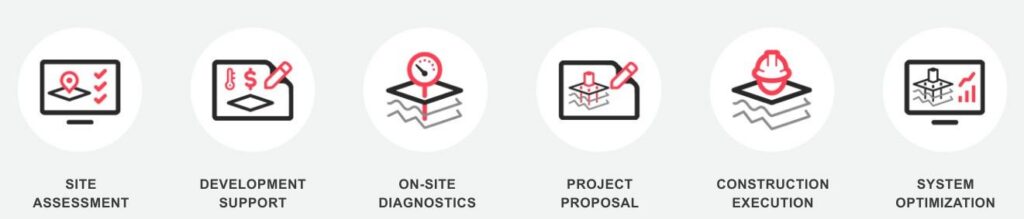
Since the basis of our systems is so closely tied to groundwater, every project starts with geology. Before any engineering, budgeting, or design work takes place, Darcy’s geology team evaluates the site to determine whether geothermal is viable and, if so, what type of system is the right fit.
During this process, a professional geologist reviews the physical characteristics of the subsurface at the location, including soil and rock formations, target aquifers, expected groundwater productivity, and the regulatory requirements and permitting landscape for the relevant jurisdictions. The output is a clear recommendation to either proceed with a specific technology, pursue further on-site diagnostics, or (in the rare case the site is not suitable) redirect the project team before significant resources are committed.
All consulting throughout this stage is provided at no cost. Darcy’s site assessment is the starting point of all projects, and requires nothing more than an address or site coordinates to get underway.
Typical duration: 1–2 weeks from submission to initial findings.
Once the site has been assessed and the team has agreed on the best path forward, Darcy’s engineering team steps in to support the development phase. This typically involves a detailed analysis that estimates the thermal capacity of the recommended system configuration for the specific site. For a groundwater-based system, this means projecting the expected tonnage or MBH output of a Dipole well or other well configuration based on the site’s hydrogeological characteristics.
While this is happening, load analysis also takes place to help understand the building’s heating and cooling requirements, which allows Darcy to estimate the number of wells needed and the appropriate system size. From there, a conservative project budget is produced so the owner has a reliable cost picture before committing to on-site diagnostics or construction.
This stage is also where the project team, the mechanical engineer of record, and Darcy align on system configuration, building integration requirements, and any development or permitting milestones that need to be addressed before construction can begin.
Typical duration: 2–4 weeks, depending on complexity of load analysis and engineering coordination required.
The majority of Darcy’s projects require some form of on-site evaluation before final system design can be confirmed, which helps validate the assumptions from the desktop assessment with direct physical data from the site.
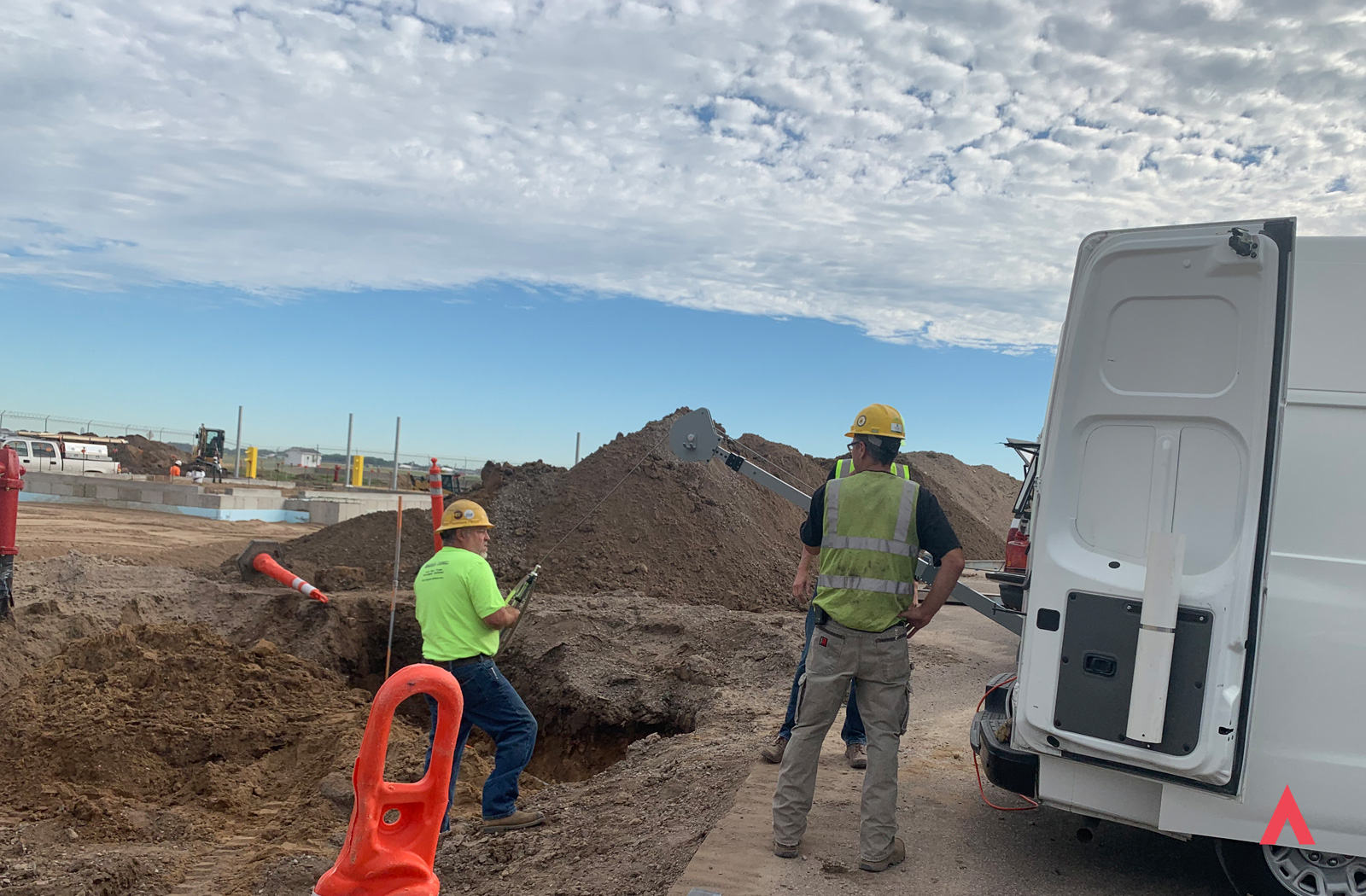
Depending on site conditions and the recommended system type, diagnostics can range from geophysical analyses at the surface to full pilot well drilling, pump testing, and physical logging of subsurface conditions. For groundwater-based systems, the goal is to confirm aquifer productivity at the target depth, characterize the subsurface geology, and verify that the site can support the system capacity required. This data directly informs well depth, spacing, pump specifications, and final system design.
Darcy oversees all elements of the on-site diagnostics, including coordinating with drilling contractors, collecting all relevant data, and delivering the results report to the owner and project team. This work is all performed at cost to keep the path to a confirmed project as accessible as possible.
Typical duration: 2–6 weeks, depending on test scope and drilling schedule.
With on-site conditions verified and the physical attributes of the location confirmed, final system design and formal proposal preparation can begin. The project proposal covers all scopes of work within Darcy’s scope, typically including geothermal system construction outside the building, startup, and commissioning of installed equipment after substantial completion.
Proposal preparation involves selecting drilling and construction partners with the relevant capabilities and experience for the specific location, assembling subcontractor pricing, and producing a detailed scope and schedule. This process typically takes one to two weeks from when the owner provides notice to proceed.
The proposal stage is also the right time for the project team to confirm the involvement of a mechanical contractor for the building-side equipment installation, since that scope runs parallel to Darcy’s exterior work and requires coordination for startup and commissioning.
Typical duration: 1–2 weeks from notice to proceed.
The construction stage is where the geothermal system takes its physical form. Darcy’s scope covers the exterior geothermal exchange system, which includes the drilled well infrastructure, the horizontal piping that connects the wells to the building, and the mechanical room connection point where the ground loop interfaces with the building’s HVAC equipment.
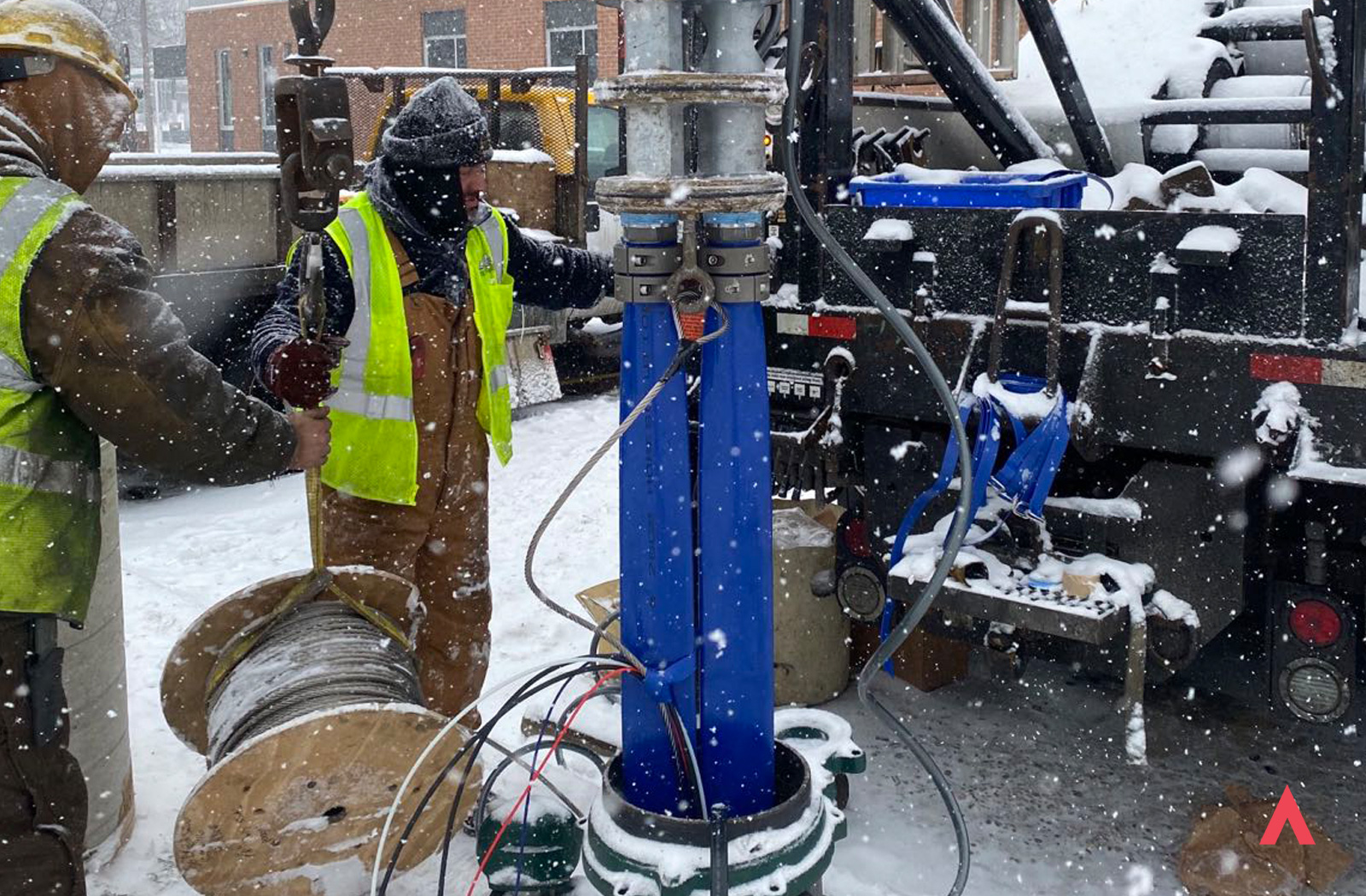
For dipole groundwater-based systems, construction typically begins with well drilling. After drilling to the specific aquifer targeted, well construction is finalized and followed by well development. Development is the process of pumping the well to eliminate all particulate matter down well and can deviate in timing depending on the specific geologic conditions of that location. Once the vertical elements are complete, horizontal piping is installed from the wells to the building and connected to the mechanical room header.
Applied equipment inside the building (e.g., water-to-water heat pumps, central plant equipment, distribution components, etc.) is installed by the mechanical contractor. Darcy does furnish some equipment used for the geothermal closed loop for use in the building, but installed by the mechanical contractor, as well. After substantial completion of both the exterior and interior work, Darcy partners with the mechanical contractor and temperature controls provider to complete startup and commissioning, verifying that the system is operating to design specifications before handoff.
For retrofit projects and occupied facilities, construction phasing is planned in advance to minimize operational disruption. Darcy’s team has experience managing geothermal installations on active campuses, in operating healthcare facilities, and alongside ongoing construction on complex multi-phase projects.
Typical duration: 8–20 weeks, depending on system size, site conditions, and construction schedule coordination.
A well-engineered geothermal system is designed to perform reliably for decades, but realizing that performance requires the facilities team to know how to operate it. Geothermal systems are not yet common enough that most facility operators have prior experience with them, and Darcy accounts for that in our project process.
After project completion, Darcy provides on-site training for facilities staff, covering system operation, monitoring best practices, and routine maintenance expectations. The Darcy data monitoring platform tracks system performance in real time, providing alerts to owners and operators when a system condition requires attention. Over time, Darcy plans to expand proactive data management services to include performance optimization and scheduled O&M recommendations based on system operating data.
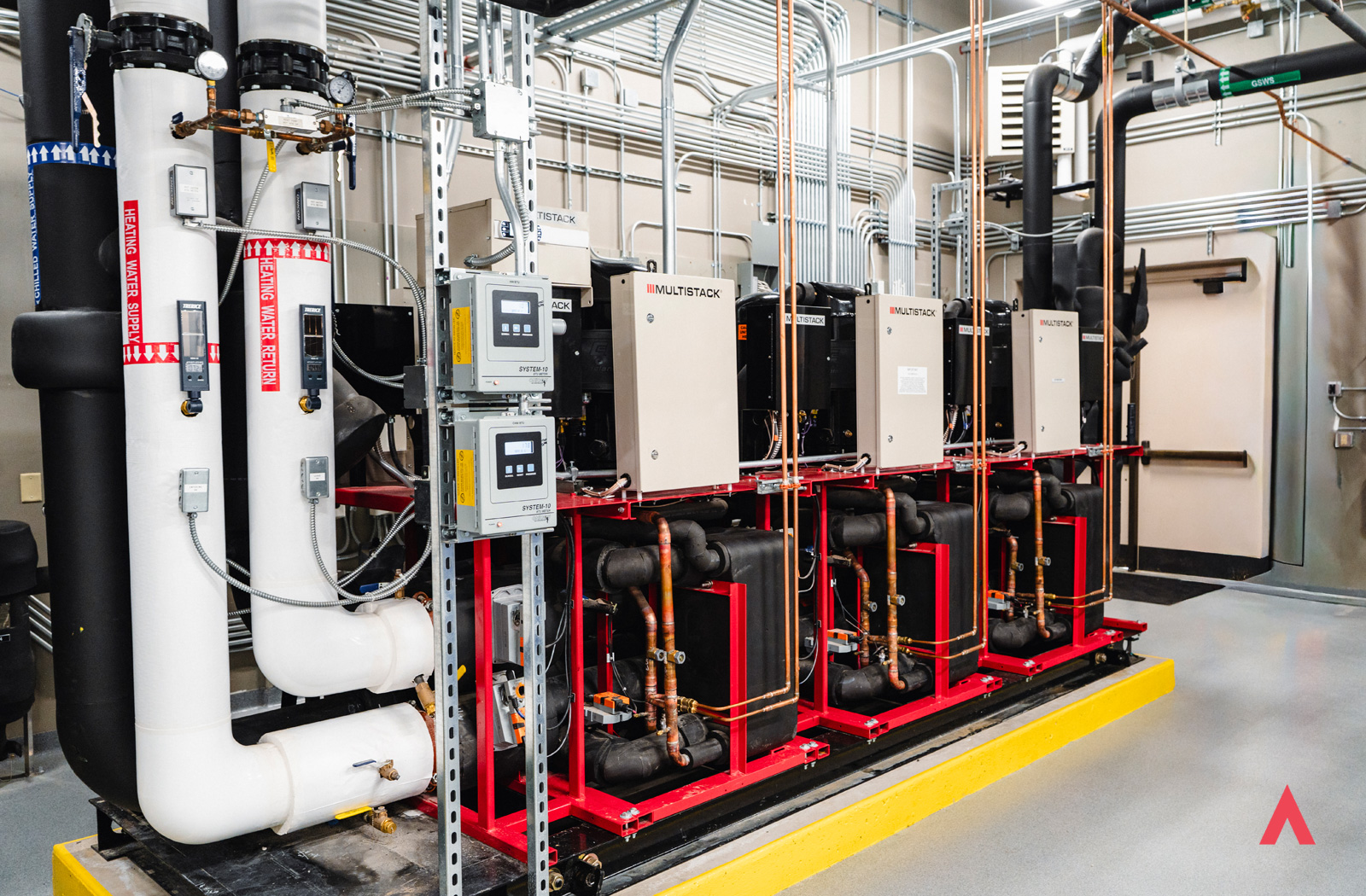
The underground well infrastructure in a properly designed system requires minimal intervention over its 50-plus-year service life. Building-side heat pump equipment follows standard preventive maintenance intervals, and any service can be completed by qualified mechanical contractors without specialized geothermal expertise.
The list below reflects typical durations for each phase of a Darcy project. Actual timelines vary based on site complexity, system size, regulatory requirements, and project team coordination.
From initial site submission to system startup, a straightforward project on a well-characterized site can be completed in as little as six months. Complex projects with phased construction, multiple buildings, or significant regulatory coordination may take 12 to 18 months or longer. The earlier a project team engages with a geothermal contractor, the more flexibility there is to plan around scheduling constraints.
A typical commercial geothermal project runs 6–12 months from initial site assessment through system startup, though complex projects can take longer. The largest variable is construction duration, which scales with system size and site conditions. Engaging a geothermal contractor early on in a project’s development phase provides the most flexibility for schedule planning.
No. Geothermal well drilling and exterior piping installation can generally proceed while a building remains occupied, particularly when construction is phased in coordination with facilities operations. For healthcare, education, and other sensitive occupancy types, Darcy’s project team develops specific phasing plans to avoid interference with building operations. The most schedule-sensitive work is the mechanical room tie-in, which may require brief coordination with the building’s existing HVAC system.
Most projects require some level of on-site testing to confirm the site’s geological and hydrogeological conditions before final system design begins. For groundwater-based systems, this typically includes pilot well drilling and aquifer testing to verify productivity, depth, and subsurface conditions. The scope and duration of testing depends on the site and system type. Darcy manages all testing activities and provides a full results report and presentation to the project team before moving to proposal.
Darcy’s scope covers the geothermal exchange system outside the building, including well construction, horizontal distribution piping, and the mechanical room connection point. The mechanical contractor handles the building-side HVAC equipment (e.g., heat pumps, distribution equipment, controls, etc. – some equipment installed in the building Darcy furnishes), with Darcy coordinating closely during startup and commissioning to ensure the full system operates as designed. Darcy can assist the project team in identifying and coordinating with mechanical contractors experienced in geothermal system integration.
Darcy’s site assessment and all consulting through the development support phase are provided at no cost to the project team. On-site diagnostics are performed at cost, because Darcy’s goal is to confirm project viability and remove barriers to geothermal deployment. Construction is contracted separately after the proposal stage.
The underground well infrastructure in a properly designed system is largely passive and requires minimal maintenance over its service life of 50 years or more. Typical maintenance includes replacement of pumps every 15 years, closed-loop fluid testing, and a few other easy-to-perform actions. Building-side heat pump equipment follows standard preventive maintenance schedules comparable to conventional commercial HVAC equipment. Darcy provides system training at project completion and ongoing performance monitoring through its data platform, with alerts sent directly to facility operators when system attention is needed.
The first step in any geothermal project is to understand what the site can support. Darcy’s site assessment is free, requires only an address or site coordinates, and typically delivers initial findings within one to two weeks. It’s the most efficient way to move beyond curiosity to obtain a clear, informed picture of your project’s potential.
→ Request Your Free Site Assessment
As the summer is coming to an end and back-to-school season is rapidly approaching, Darcy would like to take a moment to thank our wonderful interns from 2026! With the company forming out of the University of Minnesota, we remain committed to supporting higher education and helping students find their passions in geothermal and sustainability – with some of our former interns returning to Darcy full-time post-graduation. Thank you to Woody Field, Sarah Engbrecht, Kayla Brinkman-Anderson, Audrey MacPherson, Ryan Gansler, Trygg Hemstad, Sadie Cutler, Reece Passons, and Jeremiah Lanzillo for choosing Darcy as your spring and summer internship!
Hear directly from some of our interns, as well as former interns who have joined Darcy full-time:

Bio: Hi everybody! My name is Woody Field, and I’m a rising sophomore at the University of Notre Dame studying Finance and Applied Mathematics. At school, I am an analyst for the university’s Investment Club and a member of the Business Honors Program. In my free time, I love playing the guitar, golfing, and spending time with friends and family.
What work did you do at Darcy? This summer I worked across the commercial team on a mix of projects. A good chunk of my time went into our sales reporting, where I built interactive dashboards, set up booking forecasts and goal tracking, and created a repeatable, AI-assisted process for putting together monthly sales reports. I also analyzed our project sales pipeline to identify conversion trends and recognize which segments were worth prioritizing, incorporating AI into the analysis, and helped restructure our CRM data and reporting in Excel to make forecasting more reliable. I also supported the team on DSAM, our new project financing offering, contributing to the forecasting and revenue modeling behind it.

Bio: Hi, I’m Sarah Engbrecht, a fourth-year Mechanical Engineering student at the University of Minnesota – Twin Cities. My interests include engineering design, CAD modeling, and testing. On campus, I’m involved with the Society of Women Engineers, ASK – Women in STEM, and SheIsMechE.
What work did you do at Darcy? This summer, I gained hands-on experience with heat exchanger testing, sensor data logging, CAD modeling, and prototyping. My main project was designing a mobile datalogger field kit that technicians can bring directly to a wellhead to collect sensor readings when a mechanical room is not connected to the well. This project consisted of selecting components, modeling the layout in CAD, fabricating the enclosure, wiring the internal circuit, programming the datalogger software, and creating full technical documentation for the prototype. Alongside this, I supported a few other projects, including 3D modeling parts from manufacturing drawings and mapping out component layouts to work within measurement constraints. More recently, I’ve also been helping out with heat exchanger testing, running tests alongside another intern, and creating workbooks for the results. This summer, I gained valuable technical experience with CAD and testing, while also enjoying the hands-on side of engineering through prototyping and fabrication.

Bio: I am a senior Mechanical Engineering student at Minnesota State University, Mankato. I participated in the RESPEI initiative to support efforts in bringing robotics and better STEM education to school students. My interests include CAD, engineering design, controls, testing systems, mechanics, and photography.
What work did you do at Darcy? During my summer internship, I assisted with the piping of a heat exchanger testing facility and helped develop its Standard Operating Procedure (SOP). I also supported heat exchanger testing and data collection efforts. In addition, I created an SOP for control panel assemblies.

Bio: I am an incoming senior at the University of Minnesota pursuing a degree in Environmental Engineering. I am also involved in the Honors Program, Chinese Flagship Program, Clean Energy Leaders Program, and Sustainability Corps. I am particularly interested in the overlap of clean energy, water treatment, educational outreach, and international affairs, all pertaining to environment and sustainability.
What work did you do at Darcy? At Darcy, I worked as a Geothermal Data Intern, mostly working with the Regulatory Team. I was tasked with an in-depth review on the environmental impacts of geothermal. The goal of this project was to find evidence to support the claims we make, to assess outfacing diction, and to ensure internal accuracy. In the end, I created a final impact review, accessible infographics, a literature database, and a gap analysis. On the side, I worked with Scott on MATLAB 3D well modeling. Finally, I wrote a proposal on outreach opportunities on facilitating geothermal education. I am grateful for the opportunity to work with Darcy this summer. I had a great time with my project, going on-site, and working with this awesome and welcoming team!

Bio: I graduated from the University of Minnesota, Twin Cities in May 2026 with a degree in Aerospace Engineering and a minor in Sustainability Studies.
What work did you do at Darcy? I actually had two internships with Darcy: One in the summer of 2025 and one in the spring of 2026. During my first internship, I helped build a preliminary testing facility, performed energy analyses, and researched thermal energy storage. I began in a more regulatory role, before moving into a more engineering-focused role. This past spring, I deepened my understanding of the Darcy system by learning to verify mechanical room sensors and performing data analyses on our systems. Now, in my full-time role, I have continued the work I began in my internships and am supporting the Darcy Engineering team as an Installed Systems Analyst.

Bio: 2025 Grad from Carleton College, studied Geology and Data Science.
Internship started in March 2026, full-time starting in June 2026.
What work did you do at Darcy? During my internship working across the Geology, Data, and Engineering teams, I developed data standardization pipelines to build a multi-state well reference database to improve the accuracy and speed of site evaluations. In my full-time role as a Data Geologist, I’ve continued scaling these pipelines to handle increased data volume and to include additional state and national databases.
At Darcy, our roots are in the University of Minnesota, and that connection to higher education has always been part of how we operate. Bringing students into the work, giving them real problems to solve, and watching some of them come back as full-time team members is something we’re genuinely proud of. To every intern who joined us this year: thank you for the energy, the curiosity, and the work you put in. We’re glad you were here, and we’re excited to see where you go next.
If you’re a student or recent graduate interested in working at Darcy, visit our Careers page to see what’s available.
Healthcare facilities operate in a category of their own when it comes to building systems. A hospital or major clinic is never fully off, running 24 hours a day, 365 days a year, with patient comfort, clinical outcomes, and regulatory compliance all directly tied to the performance of the mechanical infrastructure. The HVAC system is much more than a background utility within healthcare settings, serving as a truly mission-critical component.
That reality shapes everything about how healthcare organizations think about energy. Reliability comes first, cost control is a close second, and sustainability (driven by board commitments, accreditation expectations, and community obligations) has increasingly become a non-negotiable third. Commercial geothermal heating and cooling addresses all three simultaneously, and healthcare facilities are among the building types where geothermal’s advantages are most compelling.
Below, we cover what makes healthcare facilities well-suited for geothermal, how the technology supports the performance and regulatory requirements of clinical environments, and what the financial case looks like over the full lifecycle of the system.
The strongest geothermal candidates have large and consistent energy loads, long building lifecycles, high reliability requirements, and organizational priorities that align with geothermal’s core strengths. Healthcare facilities check every one of these boxes.
Most commercial buildings have significant unoccupied periods when HVAC loads drop substantially. Healthcare facilities largely do not, with patient care areas, surgical suites, ICUs, emergency departments, and central utilities plants running continuously. That constant, predictable load profile is one of geothermal’s strongest performance environments. The system operates at a consistently high utilization rate, which is where its efficiency advantages compound most significantly, and the energy savings are realized around the clock rather than only during peak occupancy hours.
Hospitals and major clinical facilities are significantly more cooling-intensive than most commercial building types. Medical equipment, lighting, occupancy density, and heat generated by clinical processes all create substantial internal heat gains that must be managed year-round, including in winter months.
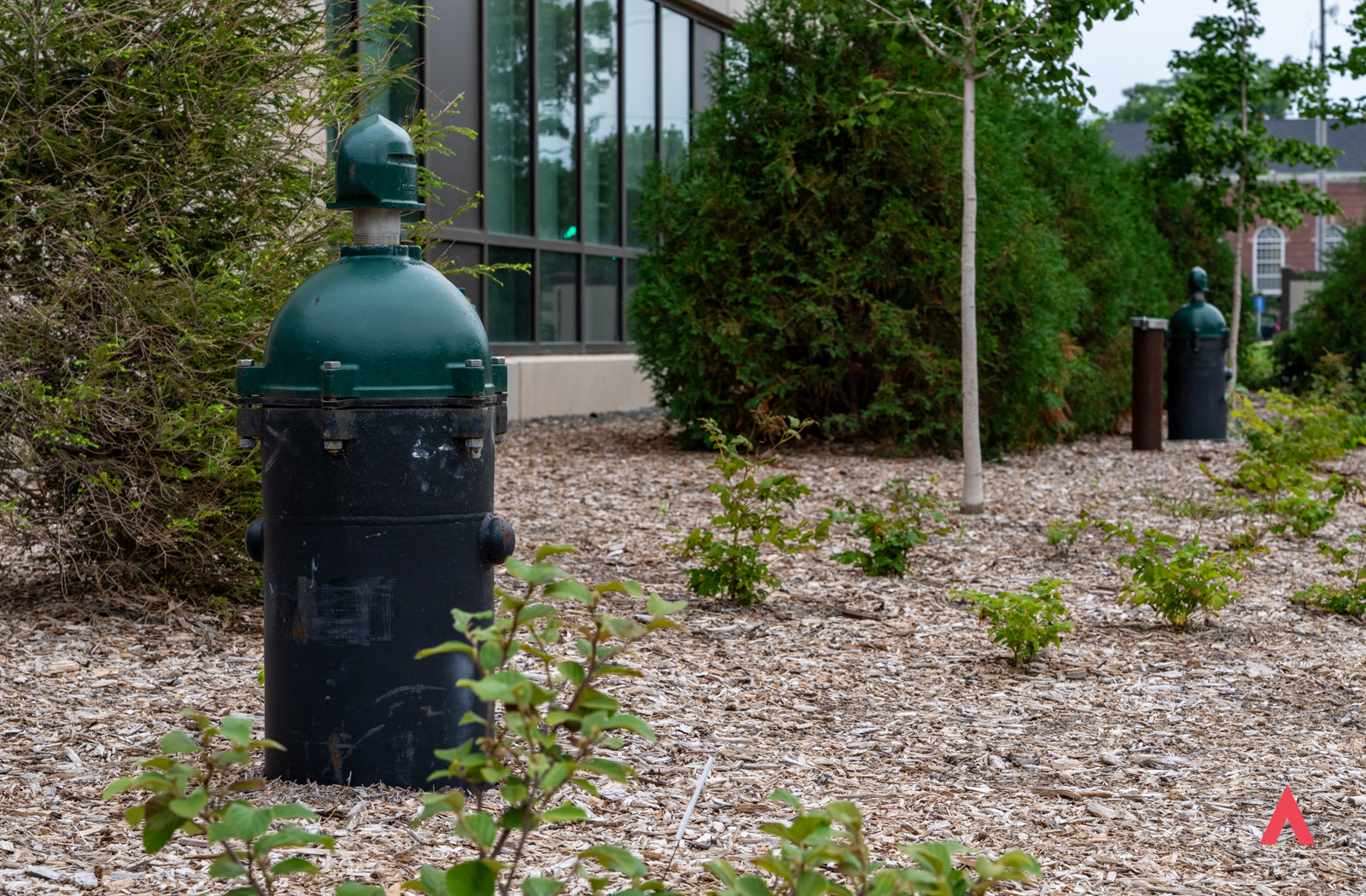
Groundwater-based geothermal systems are particularly well-suited for cooling-dominant applications. The naturally stable temperature of groundwater provides an ideal heat sink for rejecting large building heat loads efficiently, and Darcy’s Dipole well configuration can deliver 200 or more tons of cooling capacity from a single well, making it possible to serve major clinical facilities from a compact well field.
A major hospital constructed today will almost certainly still be operating 50 to 60 years from now, and the mechanical infrastructure installed during original construction or a major renovation will define the building’s energy and operating cost profile for decades. Geothermal systems are engineered to match that time horizon, with underground well infrastructure designed for 50-plus years of service life and building-side heat pump equipment carrying a service life of 20 to 25 years. The long-term financial case for geothermal is strongest in exactly the kind of capital planning environment that healthcare organizations operate in.
In a hospital, an HVAC failure can be a patient safety event. Surgical suites, ICUs, neonatal care areas, and sterile processing facilities all require continuous, precise environmental control, meeting clinically mandated temperature, humidity, and air quality parameters that directly affect patient outcomes.
A conventional heating and cooling plant for a large hospital may include gas-fired boilers, cooling towers, chillers, and extensive rooftop equipment, each representing a category of mechanical components that requires regular maintenance, is exposed to weather and wear, and can fail independently.
A geothermal system eliminates several of these categories.
For healthcare facilities teams managing Joint Commission compliance, a simplified mechanical plant with fewer outdoor components and failure modes is a meaningful operational advantage.
Healthcare facilities routinely design HVAC systems with N+1 redundancy configurations that ensure a single equipment failure does not interrupt care delivery. Geothermal systems accommodate this design approach naturally. Multiple heat pumps can be configured so that any single unit can be taken offline for service without disrupting the overall system. The underground well field provides a shared thermal resource with no single point of failure. Darcy’s engineering approach includes redundancy planning as a standard component of healthcare system design.
Gas boiler systems require fuel supply infrastructure, combustion equipment maintenance, exhaust handling, and carbon monoxide monitoring. Equipment failures in combustion systems, including flue gas leaks, burner malfunctions, and pressure events, represent safety risks that hospital safety officers and facilities teams actively manage.
A geothermal system is fully electric, with no combustion anywhere in the system, no exhaust to manage, and no combustion-related safety risk. For hospitals already managing complex safety programs across dozens of hazard categories, removing an entire class of combustion-related risk from the mechanical plant is a genuine operational benefit.
Healthcare HVAC is governed by ANSI/ASHRAE/ASHE Standard 170 (Ventilation of Health Care Facilities), the foundational standard for healthcare ventilation in the United States, most recently updated in 2025. Standard 170 defines specific, measurable requirements for air change rates, pressure relationships, filtration levels, and temperature and humidity control across more than 60 distinct space types within a healthcare facility.
These requirements exist because ventilation failures in healthcare settings translate directly into patient harm, including surgical site infections from inadequate air changes in operating rooms and airborne transmission events from isolation rooms that lose proper pressure differentials.
Geothermal systems, as central plant heating and cooling sources, are designed to support whatever air handling and distribution configuration the healthcare project requires, including the precise temperature control, humidity management, and air change rates mandated by Standard 170. The geothermal plant provides conditioned water to the building’s air handling units and terminal equipment, while the air-side design (air change rates, filtration, pressure relationships) is handled by the building’s air handling infrastructure, which remains fully configurable to meet Standard 170 requirements regardless of the heating and cooling source.
Geothermal and Standard 170 compliance are entirely compatible, and a well-coordinated design achieves full compliance while capturing all of geothermal’s efficiency and sustainability benefits.
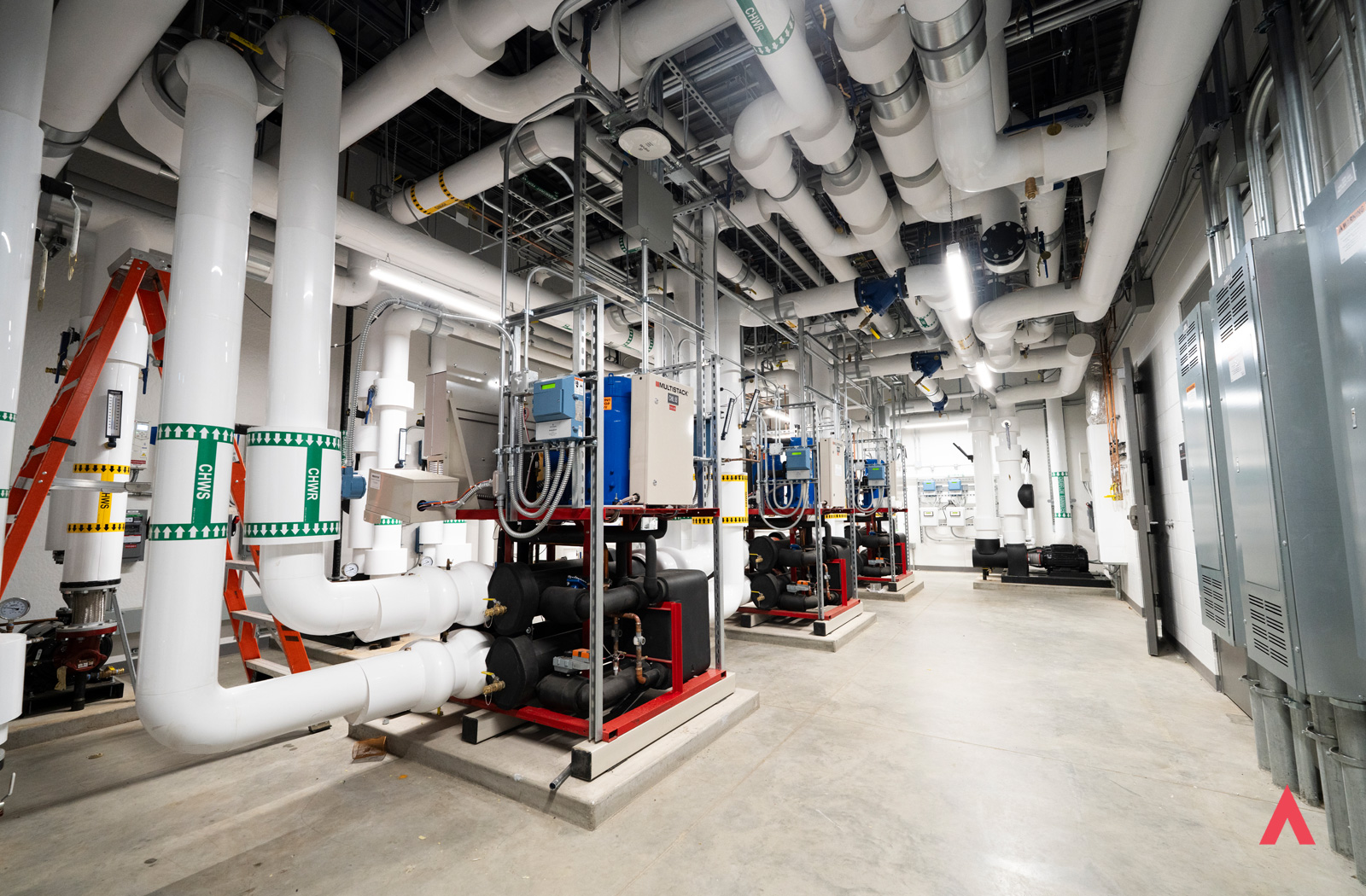
In facilities where infection control is paramount, the elimination of combustion from the HVAC system carries significant benefit for indoor air quality. A geothermal system produces no combustion exhaust, no carbon monoxide, and no combustion byproducts that could affect indoor air quality. It also eliminates the need for combustion air supply and exhaust infrastructure in the mechanical room, simplifying the ventilation design and removing a category of indoor air quality risk from the equation.
Standard 170 requires precise environmental control across a wide range of space types. Operating rooms typically require temperature control within a 68 to 75 degrees F range and humidity between 20 and 60% relative humidity, with ICUs and patient rooms requiring similar precision.
Geothermal heat pumps, operating against the stable thermal resource provided by the ground or groundwater, deliver highly consistent supply water temperatures that support the precise environmental control required. The stability of the ground-side thermal resource is an advantage in precision control applications, with the heat pump operating within a consistent performance envelope rather than chasing wide variations in outdoor air temperature.
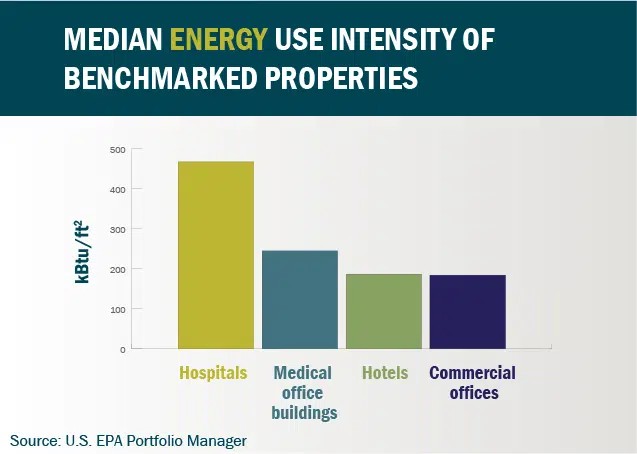
Hospitals typically rank among the most energy-intensive building types per square foot, with site energy use intensities (EUI) that are 3-4x higher than a typical commercial office building. For a major regional hospital, annual energy costs can easily reach several million dollars, of which HVAC makes up a significant portion. Geothermal addresses this directly through superior energy efficiency delivered continuously across the full operating schedule of the facility.
With a coefficient of performance (COP) in the range of 3.0 to 8.0 or better for heating, and an energy efficiency ratio (EER) for cooling that consistently outperforms conventional chiller systems when measured against the stable thermal resource of groundwater, geothermal reduces the electrical energy required to condition the building by 40 to 70% compared to conventional electric alternatives. For a hospital operating 24/7/365, that efficiency margin translates into significant annual savings that compound further as energy prices fluctuate over the life of the system.
Healthcare organizations operating gas-fired heating systems are exposed to natural gas price volatility that is difficult to hedge and budget for. Geothermal systems eliminate natural gas consumption from the HVAC equation entirely, replacing it with electricity, which can increasingly be sourced through long-term power purchase agreements, on-site solar, or utility programs that provide greater price predictability.
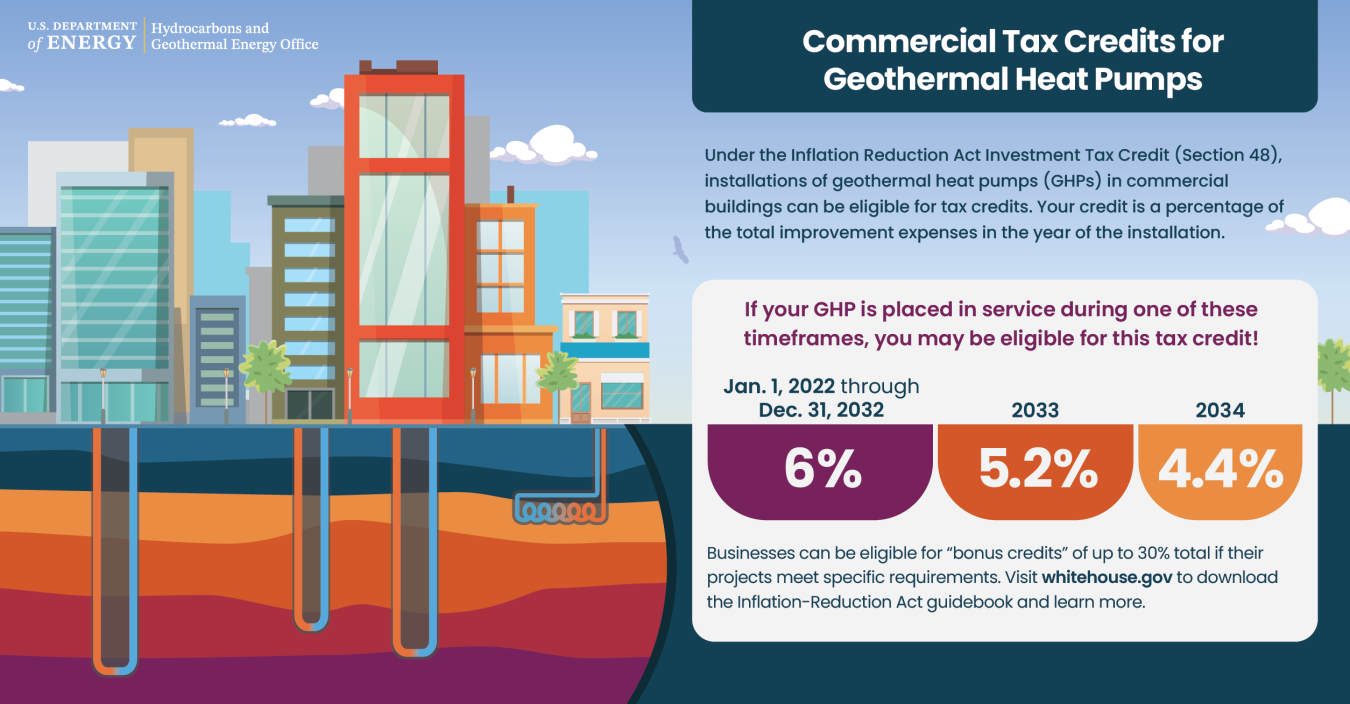
The federal Investment Tax Credit (ITC) for commercial geothermal, currently providing a base credit of 6% scalable up to 30% with prevailing wage and apprenticeship requirements met under Section 48/48E of the Internal Revenue Code, applies to healthcare facility projects.
For nonprofit hospital systems, the IRA’s direct pay provisions allow the ITC to be claimed as a direct payment from the Treasury rather than as a tax offset, making the full financial benefit accessible regardless of tax liability.
The One Big Beautiful Bill Act (OBBBA), signed in July 2025, explicitly preserved the Section 48/48E ITC for geothermal heat pump systems. The current credit structure holds through 2032 before beginning to phase down, giving healthcare organizations a well-defined window to capture the full credit value.
Darcy’s geothermal project at the Mayo Clinic Health System bed tower in La Crosse, WI, demonstrates what the technology looks like at healthcare scale. The project involved a 7-well, 828-ton groundwater geothermal system providing high-efficiency heating and cooling for a 96-bed inpatient facility. The system integrates with chilled beam technology to achieve significant carbon reductions and energy savings, and was designed to fit the constrained parcel available for the project.
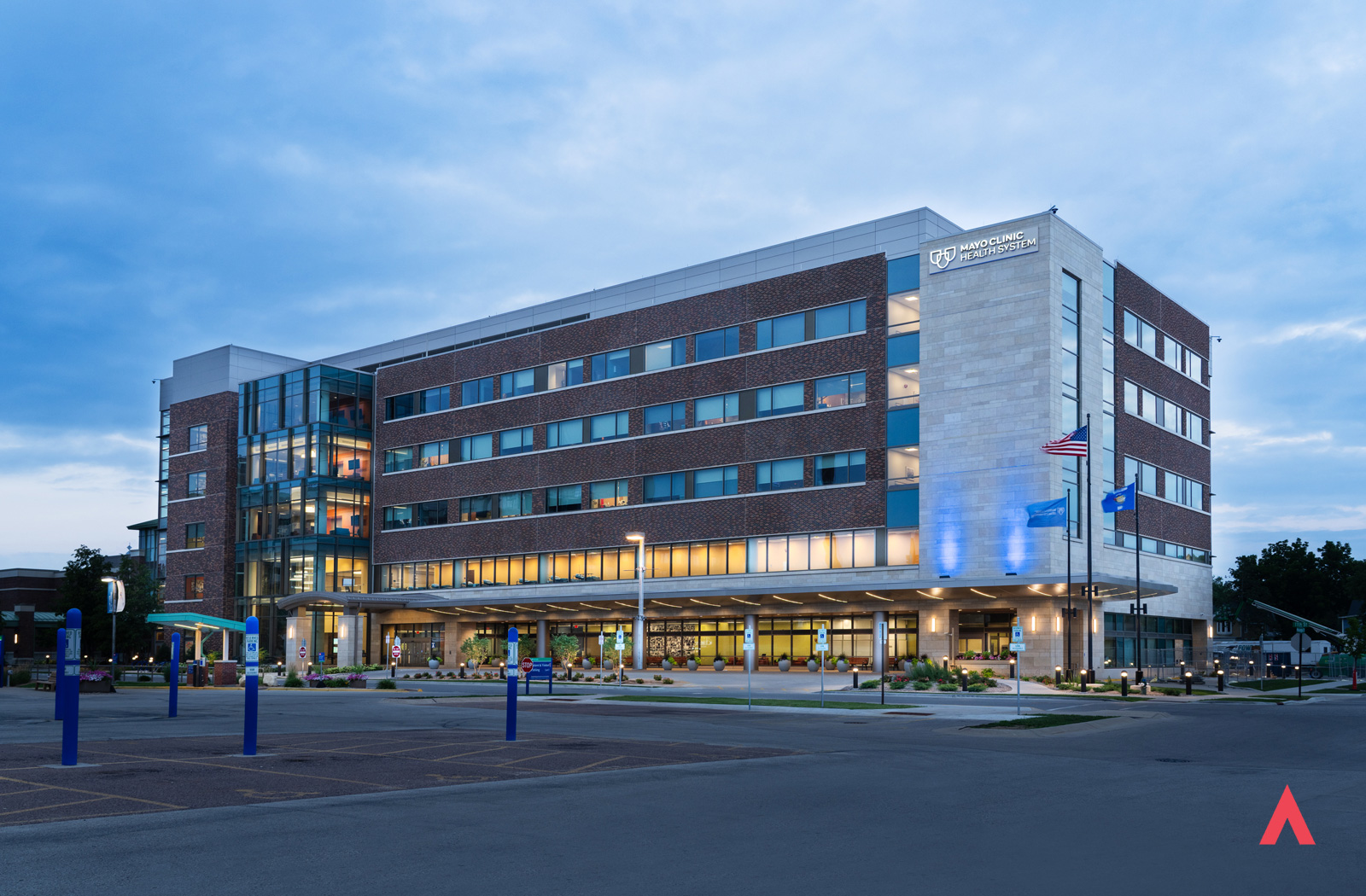
Darcy’s groundwater-based approach delivered the required thermal capacity with substantially fewer wells than a conventional borehole field would have required, illustrating both the scale at which healthcare geothermal can operate and the practical importance of a system configuration that works on the built-out, space-constrained campuses where hospitals are typically located.
The healthcare sector accounts for roughly 8.5% of U.S. greenhouse gas emissions, and major health systems have made public commitments to reduce their environmental footprint, with many signing pledges for carbon neutrality by 2030 or 2040. Accreditation bodies, donors, community stakeholders, and regulatory frameworks are all part of the accountability landscape. Buildings are where the most actionable progress is available.
For healthcare organizations measuring emissions under the GHG Protocol, replacing combustion-based heating with geothermal takes Scope 1 HVAC emissions to zero, one of the most direct and verifiable paths to meaningful progress. On the Scope 2 side, geothermal’s 40 to 70% reduction in HVAC-related electrical consumption flows directly into lower indirect emissions, and the lower electrical demand means fewer renewable resources are required to offset HVAC consumption as health systems pursue broader clean energy strategies.
Healthcare-specific sustainability programs, including Practice Greenhealth and the Green Guide for Health Care, increasingly recognize geothermal’s contribution to facility environmental performance. LEED for Healthcare and ENERGY STAR certification for hospitals are recognized benchmarks that many health systems use to communicate their energy performance, and geothermal’s reduction of site energy use intensity (EUI) is one of the most direct paths to achieving and sustaining both.
Learn more about how geothermal HVAC supports sustainability goals and ESG reporting.
Yes. Geothermal systems can be designed with N+1 redundancy configurations that ensure no single equipment failure interrupts the building’s heating and cooling delivery. The underground well infrastructure provides a shared thermal resource with no single point of failure, and building-side heat pump equipment can be configured so that individual units can be serviced without taking the system offline. Darcy’s engineering team includes redundancy planning as a standard component of healthcare system design.
Yes. ASHRAE Standard 170 governs the air-side performance of healthcare HVAC systems, including air change rates, pressure relationships, filtration, and environmental control parameters. Geothermal functions as the central plant heating and cooling source, providing conditioned water to the building’s air handling and distribution equipment. The air-side design is fully configurable to meet Standard 170 requirements regardless of the heating and cooling source, and a well-coordinated design achieves full compliance while capturing all of geothermal’s efficiency and sustainability benefits.
Healthcare facilities are among the most cooling-intensive building types, with significant internal heat gains from equipment, lighting, and clinical processes that require year-round cooling capacity. Groundwater-based geothermal systems are particularly well-matched to cooling-dominant applications. The stable temperature and high thermal capacity of groundwater provides an effective heat sink for rejecting large building heat loads efficiently, even during winter months. Darcy’s Dipole well configuration can deliver 200 or more tons of cooling capacity from a single well, enabling major clinical facilities to be served from a compact, high-capacity system.
Healthcare campuses with multiple buildings are excellent candidates for geothermal thermal energy networks, where shared underground infrastructure serves multiple facilities from a common well field or aquifer resource. These configurations allow heating and cooling loads to be balanced across buildings, create economies of scale in well construction and equipment procurement, and provide a shared energy infrastructure that can grow with the campus over time. Darcy has experience designing systems for both individual healthcare buildings and multi-building campus configurations.
Well construction and horizontal piping installation are the primary site activities for a geothermal installation, and both can be managed with minimal disruption to an operating facility when properly phased. Darcy’s project team develops construction phasing plans specifically for occupied healthcare environments, coordinating with facilities operations, infection control (ICRA and PCRA protocols), and the project schedule to ensure that construction activities do not affect patient care areas. The mechanical room integration is typically the most schedule-sensitive phase and is coordinated to align with planned maintenance windows or system downtime where possible.
Yes. The IRA’s direct pay provisions allow tax-exempt organizations, including nonprofit hospital systems, to claim the Section 48/48E Investment Tax Credit as a direct payment from the U.S. Treasury rather than as a tax offset, making it fully accessible regardless of tax liability. The current credit structure, preserved under the OBBBA signed in July 2025, provides a base credit of 6% scalable up to 30% with prevailing wage and apprenticeship requirements, plus additional bonuses for domestic content and energy community siting. The full credit structure holds through 2032 before beginning to phase down.
Healthcare organizations evaluating their long-term capital strategy are making decisions today that will shape their energy costs, emissions profile, and operational complexity for the next 50 years.
Darcy specializes in commercial geothermal that includes healthcare facilities, from individual medical office buildings to major regional hospitals and multi-building health system campuses. Our team of geologists, engineers, and builders brings the site-specific expertise needed to evaluate feasibility, model performance, and design systems that meet the reliability, regulatory, and sustainability standards that healthcare organizations depend on.
The starting point is a free site assessment. After providing your facility’s location, you’ll receive a geologically grounded picture of your project’s potential with no cost or obligation to move forward. Let’s get started.
→ Request Your Free Site Assessment
For organizations with serious sustainability commitments, the buildings they occupy are one of the most significant variables in the equation. Commercial and institutional buildings account for roughly 18% of total U.S. primary energy consumption and are among the largest sources of greenhouse gas emissions in the built environment. For sustainability managers, facility directors, and C-suite leaders working toward meaningful carbon reduction, the HVAC system is one of the highest-leverage places to act.
Commercial geothermal heating and cooling is increasingly central to that conversation. By replacing combustion-based heating and dramatically cutting the electrical energy required to condition a building, geothermal systems deliver measurable, verifiable, long-term emissions reductions that translate directly into stronger ESG reporting, better LEED and ENERGY STAR performance, and real progress toward net-zero targets.
This piece breaks down exactly how geothermal connects to the sustainability metrics that matter most to organizations and their stakeholders.
Most organizations pursuing ESG goals or net-zero commitments quickly discover that buildings are among their most significant emissions sources. Heating, cooling, ventilation, and hot water production together typically represent 50 to 70% of a commercial building’s total energy use. And for organizations that own or lease large facilities, such as hospitals, universities, corporate campuses, and government buildings, that energy footprint drives a substantial portion of total organizational emissions.
The good news is that building energy systems are also among the most actionable opportunities for reduction. Unlike industrial process emissions or supply chain impacts, HVAC is a capital decision that a single organization controls entirely. Choosing the right system at the outset (or upgrading an existing system at the right time) can lock in decades of lower emissions and lower operating costs simultaneously.
Geothermal systems are uniquely well-positioned to deliver on both dimensions. They are not a marginal improvement over conventional HVAC. They represent a structural shift in how a building produces and consumes thermal energy.
To understand where geothermal fits within a sustainability strategy, it helps to understand the GHG Protocol framework that most organizations use to measure and report emissions. The protocol divides emissions into three categories:
For most commercial and institutional buildings, Scope 1 and Scope 2 are where the HVAC system has direct impact, as well as where geothermal can deliver its most significant sustainability value.
A conventional commercial building with gas-fired boilers produces Scope 1 greenhouse gas emissions every time the heating system runs. Those emissions are direct, attributable to the organization, and show up prominently in any GHG inventory. For organizations with Scope 1 reduction targets, gas-fired HVAC systems represent a structural barrier to progress.
Geothermal eliminates this problem entirely. A geothermal system has no combustion component. There is no gas line to the mechanical room, no boiler stack, and no on-site emissions from heating. The system is fully electric, using electricity to operate heat pumps that move thermal energy between the building and the earth. For organizations with Scope 1 reduction commitments, switching from combustion-based heating to geothermal can take that entire category of building emissions to zero.
Because geothermal is electric, it does contribute to Scope 2 emissions through its electricity consumption, but does so at a fraction of the rate of conventional electric HVAC alternatives. The key metric is coefficient of performance (COP): for every unit of electrical energy consumed, a geothermal system delivers three to five or more units of heating or cooling energy. Conventional electric resistance heating, by comparison, delivers a COP of 1.0, or one unit of heat for every unit of electricity consumed.
In practical terms, a well-engineered commercial geothermal system can reduce total HVAC-related electricity consumption by 40 to 70% compared to conventional systems, depending on the building type, climate, and system configuration. That reduction flows directly toward lowering Scope 2 emissions, and as the electrical grid continues to incorporate more renewable generation, the emissions factor of that remaining electricity consumption continues to decline. Geothermal and grid decarbonization compound each other, in that a more efficient system drawing from an increasingly clean grid is a powerful combination for long-term emissions reduction.
LEED (Leadership in Energy and Environmental Design), administered by the U.S. Green Building Council, is the most widely recognized green building certification in the world. For organizations pursuing LEED certification on new construction or major renovation projects, the energy performance of the HVAC system is one of the largest point-earning opportunities in the rating system.
Geothermal systems contribute to LEED points across several credit categories:
This is the highest-value credit category in LEED, offering up to 18 points for new construction projects. Points are earned based on demonstrated energy cost savings compared to a baseline building. Because geothermal systems are among the most energy-efficient HVAC technologies available, they typically produce substantial savings versus the baseline, generating meaningful points in this category that would be difficult to achieve with conventional systems.
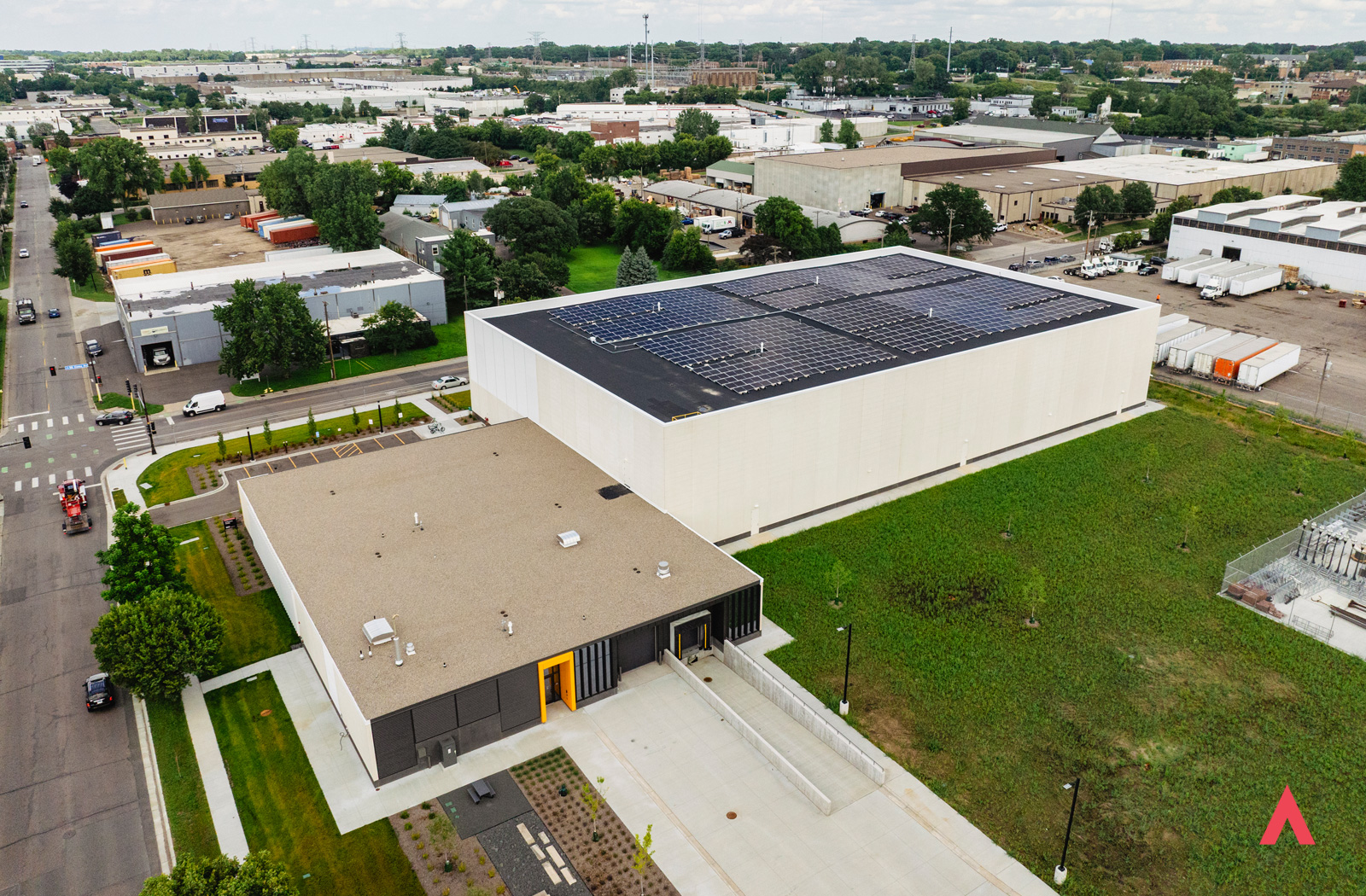
Geothermal uses renewable ground-sourced thermal energy to displace conventional fuel consumption. Depending on how the project models and documents the energy source, geothermal may contribute to on-site renewable energy credits within the LEED framework. Project teams should work with their LEED consultant to optimize the documentation approach for this credit.
LEED also rewards buildings that maintain high indoor air quality. Because geothermal systems don’t involve combustion, they produce no combustion byproducts. That means no carbon monoxide risk from gas equipment and no exhaust handling requirements. Depending on system configuration, geothermal can contribute to indoor environmental quality credits related to thermal comfort and ventilation.
LEED awards innovation credits for exemplary performance or the use of technologies that go beyond standard practice. For projects in markets where geothermal adoption is still relatively limited, its use may support innovation credit documentation, particularly in combination with other advanced building strategies.
It’s worth noting that many of Darcy’s completed projects have involved organizations with LEED aspirations or formal certification goals. The compatibility between geothermal systems and LEED is well-established, and Darcy’s team routinely coordinates with project engineers and sustainability consultants to ensure each geothermal system is modeled and documented in a way that maximizes credit potential.
ENERGY STAR certification is a performance-based certification for existing commercial buildings. To earn ENERGY STAR certification, a building must achieve a score of 75 or higher on the EPA’s 1-to-100 energy performance scale, meaning it outperforms at least 75% of similar buildings nationally.
HVAC efficiency is a primary driver of ENERGY STAR scores for most commercial building types. Because geothermal systems dramatically reduce site energy use intensity (EUI) — the standard metric EPA uses to compare buildings — installing geothermal can be a direct path to achieving or maintaining ENERGY STAR certification.
For organizations that use ENERGY STAR certification as a component of their sustainability reporting, lease negotiation, or tenant attraction strategy, geothermal is one of the most reliable tools for reaching and holding that threshold. And because geothermal’s efficiency advantage is structural rather than behavioral, it doesn’t require ongoing occupant cooperation or operational changes to sustain. The building performs because of how it’s built, not just how it’s managed.
The landscape for ESG disclosure has changed significantly and rapidly over the last few years. What began as largely voluntary reporting has become an increasingly complex regulatory patchwork, varying significantly by jurisdiction.
This regulatory complexity makes one thing more valuable, not less: the ability to produce quantifiable, verifiable, long-term emissions data that holds up under scrutiny regardless of which framework applies. Geothermal delivers exactly that.
Unlike some sustainability initiatives where impact is estimated or modeled, geothermal systems produce measurable, metered data on energy consumption. Utility bills and building energy management systems provide clear documentation of the electricity consumed. Because the system type and efficiency characteristics are known, the avoided emissions from replacing combustion-based heating can be calculated using EPA methodology and documented with confidence.
This auditability matters increasingly as ESG reporting standards tighten. Organizations that can provide well-documented, third-party-verifiable emissions data are in a stronger position than those reporting estimated or proxy-based figures.
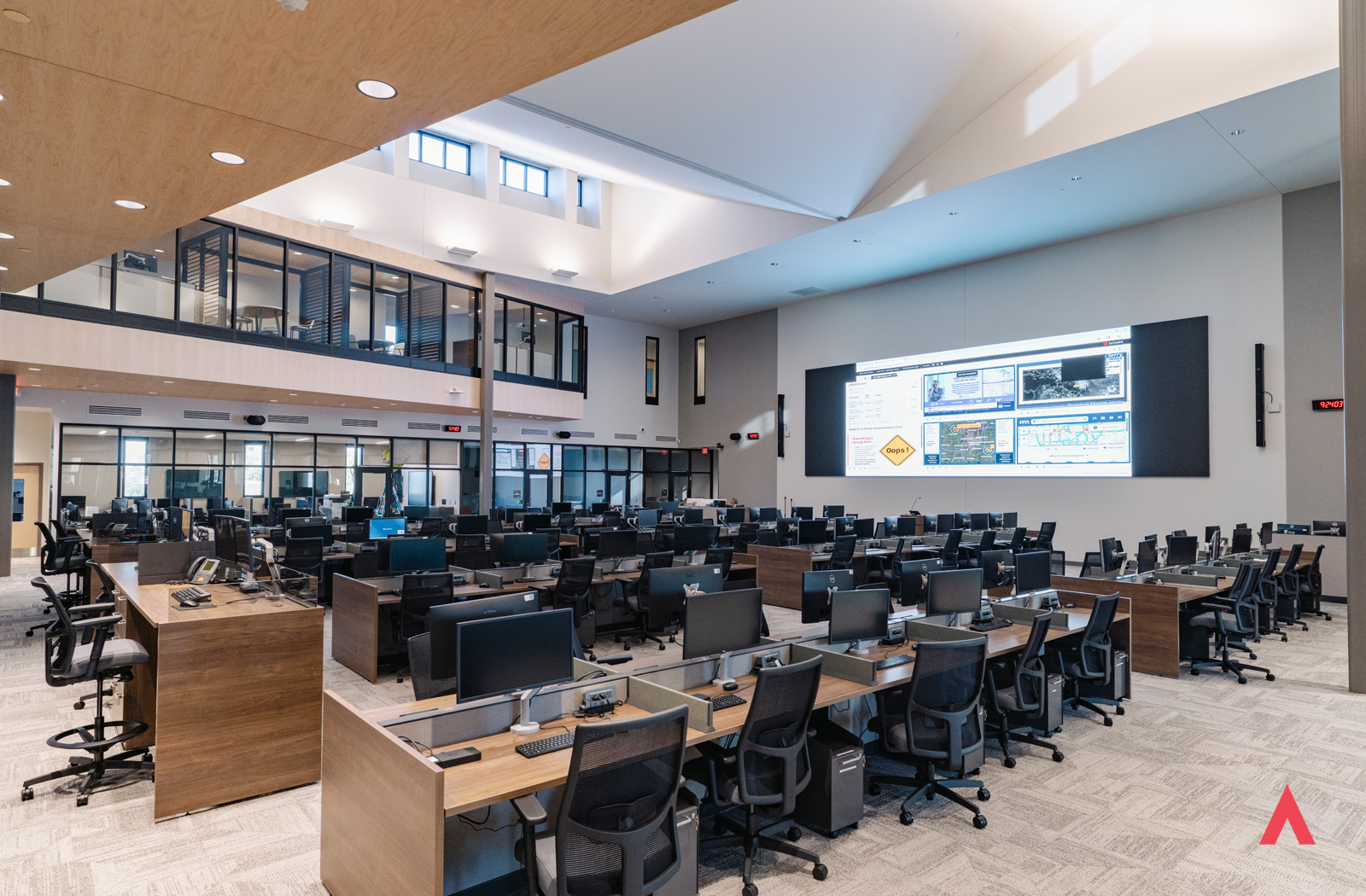
ESG-focused investors and stakeholders are increasingly sophisticated about distinguishing between short-term sustainability gestures and structural, long-term commitments. A geothermal system installed in a commercial building will continue delivering emissions reductions and energy efficiency for 50 years or more.
For organizations building an ESG narrative with institutional investors, tenants, or community stakeholders, that kind of capital commitment carries weight that a carbon offset purchase or a voluntary pledge simply cannot replicate.
Organizations aligned with the Science Based Targets initiative (SBTi) are committed to emissions reduction pathways consistent with limiting global warming to 1.5 degrees Celsius. For commercial real estate, healthcare, higher education, and other building-intensive sectors, meeting SBTi targets requires deep, measurable reductions in building energy use.
Geothermal systems are designed for exactly this standard. By eliminating Scope 1 building emissions and dramatically reducing Scope 2, geothermal provides the kind of structural decarbonization that SBTi-aligned organizations need to demonstrate credible progress against their targets.
While the sustainability case for geothermal applies broadly across commercial building types, several sectors are finding the combination of ESG pressure and operational benefit particularly compelling.
Hospital systems and healthcare networks face growing pressure from boards, accreditation bodies, and community stakeholders to demonstrate environmental stewardship. Healthcare facilities also happen to be ideal geothermal candidates from an operational standpoint. They are typically large spaces with 24/7 cooling loads, critical reliability requirements, and long building lifecycles. The combination of ESG alignment and strong operational economics makes geothermal an increasingly natural choice for healthcare capital planning.
Universities and colleges are among the most aggressive institutional investors in climate commitments, with many having signed pledges for carbon neutrality by 2030 or 2040. Campus buildings are the single largest source of most universities’ direct emissions. Geothermal, particularly in thermal energy network configurations that can serve multiple campus buildings from shared infrastructure, is a powerful tool for meeting these ambitious targets.
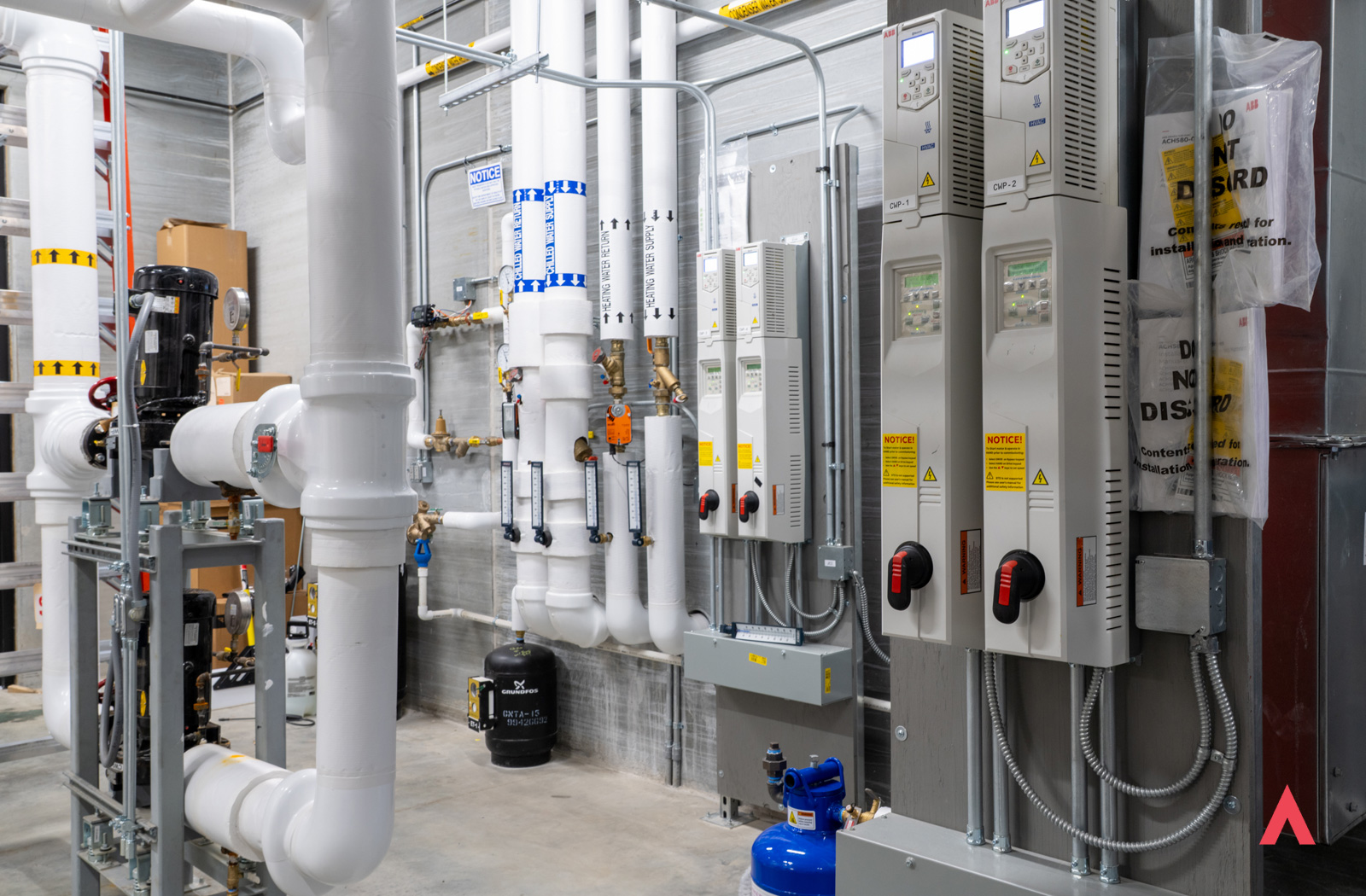
For tax-exempt entities, the IRA’s direct pay provisions for the Investment Tax Credit make geothermal financially accessible in a way that wasn’t possible before 2023. That access remains intact: the One Big Beautiful Bill Act (OBBBA), signed in July 2025, explicitly preserved the Section 48/48E ITC for geothermal heat pump systems.
The credit currently provides a 6% base rate, scalable up to 30% with prevailing wage and apprenticeship requirements met, plus additional bonuses for domestic content and energy community siting. That structure holds through 2032, after which the credit steps down to 5.2% in 2033 and 4.4% in 2034 before phasing out.
For public agencies and nonprofits evaluating geothermal for capital projects, the window to capture the full credit value is well-defined and worth building into project timelines accordingly.
Corporate tenants are increasingly using sustainability performance as a top factor in lease decisions. ENERGY STAR certification, LEED status, and documented carbon performance influence where major organizations choose to locate. For building owners and developers, geothermal is a tool for attracting and retaining sustainability-focused tenants while also building an ESG story for their own investors and stakeholders.
This depends on the specific ESG framework and how your organization defines renewable energy. Ground-source geothermal draws from the earth’s naturally stable thermal energy, which is continuously replenished. Many ESG frameworks and green building rating systems recognize geothermal’s renewable characteristics. For reporting purposes, the clearest and most defensible approach is to document geothermal’s impact through its measured reduction in fossil fuel consumption and grid electricity use, which translates directly into Scope 1 and Scope 2 emissions reductions under the GHG Protocol. Work with your sustainability advisor or ESG reporting consultant to determine the optimal treatment for your specific framework.
Emissions reductions are calculated by comparing the measured energy consumption of the geothermal system against a defined baseline — typically the energy that would have been consumed by a conventional HVAC system serving the same building. The electricity consumed by the geothermal system is converted to emissions using the EPA’s eGRID emission factors for the relevant grid region. The avoided natural gas combustion is calculated using EPA emissions factors for natural gas. Darcy’s engineering team can help project teams develop the energy models and documentation needed to support accurate, verifiable emissions reporting.
Geothermal is a strong contributor to LEED Platinum performance, primarily through its impact on the Energy and Atmosphere credits, which are the highest-point-value category in the rating system. Achieving Platinum requires strong performance across multiple credit categories, not just energy, so the overall building design strategy matters. That said, geothermal’s efficiency advantage is substantial enough that it meaningfully shifts what’s achievable on the energy side, often enabling projects to reach performance levels that would require much more complex or costly strategies without it. Your LEED consultant and mechanical engineer should model the specific contribution for your project.
LEED is a comprehensive green building certification that evaluates new construction or major renovation projects across multiple categories: energy, water, materials, indoor environmental quality, and site. It is awarded at certification, silver, gold, or platinum levels based on points earned.
ENERGY STAR, by contrast, is a performance-based certification for existing buildings that focuses specifically on energy use intensity (EUI) relative to similar buildings.
The two programs are complementary in that a new building can pursue LEED during design and construction, then use ENERGY STAR to document and certify its ongoing energy performance over its operating life. Geothermal contributes to both.
Yes, and it’s often a foundational element of carbon-neutral building strategies. Carbon-neutral and net-zero building certifications — such as those offered by the International Living Future Institute (ILFI), ASHRAE, and various national standards — require buildings to achieve deep reductions in operational energy use before relying on renewable energy or offsets to close the gap. Geothermal’s combination of Scope 1 elimination and major Scope 2 reduction makes it one of the most effective tools for meeting the operational efficiency requirements that these certifications demand.
The path to meaningful, measurable carbon reduction in commercial buildings runs through the mechanical room. For many, geothermal heating and cooling has become the infrastructure decision that will determine what your building’s emissions profile looks like for the next 50 years.
Darcy Solutions works with sustainability managers, facility teams, and project engineers across healthcare, education, government, and corporate real estate to design and build geothermal systems that deliver on both operational and ESG objectives. Our team understands the sustainability frameworks you’re reporting against, and we can help you understand the specific emissions reduction potential of geothermal for your building and site.
The starting point is a free site assessment. In two minutes, you can share your building’s location and take the first step toward gaining a geologically grounded picture of what’s possible.
The ground beneath your feet is one of the most reliable sources of energy on the planet. Regardless of what’s happening at the surface, whether Minnesota winter or Texas summer, the earth just a few hundred feet down maintains a remarkably stable temperature, year-round, decade after decade. Commercial geothermal heating and cooling systems harness that stability to deliver efficient, consistent climate control to large buildings without combustion or the volatility of fuel markets.
If you’re an engineer, facility manager, building owner, or procurement professional exploring your options, this piece is designed to provide a clear, practical foundation for understanding how commercial geothermal works — and why it’s becoming the HVAC solution of choice for forward-thinking organizations across the country.
At its most fundamental level, a commercial geothermal system is a heat exchange system. Instead of burning fuel to generate heat or using refrigerants to reject heat into outdoor air, a geothermal system moves heat between a building and the ground (or in the most efficient configurations, the groundwater beneath it).
Here’s the concept in plain terms:
No combustion. No fuel. Just a heat pump doing what heat pumps do, moving thermal energy from one place to another. Except in this case, the source and sink is the earth itself, which maintains a ground temperature of roughly 45–55°F across most of the continental U.S., regardless of outside air temperature.
This stability is the fundamental advantage of geothermal. A heat pump operating against a 50°F ground temperature works far more efficiently than one operating against 95°F summer air or −10°F winter air. The ground provides a better, more consistent thermal environment than the atmosphere, which translates directly into lower energy consumption and more predictable operating costs for your facility.
A commercial geothermal HVAC system has two primary components: a ground-side subsystem that interfaces with the earth, and a building-side subsystem that delivers heating and cooling to the space. Understanding both sides helps demystify the technology and clarifies where both the real value and the engineering complexity reside.
The ground-side subsystem is what most people think of when they picture geothermal. This is the part of the system installed underground, where thermal energy is either extracted from or deposited into the earth. There are several configurations used in commercial applications, each suited to different site conditions.
The most widely known geothermal configuration involves drilling vertical boreholes, typically 150 to 500 feet deep, and installing a sealed loop of pipe through which a fluid (usually a water-antifreeze mixture) circulates. The fluid absorbs or releases heat as it passes through the ground, then travels back to the building’s heat pump equipment to complete the exchange.
Vertical borehole fields are highly versatile and can be installed in a wide range of geological settings. They’re a proven technology across the U.S. and globally, and they work well for many commercial projects. For buildings with very large thermal loads, delivering sufficient capacity may require a significant number of boreholes. This is where site conditions and groundwater availability can significantly shape the optimal approach.
Where suitable aquifers exist, groundwater-based systems offer a step-change improvement in thermal efficiency and capacity. Rather than relying on heat transfer between pipe and soil, these systems draw directly from a groundwater source, which naturally maintains a stable temperature and provides far greater thermal capacity per well than a closed-loop borehole.
In a groundwater-based open-loop system, water is pumped from a supply well, passed through a heat exchanger where thermal energy is transferred, and then reinjected into the aquifer through a separate return well. Because groundwater is a far more thermally conductive medium than most soils, these systems can deliver substantially more heating and cooling capacity with fewer wells and a dramatically smaller surface footprint.
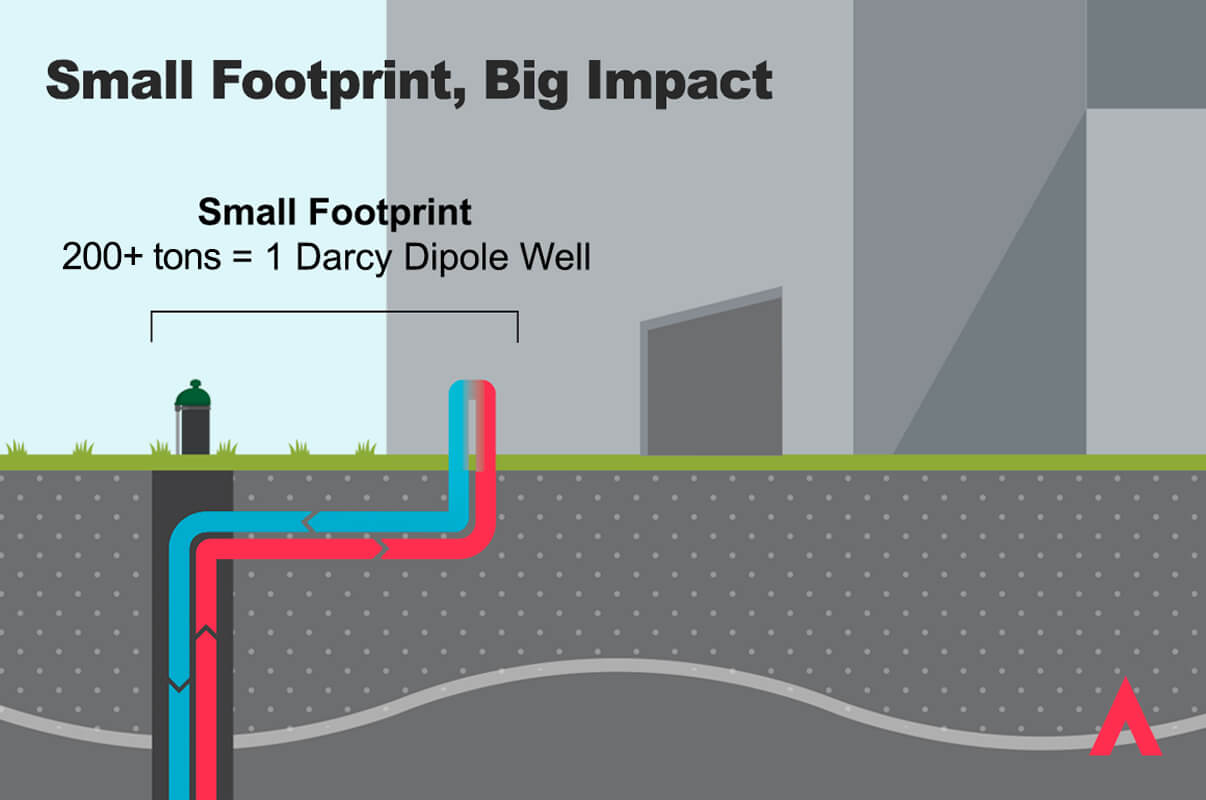
This is the foundation of Darcy’s approach. By engineering for the specific hydrogeological conditions at each site, Darcy’s systems — including the proprietary Darcy Dipole well configuration — are capable of delivering 200 or more tons of cooling capacity from a single well. The result is a geothermal system that can be deployed in dense urban environments, constrained sites, and retrofit scenarios where traditional geothermal was never considered viable.
For campuses, districts, or multi-building developments, geothermal systems can be interconnected into thermal energy networks — shared loops or aquifer resources that serve multiple buildings simultaneously. These configurations enable heating and cooling loads to be balanced across a portfolio, allow waste heat from one building to serve another, and create economies of scale in infrastructure, procurement, and operations. University campuses, hospital systems, and municipal districts are natural candidates for this approach.
On the building side, a geothermal system looks and feels very similar to conventional HVAC. The ground-side loop connects to one or more heat pumps that are either centralized (serving the whole building from a central plant) or distributed (smaller units serving individual zones). Those heat pumps condition water or refrigerant that feeds the building’s air handlers, radiant systems, fan coil units, chilled beams, or other terminal equipment.
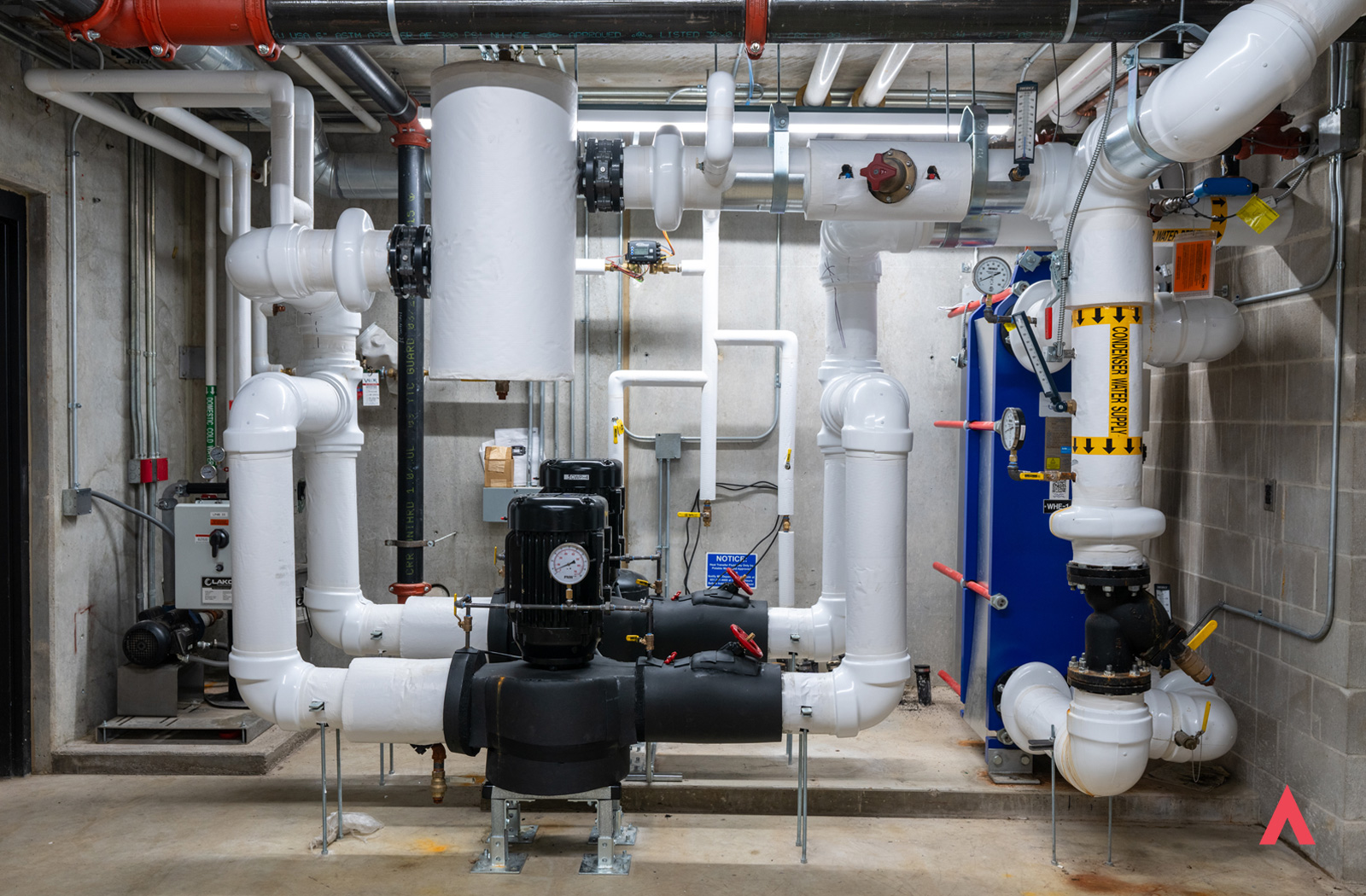
This compatibility with a wide range of building-side equipment is one of geothermal’s underappreciated strengths. Geothermal doesn’t require a wholesale redesign of a building’s HVAC distribution system. Engineers have significant flexibility in how ground-side energy is delivered to the space, which means geothermal can be integrated into new construction or designed around existing mechanical infrastructure.
Geothermal has long been used in residential applications, but the economics and performance characteristics of geothermal are often significantly better at commercial scale. Here’s why:
Commercial buildings consume far more energy for heating and cooling than residences, and they do so on consistent, predictable schedules. That means geothermal’s efficiency advantages compound over time, and the operational savings are proportionally larger. A meaningful improvement in HVAC efficiency at commercial scale can represent tens or hundreds of thousands of dollars in annual savings. That math only improves as energy prices fluctuate.
Commercial and institutional buildings such as schools, hospitals, office campuses, and government facilities are typically built to last 40 to 60 years or more. Geothermal systems are designed with the same longevity in mind: underground loop fields and well systems are engineered to last 50 years or longer, while building-side heat pump equipment typically carries a service life of 20 to 25 years. When you evaluate geothermal across the life of a building rather than just the upfront installation cost, the financial case is compelling.
Commercial real estate, healthcare, higher education, and government organizations increasingly operate under sustainability mandates ranging from board-level ESG commitments to municipal carbon reduction targets. Geothermal directly addresses Scope 1 emissions by eliminating on-site combustion, and contributes to Scope 2 reductions by dramatically cutting electrical demand for HVAC. For organizations working toward net-zero targets, LEED certification, or ENERGY STAR compliance, geothermal is one of the most powerful tools available.
The federal Investment Tax Credit (ITC) for commercial geothermal currently provides up to 30% of system cost under Section 48/48E of the Internal Revenue Code. This is specifically structured for commercial and institutional projects. Tax-exempt organizations such as public schools, municipalities, and nonprofits can access the ITC through direct pay provisions, making the incentive available regardless of tax liability. These incentives materially improve the financial profile of geothermal projects, often shortening payback timelines significantly.
When facility managers and engineers evaluate HVAC options, it helps to understand what makes geothermal distinctly different from other technologies in both concept and in practice.
Geothermal systems use electricity to move heat rather than generate it, at a coefficient of performance (COP) that typically ranges from 3.0 to 5.0 or higher. That means for every unit of electrical energy consumed, a geothermal system delivers three to five units of heating or cooling energy. This efficiency ratio is available 24 hours a day, 365 days a year, independent of weather conditions. It’s the foundational reason geothermal consistently outperforms conventional HVAC in operating cost over a building’s lifetime.
The earth doesn’t have cloudy days beneath its surface. Groundwater temperatures don’t fluctuate with the seasons. A properly engineered geothermal system delivers consistent, reliable performance year-round, with fewer mechanical components exposed to outdoor elements and a maintenance profile that building operators appreciate over the long term.
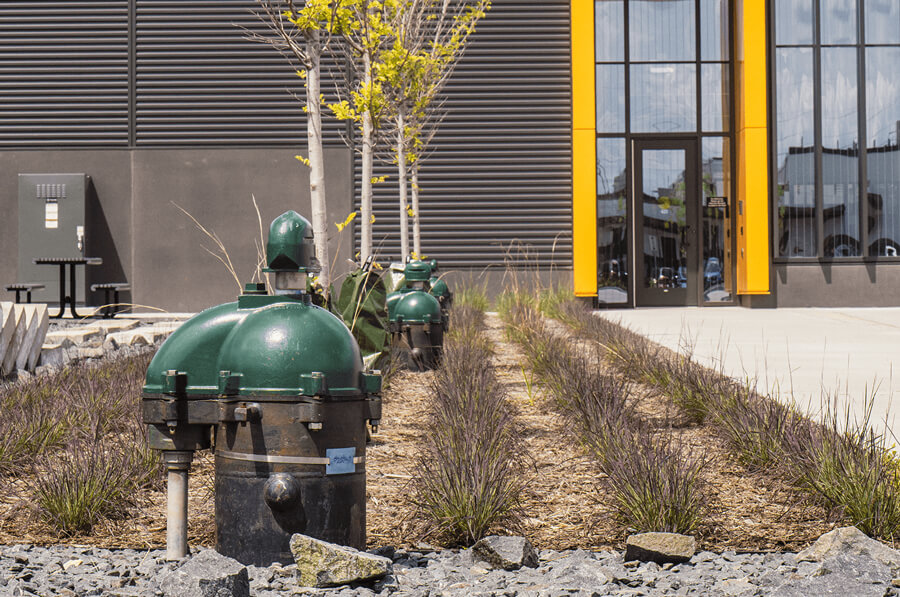
Underground components are largely passive; the primary maintenance activities center on the building-side heat pump equipment, which follows standard service intervals. For facilities where HVAC reliability is mission-critical, such as hospitals, data centers, and manufacturing facilities, this consistency is a meaningful operational advantage.
Geothermal is a fully electric system that uses electricity to operate heat pumps, with no combustion anywhere in the process. This eliminates on-site greenhouse gas emissions from the HVAC system, simplifies operations, and positions the building for a clean energy future as the electrical grid itself continues to decarbonize. It also removes the dependency on fossil fuel supply chains and the price volatility that comes with them.
Geothermal heat pumps can be configured to work with virtually any type of building-side distribution equipment, from ducted air systems and radiant heating to chilled beams and beyond. This compatibility means geothermal isn’t limited to new construction, but is a viable upgrade path for buildings with existing mechanical infrastructure, including many retrofit scenarios that building owners might assume are too complex or costly to address.
One of the most common questions from building owners and facility managers considering geothermal for the first time is simply: what does this actually look like in practice? The answer is highly site-specific, but the general process follows a logical, well-established sequence.
The process begins with a geological and hydrogeological evaluation, examining subsurface conditions, available land, groundwater resources, and the building’s thermal load profile. This assessment determines not only whether geothermal is feasible but which configuration will perform best. Darcy provides free site assessments as a starting point for any project, giving owners and engineers a geologically grounded picture of what’s possible before any significant commitment is made.
Once a site is confirmed as a strong candidate, the engineering team develops preliminary system layouts, performance models, and budget estimates. This phase includes coordination with the building’s mechanical engineer, regulatory review where applicable, and refinement of the thermal load analysis to ensure the system is sized correctly for the facility’s actual needs.
For groundwater-based projects, on-site design well drilling and aquifer testing validates the assumptions from the study and provides the data needed to finalize system design. This step is one of Darcy’s core competencies and is critical to engineering a system that performs as modeled, not just on paper.
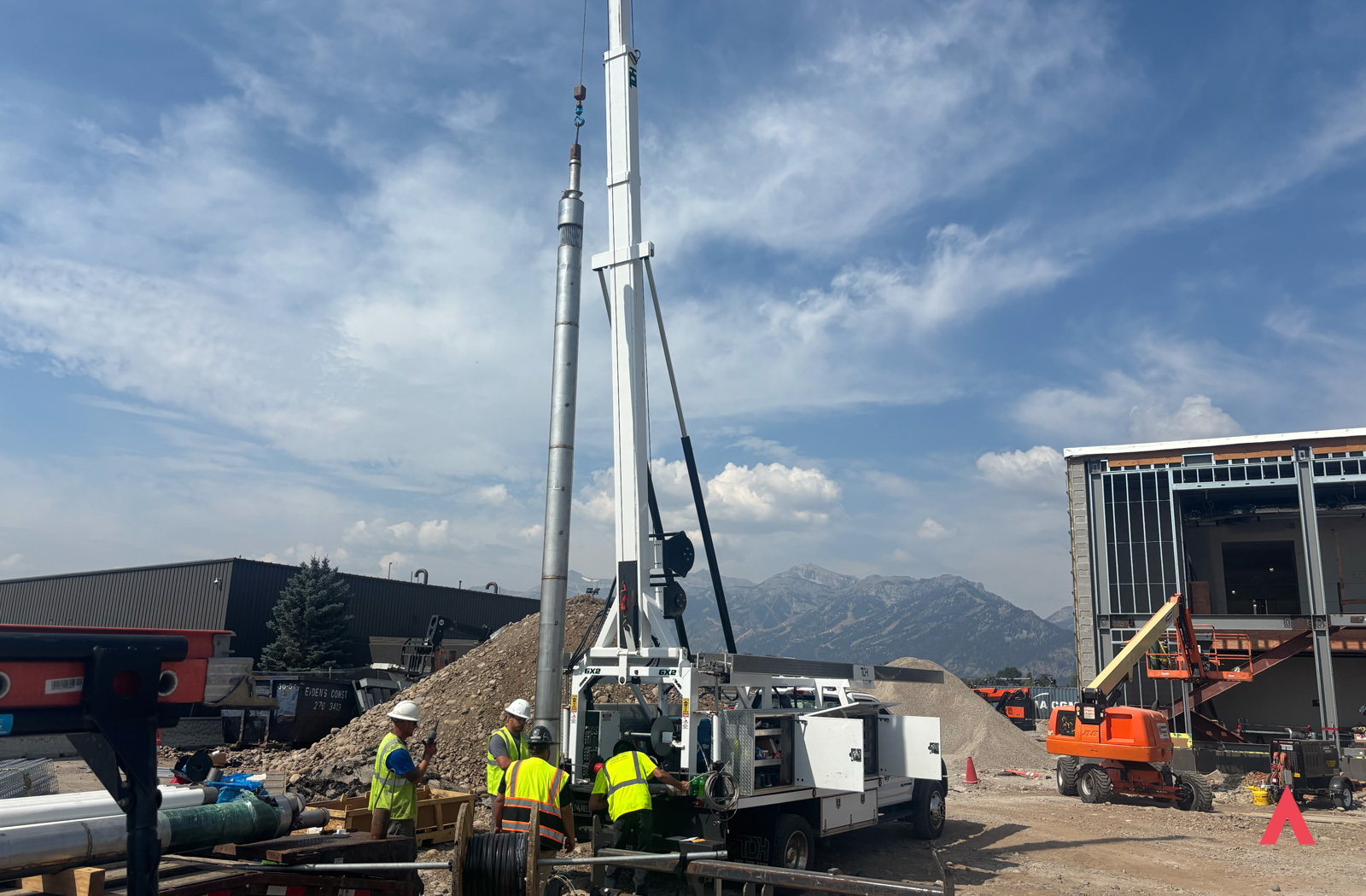
Well construction, horizontal distribution piping, and mechanical equipment installation typically proceed in coordination with other construction activities on the project. For retrofit projects, this work is often phased to minimize disruption to ongoing building operations. Commissioning ensures the system is operating within design parameters before handoff to the owner.
A well-engineered geothermal system is designed to perform reliably for decades. Many owners invest in remote monitoring and performance optimization to ensure the system continues to operate at peak efficiency throughout its service life, as well as to catch any issues early before they affect building comfort or energy costs.
Commercial geothermal is a strong option for a wide range of building types and ownership situations. Some of the most compelling candidates include:
The question isn’t really whether geothermal can work for a given building, but whether the site’s geological conditions, the building’s thermal load profile, and the project’s financial parameters align to make it the best choice. That’s exactly what a site assessment is designed to determine.
The underlying technology is the same in that both use the earth as a thermal source and sink, but commercial systems operate at far greater scale and complexity. Commercial projects involve larger thermal loads, more sophisticated engineering, larger well fields or groundwater systems, and typically multiple heat pumps, central plant configurations, and distribution systems serving many zones or buildings. The financial incentives, permitting processes, and engineering requirements are also distinct from residential applications.
Yes. Because geothermal systems exchange heat with the ground rather than outdoor air, they perform consistently across a wide range of climates from the Upper Midwest to the Southeast and beyond. Ground temperatures below the frost line remain stable regardless of surface climate. Darcy has designed and built systems in states across the country, and the underlying principles apply wherever geothermal resources are accessible.
Payback periods vary based on system size, project type, local energy costs, and the incentives applied. When federal tax incentives including the ITC (up to 30%) and bonus depreciation are combined with energy cost savings, many commercial projects achieve payback in the 5 to 10 year range. Some projects with favorable conditions and significant incentive stacking achieve payback even faster. Accurate energy modeling and financial analysis during the development phase are the best way to understand the economics for a specific project.
It depends on the system configuration. Groundwater-based systems like those Darcy engineers can deliver substantially greater capacity in a much smaller footprint than conventional borehole-based approaches, making geothermal viable in urban sites, existing campuses, and constrained properties where it was previously impractical. A free site assessment is the best way to determine what’s possible for a specific location.
Yes. Geothermal can be retrofitted into existing buildings, and Darcy has completed retrofit projects across a range of building types. The complexity of a retrofit depends on the building’s existing mechanical infrastructure, the available site for well or borehole installation, and the coordination required to maintain building operations during construction. Darcy’s project team has developed phased construction processes specifically to manage retrofit installations in occupied facilities.
In a properly engineered groundwater-based system, water is extracted from the aquifer, passed through a heat exchanger where thermal energy is transferred, and then fully reinjected into the same aquifer through a return well. The water’s temperature changes slightly before returning to the ground, where it quickly equilibrates with the surrounding aquifer. Darcy’s systems are designed with aquifer sustainability in mind and comply with all applicable groundwater regulations and permitting requirements.
Geothermal heating and cooling is a proven, deployed, operating reality across commercial and institutional buildings throughout the U.S. It is currently delivering lower energy costs, reduced emissions, and long-term operational reliability to organizations that have chosen to invest in it.
Darcy has completed or has under contract more than 65 commercial geothermal projects, from Minnesota to Florida, and has conducted over 1,200 site evaluations for facilities across the country. Our team of geologists, engineers, and builders specializes exclusively in commercial geothermal, and we’ve developed the proprietary technology and the project methodology to make geothermal work in locations where it wasn’t possible before.
If you’re evaluating geothermal for your facility, the best place to start is a site assessment. It takes two minutes, it’s free, and it gives you a geologically grounded picture of your project’s potential.
→ Request Your Free Site Assessment
Many school districts already know their existing HVAC equipment systems need work. What they don’t always have is a trustworthy way to decide what to replace it with — including a plan that weighs student health, energy costs, climate impact, and unfamiliar funding mechanisms. That’s the gap UndauntedK12 set out to close, and the result is Ground-Source Heat Pumps in Schools: A Guide to Maximizing Energy Tax Credits — a guide that has quickly become one of the most useful decision-making tools for those groups.
Darcy builds geothermal systems that heat and cool buildings using groundwater beneath our feet. But a great system only gets installed if a district can first make a confident, well-informed decision the community can support. UndauntedK12’s guide helps them do exactly that — and a few hours down the road from us, Winona, MN, shows the choice paying off.
The guide’s strength is that it doesn’t sell a product — it teaches a framework. It starts from an uncomfortable fact: roughly 41% of districts need to update or replace HVAC in at least half their schools, and most are still running legacy systems that burn fossil fuels on site, often without delivering adequate cooling, ventilation, or filtration. Then it gives practical considerations for how to navigate the process step by step.
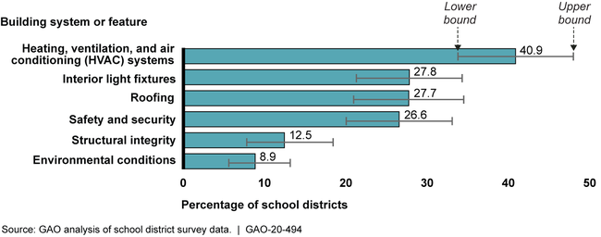
Three principles anchor the whole thing. A modern school HVAC system should be built on all-electric heating and cooling, high-performance ventilation, and high-performance filtration — and for most schools, some form of heat pump is the centerpiece. From there, the guide lays out why that is the best solution for many schools:
Crucially, the guide also tackles the question that stops most projects cold: how to pay for it. It walks districts through the federal incentives — the Investment Tax Credit, direct/Elective Pay, domestic content, and energy community bonuses — that together can offset a large share of a geothermal heat pump’s up-front cost, the single biggest barrier districts cite.
That’s the part we see make or break projects. The engineering is rarely the obstacle. The decision-making and the financing are. This guide takes on both.
Washington-Kosciusko and Jefferson Elementary Schools were both built in the 1930s, both listed on the National Historic Register, and both stuck with outdated HVAC — no cooling, poor ventilation, uncomfortable in spring and fall, unusable in summer, and a real health concern in extreme weather. Winona Area Public Schools wanted to modernize two neighborhood landmarks without erasing them.
The district’s decision tracks the guide’s framework almost point for point: it chose all-electric, high-performance heating and cooling, centered on heat pumps, with the air quality and efficiency benefits front of mind. Working with Wold Architects & Engineers and Kraus-Anderson, Winona selected groundwater-enabled geothermal and brought Darcy in to design and deliver the well fields:
Both systems decarbonize the buildings by electrifying their heating and cooling, fit the schools’ existing footprints, and are built to last — a typical boiler runs about 25 years, while a heat exchange well can last up to 75. The renovations ran through summer 2023 and were complete for the 2024-25 school year. The district reports exactly the outcomes the guide promises: better air quality, more comfortable classrooms, and falling energy costs.
Then came the funding payoff the guide is designed to unlock. In March 2026, Winona Area Public Schools received a $5,523,230 reimbursement check from the IRS for the two systems, through Elective Pay — earning a bonus credit for meeting prevailing wage and apprenticeship requirements, and giving 12 apprentices hands-on experience with next-generation geothermal along the way.
“We were always hopeful that the projects would qualify for the tax credit, but we never counted on it,” said Superintendent Brad Berzinski. “Now that the funding is secured, it opens up a world of possibilities for strategic, one-time capital investments that will benefit our students and staff for years to come.”
That’s the difference a good framework makes. A district shouldn’t have to hope a multi-million-dollar reimbursement materializes. With the right guidance, it can plan the project — and the financing — with confidence from the start.
We’re engineers, and we love the elegant part of this work — a handful of wells replacing a half-acre borefield, a 90-year-old building quietly electrified. But decarbonizing the country’s school buildings was never only an engineering problem. It’s a decision problem and a financing problem too, and those are exactly the barriers that keep good projects from ever breaking ground.
UndauntedK12’s HVAC guide takes those barriers down. It gives district leaders, school boards, and facilities teams a clear-eyed way to evaluate their options before a single well is drilled — and it points them toward the funding that makes the better option affordable. It’s the resource we point districts to when they’re earlier in the journey than a site assessment, when the real question isn’t can this work on our site but how do we make the right call, and pay for it.
Winona answered both questions. So can the next district.
If your district is rethinking its HVAC, start with UndauntedK12 and RMI’s guide. When you’re ready to find out what your site can deliver, schedule a free site assessment with Darcy.